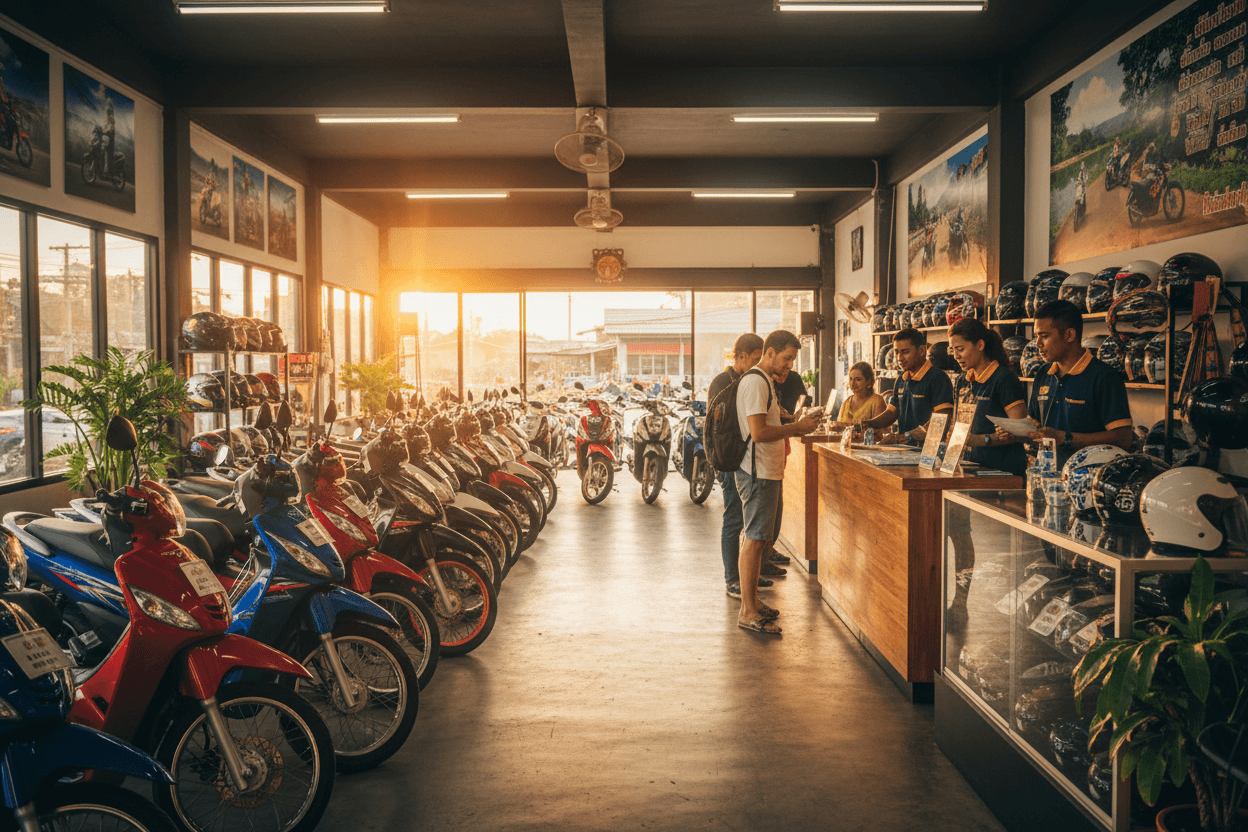
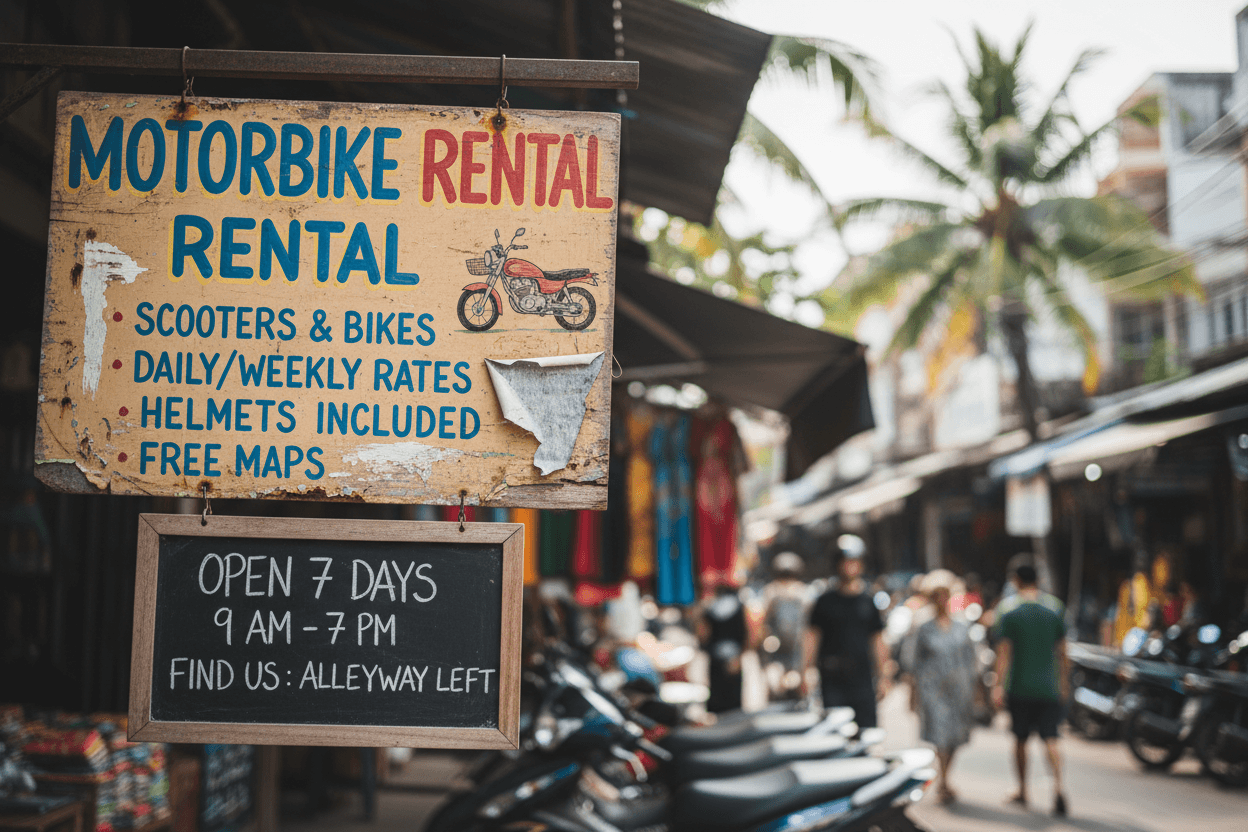
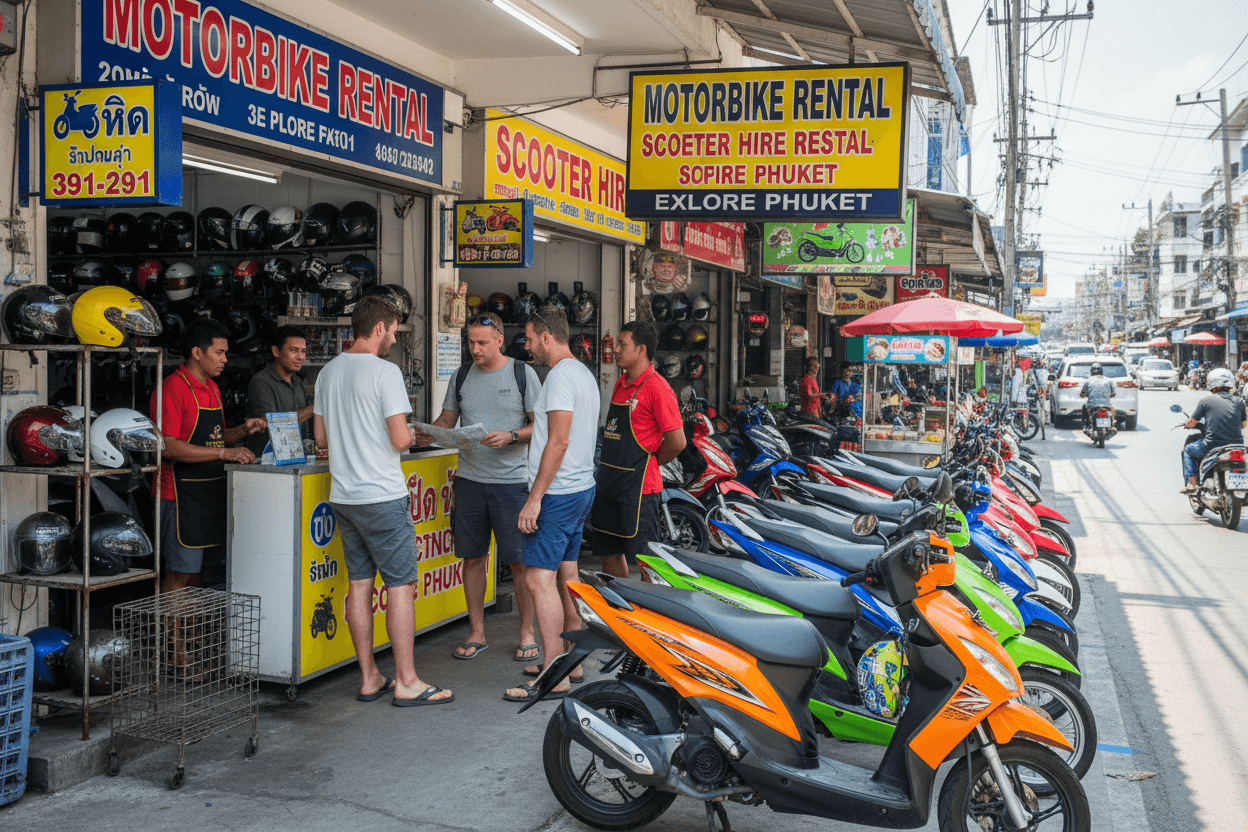
Motorbike rental Thailand in 2026 starts at 150 THB/day for a 110-125cc Honda Click and runs to 2,500 THB/day for a 650cc big bike, with weekly rates 15-25% off and monthly rates 40-50% off the daily count. The legal floor is your home-country motorcycle license plus an International Driving Permit with the "A" (motorcycle) endorsement; ride without it and police checkpoints in Patong, the Chiang Mai Old City moat, Beach Road in Pattaya, and the Ao Nang strip in Krabi issue 500-1,000 THB on-the-spot fines AND void your travel insurance. Deposits are cash (500-2,000 THB) or a passport copy at vetted shops; never the original passport.
Key Takeaways
- Daily rates: 150-350 THB ($4-10 USD) for a 110-125cc Honda Click in 2026. Big bikes 500cc+ run 1,200-2,500 THB/day.
- License floor: home-country motorcycle license PLUS an International Driving Permit with the "A" (motorcycle) endorsement. A car-only license or a car-only IDP is not legal for any scooter.
- Cash deposits only: 500-2,000 THB at most vetted shops. Walk away from any shop that demands the original passport; a passport copy is acceptable.
- Insurance reality: compulsory Por.Ror.Bor caps at 30,000-80,000 THB and covers third parties only. You need Class 1 comprehensive plus a travel-insurance motorbike rider for genuine cover.
- Helmet law: mandatory for rider and pillion. Police checkpoint fines for no helmet or no IDP run 500-1,000 THB on the spot.
- Top riding markets: Chiang Mai for the Mae Hong Son Loop, Krabi for Andaman coast, Pai for the Route 1095 loop, Phuket and Koh Samui for island circuits, Bangkok and Pattaya for short-trip city rentals.
How much does motorbike rental in Thailand cost in 2026?
Motorbike rental in Thailand in 2026 averages 150-350 THB/day for a 110-125cc automatic scooter, the workhorse of every rental fleet in the country. Weekly rentals run 900-1,800 THB and save 15-25% versus paying daily for seven days. Monthly rentals run 2,000-4,000 THB and save 40-50% on the same calculation, which is why digital nomads in Chiang Mai, Pai, and Koh Phangan default to the monthly tier. Touring scooters at 150-160cc (Honda PCX 160, Yamaha NMAX) sit at 250-450 THB/day; manual 200-400cc bikes run 500-1,200 THB/day; 500cc+ big bikes for highway touring sit at 1,200-2,500 THB/day.
City variation matters more than season. The same Honda Click that rents for 150 THB/day in Pai's long-stay nomad market sits at the top of the Bangkok band on Sukhumvit Road, driven by real-estate cost, fleet age, and local competition rather than tourist density. The next H2 walks city by city. For the dedicated price-guide breakdown including weekly and monthly tier math across 9 rental hubs, see Thailand Scooter Rental Cost.
The 50-100 THB/day premium between a street-corner shop and a vetted partner buys you maintained brakes, a cash-deposit policy that respects your passport, and a written rental agreement before keys change hands. Rentals below 100 THB/day for a 125cc Click are a quality red flag, not a deal: the Thailand motorbike rental scams guide covers the scratch-fee and bald-tire patterns that fund those rates.
City and island pricing across Thailand
Motorbike rental in Thailand is priced by city, not nationwide. Bangkok and Phuket sit at the top of the mainland band; Pai and Hua Hin sit at the bottom. The table below compares the typical 110-125cc Honda Click rate across nine of the country's largest rental markets in 2026, sourced from each city's canonical Byklo rental guide. Use it to budget your trip and to spot any price gouging on arrival.
Northern Thailand is the budget paradise. Chiang Mai and Pai run shops that cater to long-stay digital nomads and serious touring riders, so the baseline is lower and the bikes tend to be better-maintained because they're used for the Pai Loop on Route 1095 (130km, 762 curves) rather than 7-Eleven runs. Bangkok sits at the top of the mainland band because the rental shops have to amortize Sukhumvit-grade real estate. Phuket sits mid-range despite Patong's tourist density because dozens of shops along Bangla Road compete each other into the 150-300 THB band.
For the islands, Koh Lanta's 200-300 THB/day matches the mainland mid-tier; Koh Samui and Koh Phangan add a 20-50 THB premium during full-moon weekends. The bike-class step up from a 125cc Click to a 150cc PCX or NMAX adds 100-200 THB/day and is genuinely worth it for hilly southern Lanta or the southern half of Phuket.
Bike class comparison: Honda Click vs PCX 160 vs CB500X
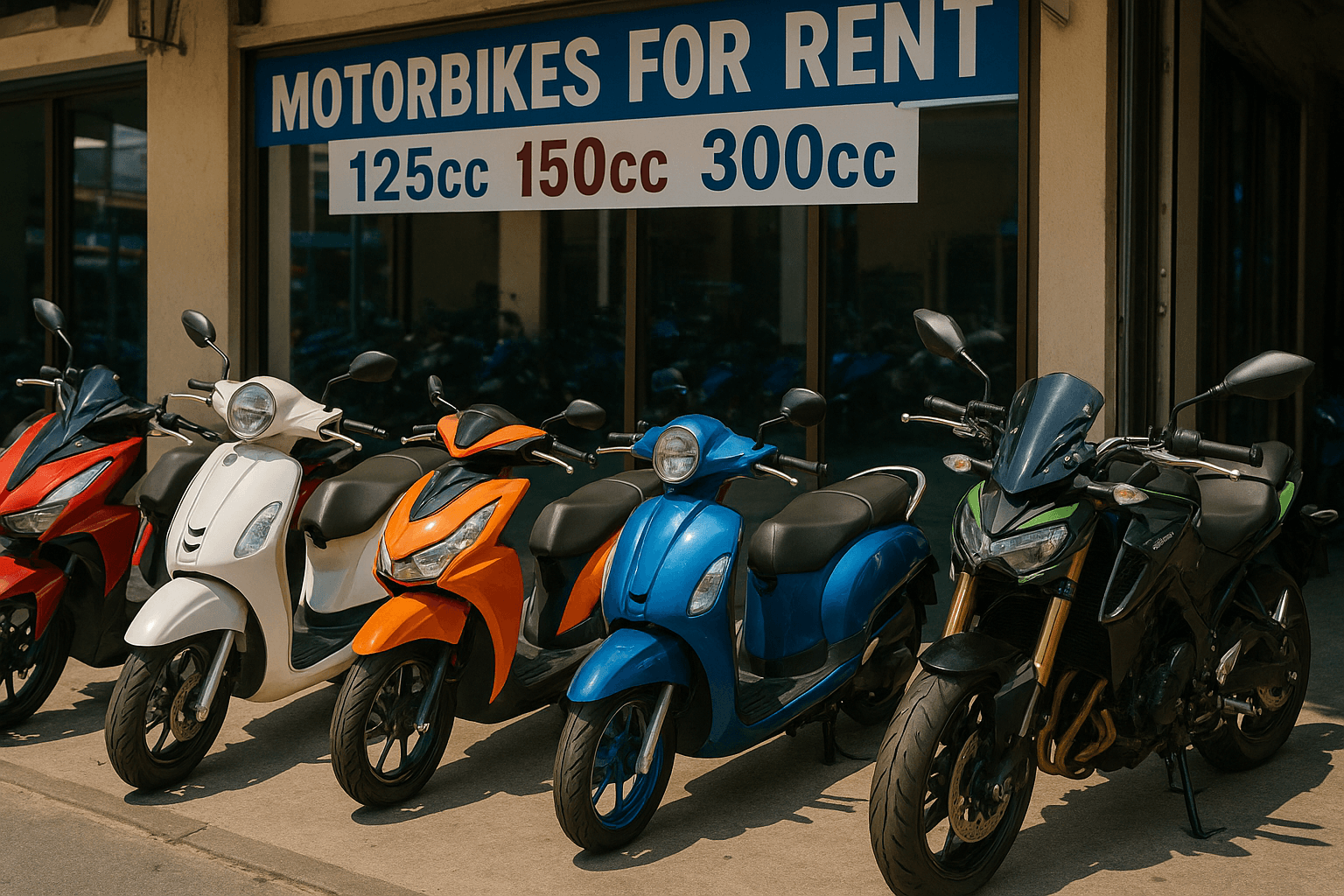
Thailand rental fleets concentrate on five bike classes in 2026, with the 110-125cc automatic Honda Click 125 covering 70%+ of all daily rentals. The step-up classes are the 150-160cc maxi-scooter (Yamaha NMAX 155, Honda PCX 160), the 200-400cc manual (Honda CB300R, Kawasaki Versys-X 300), the 500cc+ big bike (Honda CB500X, Kawasaki Versys 650), and the niche 700-1000cc adventure-tourer market for the big-bike scene in Chiang Mai and Phuket. The price gap between the Click and the maxi scooters runs 100-200 THB/day; the gap to a 500cc big bike runs 1,000+ THB/day.
The Honda Click 125 is fine for 90% of trips. It absorbs Thai potholes adequately, fits 5-7 kg of shopping under the seat, and gets a 6-foot two-up rider up Doi Suthep without complaint. Pay the extra 100-200 THB/day for the PCX 160 only when you'll do more than two hours of riding in a sitting or have a passenger who'll feel every bump. For first-time riders specifically, the Best Beginner Motorcycles in Thailand breakdown ranks the five most rentable models on stability, weight, and parts availability.
A note on big bikes: most 500cc+ rentals in Chiang Mai and Phuket require a Thai motorbike license OR an IDP that explicitly covers your engine displacement, and the deposit jumps to 5,000-20,000 THB. Big-bike shops also typically demand a credible riding history (a motorbike license from home held for 2+ years, photos of bikes you've owned). Show up wanting your first big bike and most shops will route you to a 250cc CB300R for the day instead.
What you legally need to ride
Thailand's rental shops range from "wave you onto a Honda Click and forget the paperwork" to "verify three documents before keys change hands"; the law is the same in both cases. The legal minimum to ride any motorbike in Thailand, including a 110cc scooter, is a valid home-country motorcycle license PLUS an International Driving Permit with the "A" (motorcycle) endorsement, or a Thai motorbike license. There is no displacement carve-out: a 110cc Honda Click and a 1000cc Africa Twin both require a full motorcycle license under the Traffic Act. The Thai Motorbike License Guide covers the 6-step DLT application for long-stay riders; the Thai Driving License Requirements post details the document checklist.
The motorcycle "A" endorsement is the single most-overlooked detail. UK, EU, and Australian licenses commonly issue a car-only ("B") IDP by default; the motorcycle ("A") endorsement is a separate stamp that must appear on both your home-country license AND your IDP. Police-checkpoint officers in Patong, the Chiang Mai Old City moat, and Beach Road in Pattaya check the IDP class explicitly. A car-only IDP at a checkpoint is the same as no license: 500-1,000 THB on the spot plus a voided travel-insurance policy in any subsequent accident. The Royal Thai Embassy publishes official guidance on which IDP classes Thailand recognizes.
Helmet law is mandatory for both rider and pillion, no exceptions. Checkpoint fines run 500-1,000 THB for no helmet (rider and pillion charged separately) and another 500-1,000 THB for no IDP. Por.Ror.Bor compulsory third-party insurance is included in every legally-registered rental's road tax and pays the OTHER person you injure up to 30,000-80,000 THB; it does not cover your bike, your injuries, or your travel companion as pillion if you caused the crash. The Thailand Motorbike Insurance Guide walks through the three coverage layers you actually need.
How to rent without getting scammed: the 5-step checklist
The safest way to rent a motorbike in Thailand is to do five things in sequence: pre-book through a vetted shop, verify the bike with a 30-second video walkaround, refuse passport-as-deposit, read the written rental agreement before signing, and inspect the bike together with the staff at return. Each step shuts down a specific scam pattern. Skip any one and you've reopened the door.
Step 1: Pre-book a vetted shop, not a curbside table. Random street stalls in Patong, Pattaya, and the Old City moat have the highest scam-rate per rental in the country. Vetted partner networks like Byklo.rent screen for documented insurance, cash-deposit policies, and written agreements; the alternative is a 30-minute walk comparing scribbled prices on a piece of paper. The Pattaya Motorbike Rental Safety and Scams post names the five highest-risk locations specifically.
Step 2: Run the 30-second video walkaround at pickup. Walk around the bike with your phone recording in slow motion, calling out every existing scratch, dent, and scuff aloud. Test the brakes (both levers should bite firmly), the lights (headlight high and low beam, both indicators, brake light), the horn, and both mirrors. The video is your evidence against the pre-existing-damage scam at return.
Step 3: Pay a cash deposit, never the original passport. Standard practice in 2026 is 500-2,000 THB cash OR a high-quality passport copy. Shops that demand the original passport are flagging themselves. The No Passport Deposit Rental Guide walks through how vetted shops handle deposits without the passport-hostage risk; shops who insist on the original are the same shops who run the scratch-fee scam later.
Step 4: Read the written rental agreement before signing. Every term in print: daily rate, return date and exact time, fuel policy (most shops use "same-to-same"; bring back what you took), late-return fee structure (often 50-100 THB/hour), and what counts as new damage. Verbal promises about insurance or fuel are worth nothing in a dispute.
Step 5: Inspect together at return, get a receipt for the deposit. Bring the bike back on time, do a joint walkaround with shop staff, watch them count and return the cash deposit, get a written or photographed receipt confirming the bike was returned without new damage. The deposit should be in your hand before you walk out of the shop. The Motorbike Rental Problems Thailand Guide covers what to do when a shop tries to keep the deposit anyway.
Best regions for first-timers vs experienced riders
Thailand's rental markets split cleanly by rider experience. First-timers rent in Chiang Mai's Old City, Hua Hin's flat coastal road, Krabi Town's grid streets, and Pai's Walking Street, where the traffic is gentler and the bikes are smaller. Experienced riders rent in Bangkok for chaotic city navigation, Pattaya and Jomtien for fast cross-region rides, the Mae Hong Son Loop for sustained mountain touring, and the Pai Loop on Route 1095 for tight switchbacks. Trying to learn motorbike-riding on Patong's Bangla Road or Bangkok's Sukhumvit at rush hour is an expensive way to find your edge.
For first-timers, Chiang Mai is the gold standard. The How to Rent a Scooter in Chiang Mai guide walks through the Old City rental flow; the Motorbike Rental Chiang Mai Guide covers the seven-shop comparison. Hua Hin's main strip and the How to Rent a Motorbike in Hua Hin guide give you 7km of flat beach road to find your seat-position before tackling anything serious. Krabi's grid is similarly forgiving; the Scooter Rental Requirements Krabi guide covers the documentation specifics for the province.
For experienced riders, the routes are the draw. The Mae Hong Son Loop is 600 km and 1,864 curves around the northern mountains; the Pai Loop on Route 1095 compresses 762 of those curves into a 130 km day-ride out of Chiang Mai. Bangkok's How to Rent a Motorbike in Bangkok covers the Sukhumvit-Silom-Khao San rental triangle; the Best Motorbike Rental Bangkok post ranks the seven shops that rent to foreigners without surprises. Koh Lanta's How to Rent a Scooter on Koh Lanta covers the island circuit; the Best Motorbike Rental Koh Lanta post covers Saladan-area shops specifically.
The bike class should match the route. A 125cc Honda Click handles Old City Chiang Mai and Hua Hin's flat road perfectly, but it labors on the Pai Loop's sustained climbs and runs out of seat comfort 90 minutes into a long day. Step up to a 150cc PCX or NMAX (250-450 THB/day) for any sustained mountain riding or two-up touring; step up to a 250-300cc manual or a 500cc+ big bike for the full Mae Hong Son Loop. The Best Scooter Rental Phuket post covers the island-wide rental scene including the touring-class options. Once you have the bike, pick the route; the country-level routes pillar is in Thailand Motorcycle Routes.
Hidden costs that catch out first-time renters
The daily rate isn't the only line on your motorbike-rental ledger. The four side costs that catch out first-time renters are fuel, insurance excess, helmet rental, and police-checkpoint fines, and they add another 100-300 THB/day to your real cost. Plan for them at booking, not at return.
Fuel runs 100-150 THB to fill a 125cc tank from empty at 2026 pump prices. Most Thai rental shops use a "same-to-same" fuel policy: return it as you found it. Gasohol 95 (the green pump) is the standard fuel; some older bikes accept 91, but only if specifically approved by the shop. In rural Pai, Mae Hong Son, or northern Chiang Rai, watch for roadside whiskey-bottle gasoline: it costs 10-20% more and works in a pinch when the next station is 20 km away.
Insurance excess gets understated. Compulsory Por.Ror.Bor third-party insurance is included in the rental rate, but its 30,000-80,000 THB cap is consumed in the first hour of a private-hospital ER visit. Class 1 comprehensive (the daily add-on at 100-700 THB/day depending on bike value) covers damage to the bike you're riding; without it, a totaled Honda Click costs you 80,000-150,000 THB in shop replacement fees. Travel insurance with a motorcycle rider that explicitly covers 125cc is the third layer; the Thailand Motorbike Insurance Guide covers the three layers in detail, and the 50cc engine-size trap most travel policies hide in the fine print.
Helmets are legally required and provided by every legitimate rental, but the helmet quality varies. Inspect for clean shells (no cracks), working chin straps, and a snug fit; budget 200-500 THB for a better helmet from any 7-Eleven or motorbike shop if the rental's loaner is "soup-bowl" grade. Police-checkpoint fines compound: 500-1,000 THB for no helmet, 500-1,000 THB for no IDP, 1,000-2,000 THB for riding above your IDP class. The Top 10 Motorbike Safety Tips for Thailand covers the helmet law, IDP requirement, and checkpoint behavior in full.
Cross-border rides are off-limits. Almost every Thai rental contract prohibits taking the bike across into Cambodia, Laos, or Malaysia; doing so usually voids insurance entirely and may trigger a theft charge if you don't return on schedule. If you want a Cambodia or Laos border run, rent locally on the other side instead.
Frequently Asked Questions
How much does it cost to rent a motorbike in Thailand?
A standard 110-125cc Honda Click rents for 150-350 THB ($4-10 USD) per day across Thailand in 2026. Pai and Hua Hin are the cheapest mainland markets at 120-200 THB/day; Bangkok and Pattaya sit at the top at 200-400 THB/day. Weekly rates drop the effective rate to 130-260 THB/day, monthly rates to 70-130 THB/day. Big bikes (500cc+) run 1,200-2,500 THB/day separately.
Do I need an International Driving Permit to rent a motorbike in Thailand?
Yes, if you're a non-ASEAN tourist. Thai law requires the IDP-with-motorcycle-endorsement carried alongside your home-country motorcycle license. A car-only license, a car-only IDP, or no IDP at all leaves you uninsured and liable for 500-1,000 THB police fines per checkpoint. The IDP must be issued by your home-country automobile association (AAA, CAA, UK Post Office, AA Australia) BEFORE you fly; in-country issuance is not available.
Should I leave my passport as a deposit?
No. Never leave your original passport with a Thai rental shop. Reputable shops accept a cash deposit of 500-2,000 THB or a high-quality passport copy. The passport-hostage scam is the most common dispute pattern reported on Beach Road in Pattaya, Bangla Road in Phuket, and Walking Street in Pai. If a shop refuses anything but the original passport, walk to the next shop on the same street.
Is helmet wearing mandatory in Thailand?
Yes. Helmets are legally required for both rider and pillion under the Traffic Act, no exceptions. Police checkpoint fines for no helmet run 500-1,000 THB on the spot, charged separately to rider and pillion. Riding without a helmet also voids your travel insurance entirely; the "illegal act" clause in standard policies kicks in the moment a helmet-less rider hits the road.
What's the cheapest city in Thailand to rent a motorbike?
Pai and Hua Hin are the cheapest mainland rental markets in 2026, with Honda Click 125s starting at 120-150 THB/day. Chiang Mai's Old City matches at 150 THB/day. Bangkok runs 150-400 THB/day at the top end; Phuket sits at 150-300 THB/day. The budget play in Phuket is to rent in Phuket Town and ride out to Patong rather than rent on Bangla Road directly.
What happens if the bike breaks down or I have an accident?
Call the rental shop first; reputable shops offer roadside assistance and a replacement bike within an hour in major cities. For accidents involving other people or property, call Tourist Police on 1155 and your travel insurance provider immediately. Without a valid IDP and helmet, your travel insurance is voided and you are personally liable for medical and property costs. A typical Thai private-hospital surgery for a motorbike injury runs 100,000-300,000 THB.
Can I rent for a month and return the bike in a different city?
Usually not. Almost every Thai rental shop requires return to the original pickup location; one-way rentals between cities (e.g., Chiang Mai pickup, Bangkok return) are rare and carry 1,500-3,000 THB extra fees when offered. Vetted partner networks sometimes coordinate inter-city returns through their shop network; ask before booking. Cross-border returns into Cambodia, Laos, or Malaysia are universally prohibited.
When is the best season to rent in Thailand?
The dry-cool season (November to February) is ideal across most of the country: low humidity, no monsoon rain, 20-30°C daytime temperatures. March to May is hot-dry season (28-38°C); June to October is the southwest monsoon for the Andaman coast (Phuket, Krabi) with afternoon storms most days. The Gulf coast (Koh Samui, Koh Phangan, Koh Tao) reverses, with a November-December rainy peak. Plan mountain-loop rides (Mae Hong Son, Pai) for November to February when the curves are dry.
Lock in your bike before you fly
Motorbike rental in Thailand rewards preparation. Apply for the IDP with the motorcycle "A" endorsement in your home country, confirm your travel insurance has an explicit 125cc+ motorcycle rider, and pre-book a vetted shop in your arrival city instead of negotiating curbside on day one. The 50-100 THB/day premium for a vetted partner buys you working brakes, a cash-deposit policy, and a written agreement; the alternative is a 100 THB/day Honda Click with bald tires and a passport-hostage clause hidden in unsigned paperwork.
Browse vetted partner shops in 15 cities at Byklo.rent. Cash deposits, passport copies accepted (never the original), helmets included, written rental agreements at pickup, free hotel and airport delivery. Compare real renter reviews, lock in your bike for the dates you want, and collect the keys at your hotel on arrival day.