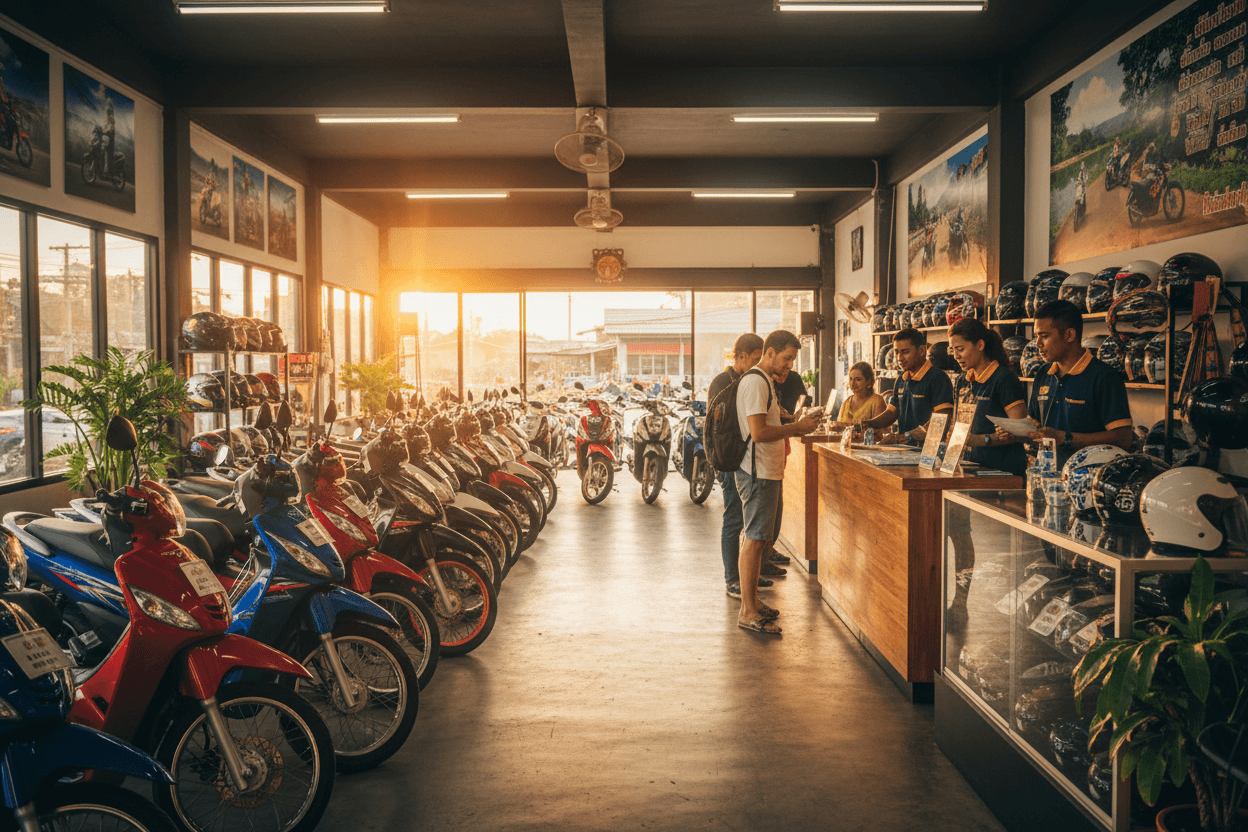
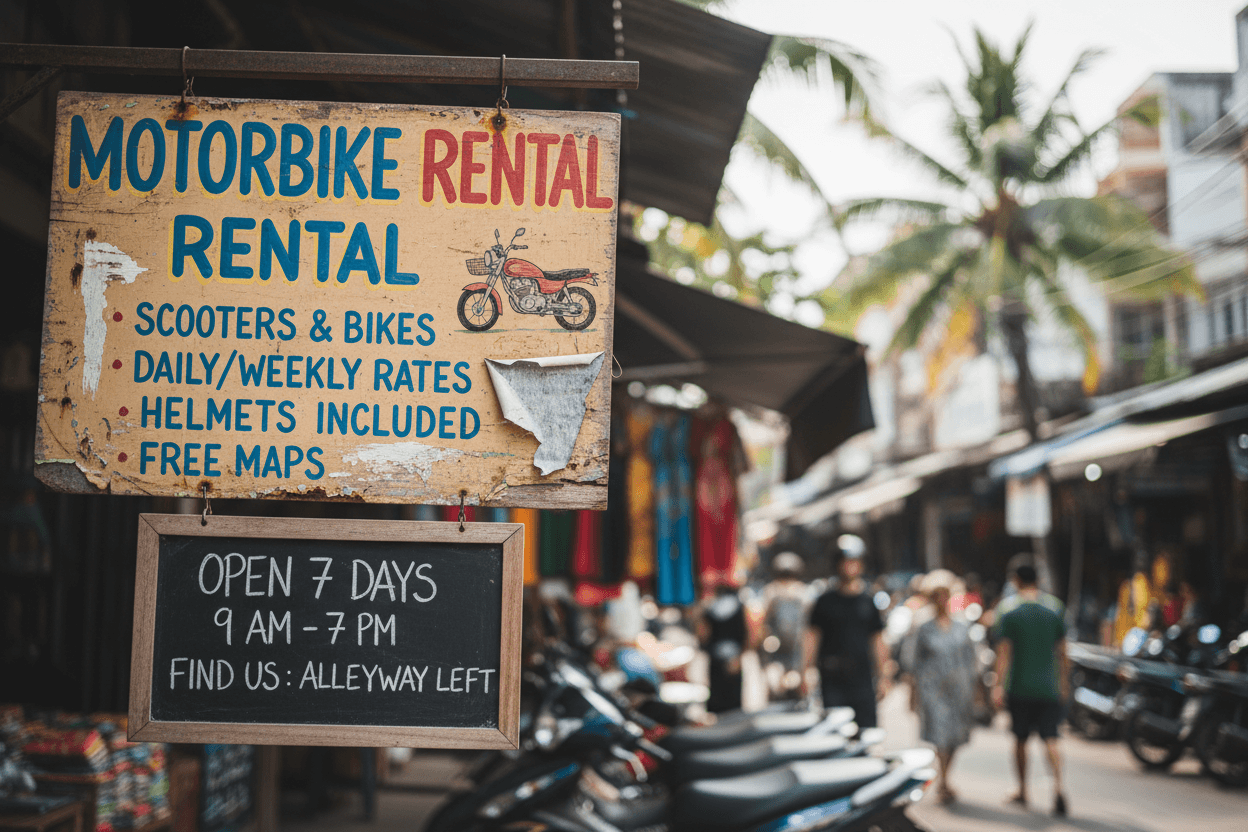
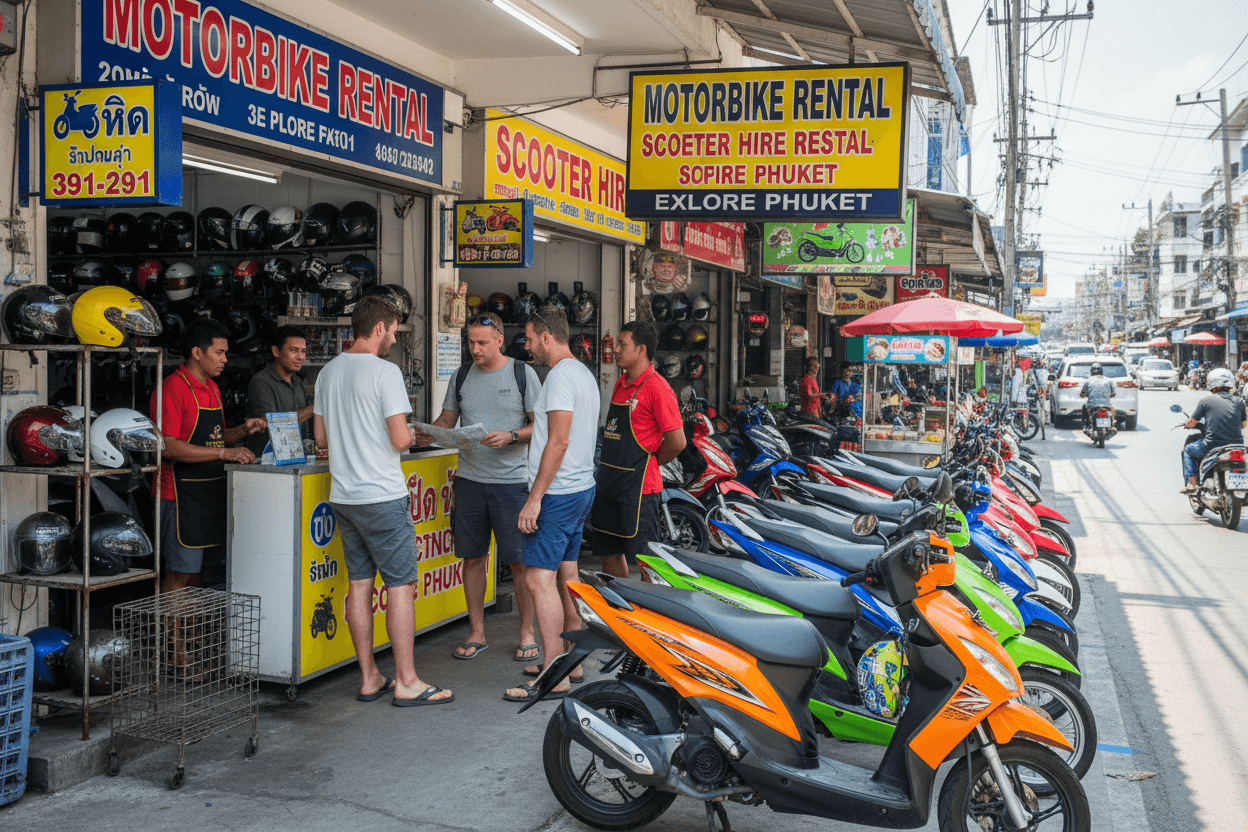
Motorbike rental problems Thailand visitors face cluster around six recurring patterns in 2026: the scratch scam, passport-hostage deposits, fake-police shakedowns, breakdown-fee disputes, fuel-level arguments, and worn-bike crashes that the shop bills back to the rider. Five of the six are preventable with a 90-second video walkaround, a cash deposit that protects your passport, and a written rental agreement in English. The sixth (mechanical failure) is preventable by walking away from any 100 THB/day bike on Bangla Road in Phuket or Beach Road in Pattaya.
Key Takeaways
- Six recurring problems: scratch scam, passport-hostage deposit, fake-police shakedowns, breakdown-fee disputes, fuel-level arguments, worn-bike crashes billed back to the rider.
- Cash deposits, not passports: 500-2,000 THB cash is the Thai market norm. Reputable shops accept a passport copy. Original passports never leave your hand.
- Tourist Police hotline: dial 1155 in any rental dispute. The Tourist Police are a separate Royal Thai Police unit with English-speaking officers in Bangkok, Phuket, Pattaya, Chiang Mai, and Krabi.
- Documentation defeats 90% of damage claims: a continuous video walkaround at pickup plus a timestamped photo of the fuel gauge and the odometer.
- License requirement: home-country motorcycle license plus an International Driving Permit with the "A" (motorcycle) endorsement. A car-only IDP at a checkpoint is the same as no license.
- Por.Ror.Bor doesn't cover the bike: Thai compulsory insurance covers third-party bodily injury only. Damage to the rental motorbike is your liability without supplementary cover.
Why are motorbike rental problems in Thailand so common?
Thailand's rental scooter market is structurally informal in 2026. Most shops in tourist hubs are family operations running on handwritten receipts, cash transactions, and contracts photocopied from your passport. The Department of Land Transport (DLT) regulates the bikes (registration, Por.Ror.Bor compulsory insurance) but not the rental contracts themselves, so two riders can walk into the same shop on Bangla Road in Phuket and pay completely different prices on completely different terms. That negotiation latitude is where every recurring problem lives.
The maintenance gap matters too. Tourist demand keeps rental fleets in near-constant use, especially in Phuket's Patong, Pattaya's Beach Road, and Chiang Mai's Old City moat. Shops chasing rapid turnover often skip the brake-pad swap and the tyre rotation, and bikes that should be retired at 60,000 km stay on the road well past 100,000 km. Combine a worn bike with a passport-hostage deposit and a hand-written contract in Thai script, and a routine rainy-season slide becomes a 3,000-15,000 THB invoice you have no leverage to dispute.
The licensing trap is the other compounding factor. Thai law requires a Thai motorbike license or a valid International Driving Permit with the motorcycle "A" endorsement; a car-only license or a car-only IDP does not legally authorize riding. Many rental shops will rent without checking, but the legal exposure shifts entirely to the unlicensed rider. If you crash, your travel insurance denies the claim immediately on the basis of "incorrect license category", and the rental contract may be unenforceable in your favor because you weren't legally permitted to ride in the first place.
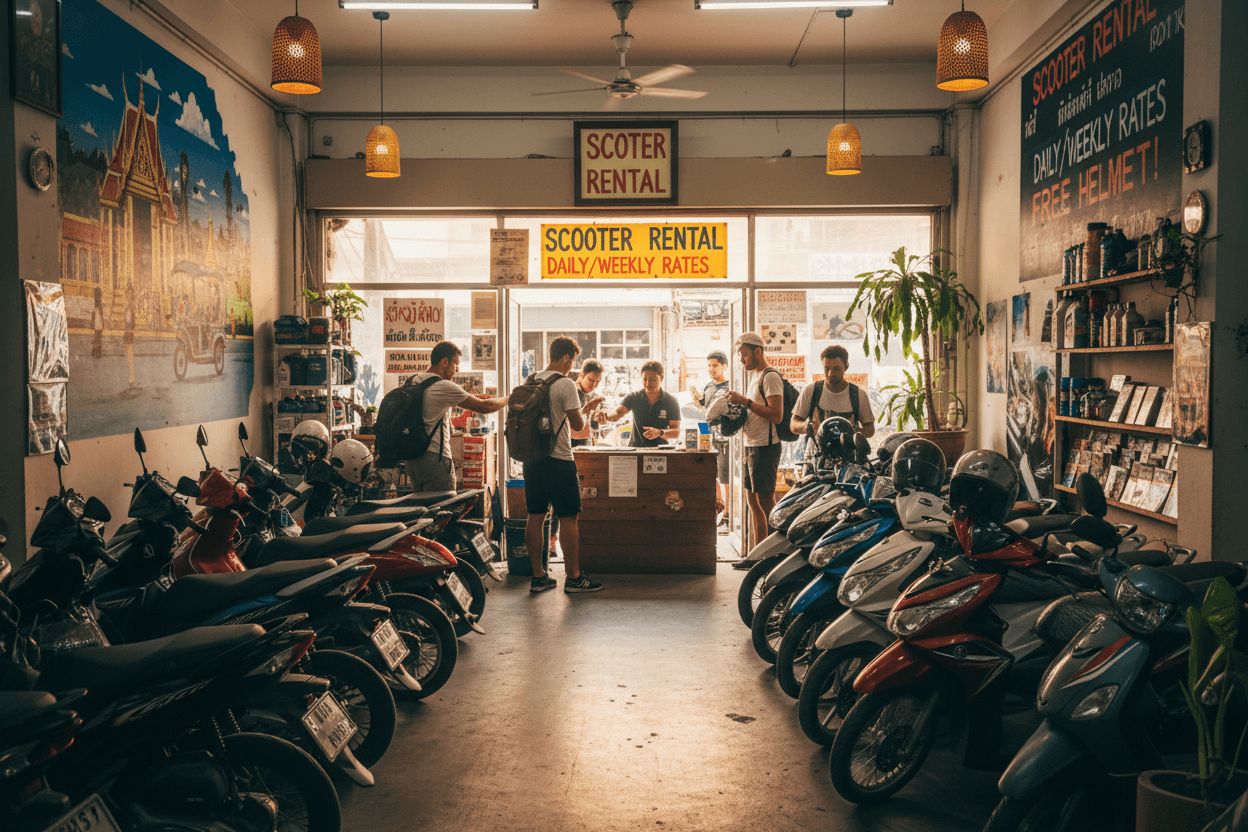
The 6 most common motorbike rental problems in Thailand
Six patterns account for almost every rental dispute reported to the Tourist Police hotline 1155 in 2026. The table below breaks each one down with its detection signal, the cost if it happens, and the single counter-action that pre-empts it. Memorize the counter-actions before you walk into a shop.
Each of the six is enumerated below with the specific Callout overlay (scam vs warning) appropriate to the problem.
Documentation discipline that pre-empts disputes
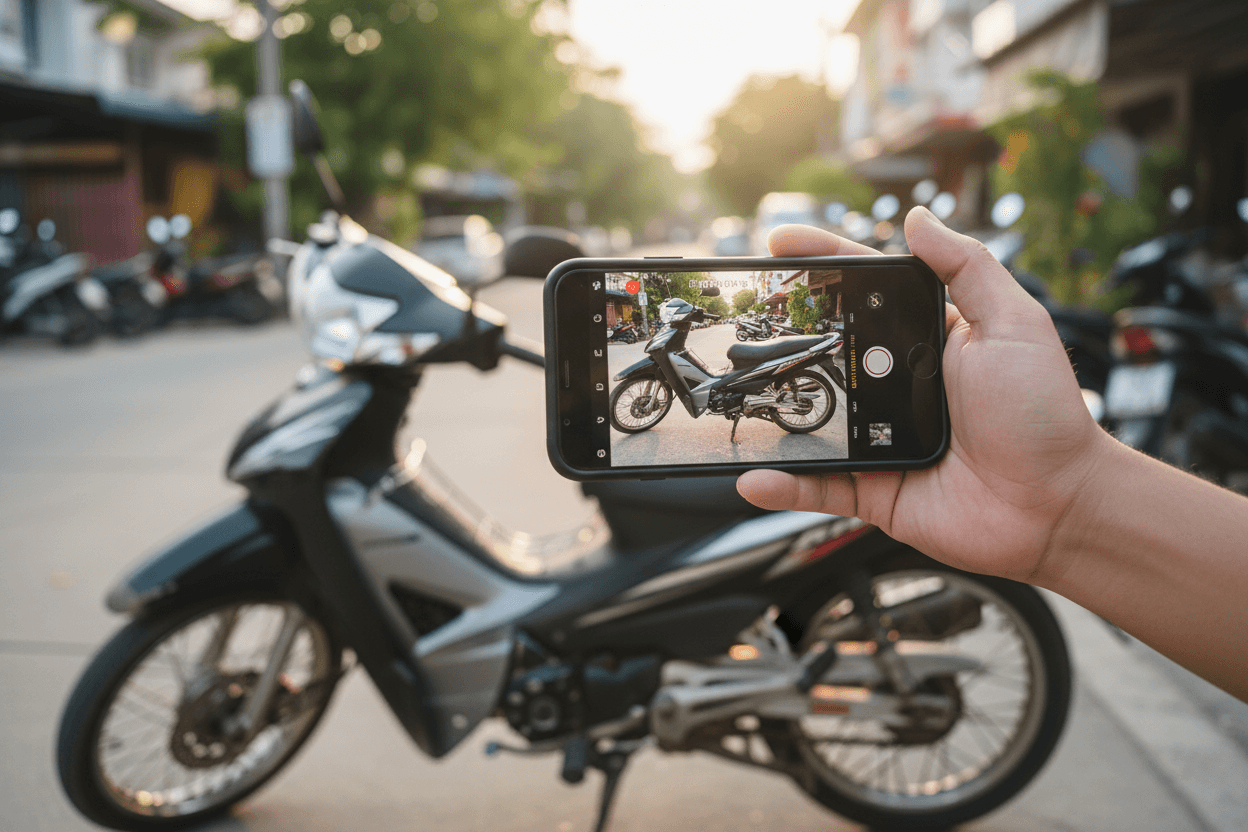
A 90-second routine at pickup defeats almost every dispute pattern Thai rental shops use. Take a continuous video walkaround of the bike with the shop employee visible in frame, narrate the date and city in English, and zoom in on every existing scratch, scuff, and dent. Then photograph the fuel gauge, the odometer reading, and the helmet's strap and shell condition. The whole sequence takes under two minutes, lives on your phone with iOS or Android timestamp metadata, and is the strongest possible evidence in any subsequent damage dispute.
Get the rental agreement in English and read it before you sign. Reputable shops in Bangkok's Sukhumvit, Chiang Mai's Old City, and Krabi Town's Maharat Road print bilingual agreements; if a shop will only offer you a Thai-only document, walk away. The agreement should specify the daily or weekly rate, the deposit amount and form (cash vs passport copy, original passport never), the fuel policy (almost always same-to-same), the per-day late-return fee, and the procedure if the bike breaks down. The Motorbike Rental Checklist Thailand covers the full inspection sequence in five minutes.
Pay the deposit in cash and get a written, dated receipt. Mobile-banking transfers to a Thai shop owner are nearly impossible to dispute; cash with a stamped receipt creates a paper trail. The Thai market norm is 500-2,000 THB cash for a 125cc Honda Click and up to 5,000 THB for a 150-160cc Yamaha NMAX or Honda PCX 160. Anything above 5,000 THB without a clear written justification is a red flag, and the Thailand scooter rental cost guide shows the canonical city-by-city deposit ranges so you can spot the over-ask.
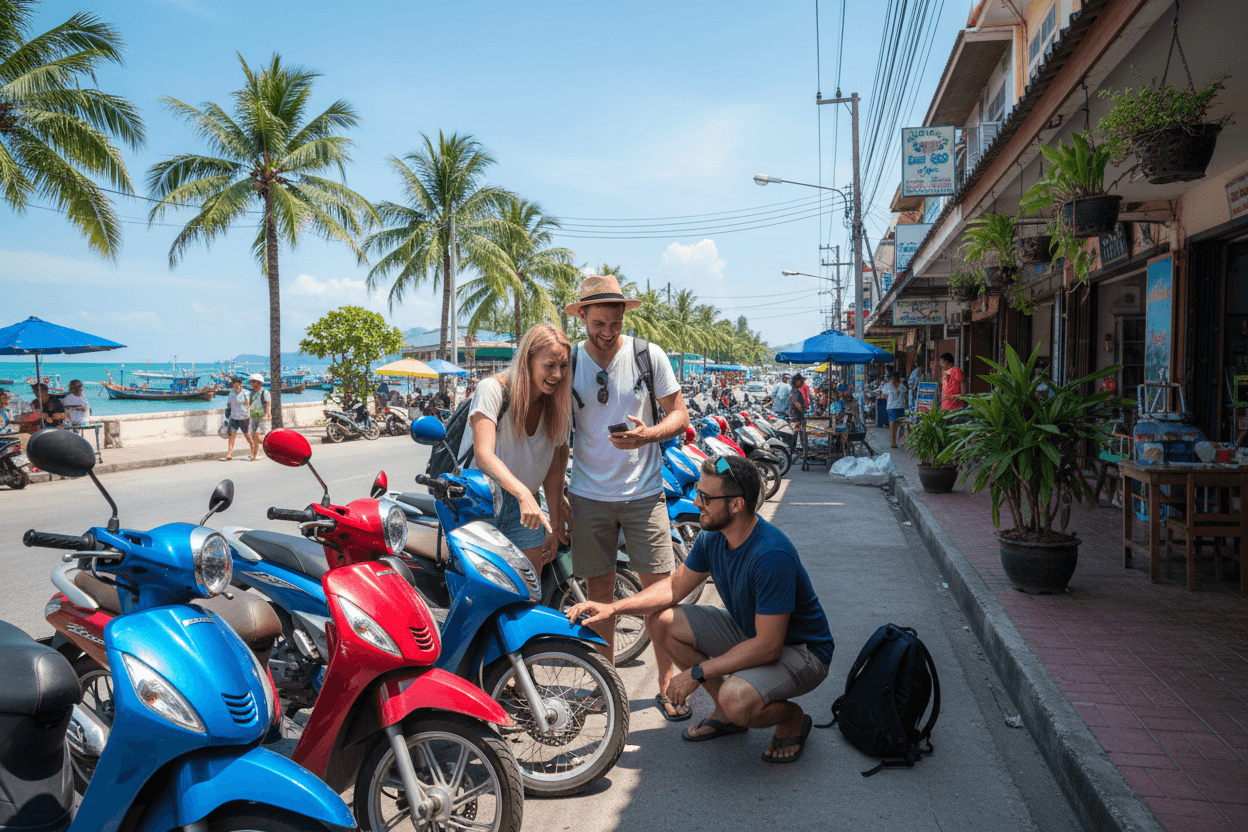
Breakdowns and roadside emergencies: the safe sequence
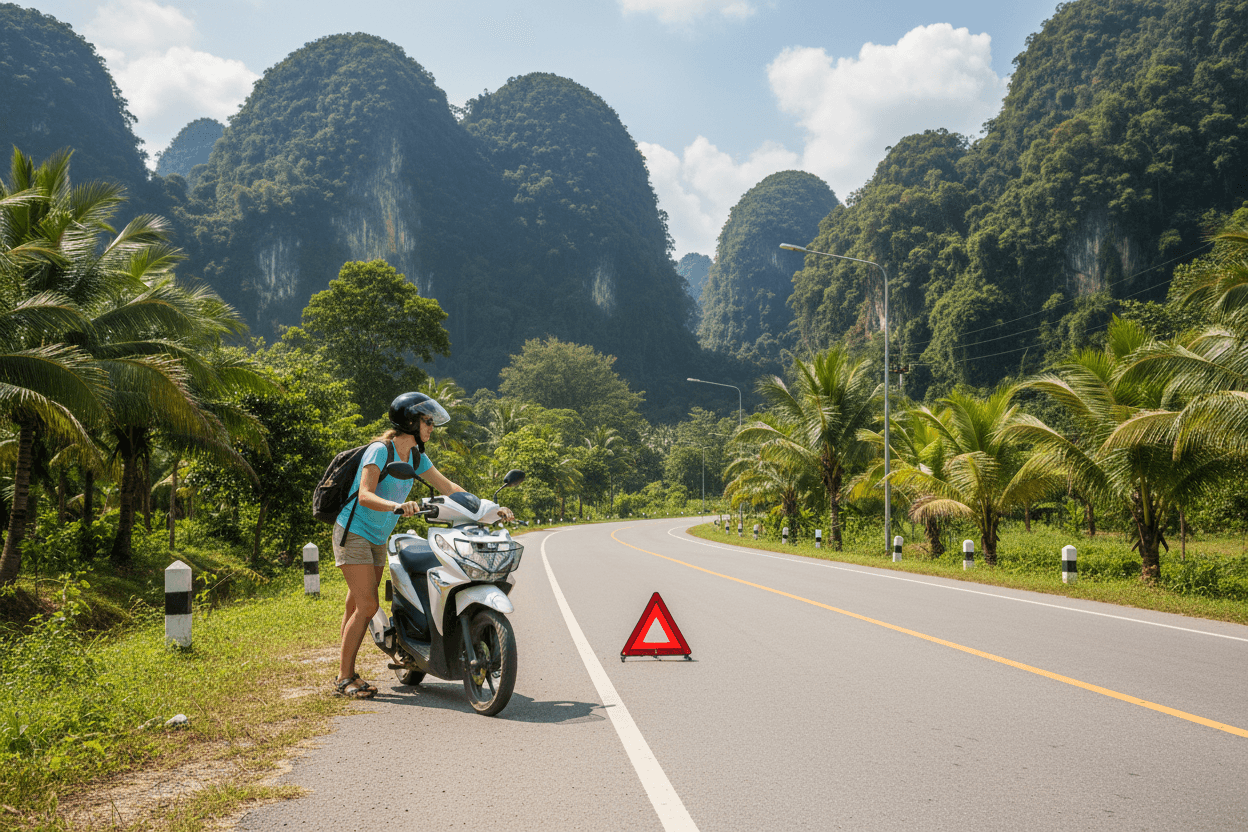
Mechanical breakdowns on Thai rural roads (the Pai Loop on Route 1095, the Mae Hong Son Loop in the north, the Krabi-Trang coastal stretch) follow the same containment sequence regardless of bike model. Pull off the road clear of traffic, kill the engine, and don't restart while the bike is overheated; that's how minor problems become engine seizures the shop later bills back to you. Photograph the bike where it stopped, capture the odometer and fuel gauge, and note the GPS coordinates from Google Maps before you do anything else.
Call the shop's emergency number from the rental agreement first, before any local mechanic. Thai shops contract their own roadside repair networks, and authorizing a third-party mechanic without consent is the fastest way to lose your deposit and pay the repair twice. Describe the location using GPS coordinates plus a nearby landmark (Tha Phae Gate, Doi Suthep base, Promthep Cape, Big Buddha viewpoint). Most reputable shops dispatch a replacement bike or a flatbed within 60-90 minutes in major rental hubs; remote-area dispatch can take 3-4 hours.
Distinguish minor fixes from major ones. A loose mirror, a burnt headlight bulb, or a flat valve stem is a 50-200 THB roadside fix at any local mechanic shop, and most rental contracts let you pay it and get reimbursed on return. Anything involving the engine, brakes, or steering is a "stop riding now" call: continuing to ride compounds the problem and the Thailand motorbike insurance cover may not pay out if you knew the bike was unsafe and rode anyway.
License, insurance, and the legal trap most tourists miss
Thai law requires a Thai motorcycle license or an International Driving Permit with the motorcycle "A" endorsement, carried alongside your home-country motorcycle license, for any motorbike above 50cc. There is no 50cc exemption, and Thai rental fleets start at 110cc anyway, so every rented motorbike requires a full motorcycle license. UK, EU, and Australian licenses commonly issue car-only ("B") IDPs by default; the motorcycle endorsement is a separate stamp you must request in advance from your home-country issuing body. The Royal Thai Embassy publishes official guidance on which license classes Thailand recognizes.
Police checkpoints in tourist hubs (Bangla Road in Phuket, Beach Road in Pattaya, the Old City moat in Chiang Mai, Maharat Road in Krabi Town) check the IDP class explicitly in 2026. Fines for missing or wrong-class licensing run 500-1,000 THB on the spot, plus the larger problem: your travel insurance is voided in any subsequent accident where you weren't legally licensed. The Department of Land Transport publishes the official license rules on its portal, which is also the issuing authority for a domestic Thai license if you decide to convert.
Insurance is the second trap. Every legally registered Thai motorbike carries Por.Ror.Bor compulsory third-party insurance, but it covers other people's medical bills only, not the rental bike, not your injuries, and not theft. If a shop advertises "full insurance included" without specifying tier, ask whether comprehensive cover (Class 1) or only third-party (Class 3) is included, and check whether the deductible is 5,000 THB or 30,000 THB. The Thailand motorbike insurance guide walks through the four insurance tiers in detail.
Tourist Police 1155: how to escalate when negotiation fails
The Tourist Police are a dedicated Royal Thai Police unit with English-speaking officers in Bangkok, Phuket, Pattaya, Chiang Mai, and Krabi. The hotline is 1155, free from any Thai mobile or landline, and is the correct first call for any rental dispute that turns hostile or any suspected fake-police encounter. Officers either dispatch on-site (in major tourist hubs) or coordinate with the local rental shop by phone in less time than most disputes take to escalate.
Save 1155 in your phone before the trip starts. The mention of Tourist Police involvement resolves most rental disputes without an actual dispatch: shop owners who were prepared to pocket a 5,000 THB scratch fee become abruptly reasonable when "Tourist Police" enters the conversation. If the dispute escalates to a credit card charge or a withheld passport, document everything (photos, video, receipts, contract) and file a formal report at the nearest Tourist Police office; the report number is what your bank will need for a chargeback. The Tourist Police's own page is hosted at the Royal Thai Police portal (search "tourist police" for the dedicated unit).
For credit card disputes after you've left Thailand, the same documentation supports a chargeback through Visa, Mastercard, or American Express. Most card issuers honor a "services not as described" or "false damage claim" dispute when the cardholder presents timestamped pre-rental video evidence and a Tourist Police case number. Disputes filed within 60 days of the charge have the highest success rate; older charges are progressively harder to reverse.
Frequently Asked Questions
What should I do if a Thai rental shop demands my original passport as a deposit?
Walk away immediately. Reputable shops in 2026 accept a 1,000-2,000 THB cash deposit and a high-quality passport copy; original passports are never standard practice in Thailand. A shop that insists on the original is positioning to invent an inflated damage claim and hold the document until you pay. Find the next shop; in tourist hubs there are dozens within walking distance.
What licence do I legally need to rent and ride a motorbike in Thailand?
Thai law requires either a Thai motorbike license or your home-country motorcycle license plus an International Driving Permit with the "A" (motorcycle) endorsement. A car-only license or a car-only IDP is not sufficient, even though many street shops will rent without checking. Police checkpoint fines for incorrect licensing run 500-1,000 THB on the spot and your travel insurance is voided in any subsequent crash.
How can I protect myself from false damage claims at return?
Take a continuous 90-second video walkaround at pickup with the shop employee visible in frame, narrate the date and city, and zoom in on every existing scratch and scuff. Photograph the fuel gauge, odometer reading, and helmet condition. The Smartphone metadata timestamps are admissible evidence in a Tourist Police report and a credit card chargeback. Five minutes of footage closes 90% of disputes before they're filed.
What should I do if my Thai rental scooter breaks down on the road?
Pull off the road clear of traffic, kill the engine, and call the shop's emergency number from your rental agreement before any local mechanic. Photograph the bike's location, odometer, and fuel gauge. Most reputable shops dispatch a replacement bike or flatbed within 60-90 minutes in major hubs. Don't authorize third-party repairs without explicit shop consent or you may pay twice.
Who do I call if I have a serious dispute with a Thai rental shop?
Dial 1155 for the Tourist Police, a dedicated Royal Thai Police unit with English-speaking officers in Bangkok, Phuket, Pattaya, Chiang Mai, and Krabi. The hotline is free from any Thai mobile. Most disputes resolve as soon as Tourist Police involvement is mentioned; for escalations, file a formal report and use the case number for credit card chargebacks within 60 days of the charge.
Are platform rentals safer than walking into a Thai street shop?
Yes, in measurable ways. Vetted platforms enforce the documentation discipline that prevents the six recurring problems: cash deposits only (no original passport), bilingual written agreements, verified Por.Ror.Bor on every fleet bike, and a formal dispute-resolution path that doesn't require Tourist Police escalation. The 50-100 THB/day premium over a street-corner shop is meaningfully cheaper than one passport-hostage dispute or one scratch-scam invoice.
What insurance should I expect on a Thai rental motorbike?
Every legally registered Thai motorbike carries Por.Ror.Bor compulsory insurance, but it covers third-party bodily injury only, not the rental bike, not your own injuries, and not theft. Without supplementary cover (Class 1 comprehensive, sometimes offered by the shop or by your home-country travel insurer), you are personally liable for the bike's replacement cost in any crash, typically 80,000-150,000 THB for a Honda Click 125.
Plan a problem-free rental before you fly
Most motorbike rental problems in Thailand are predictable, preventable, and concentrated at the cheapest 100 THB/day end of the market. The 50-100 THB/day premium between a street-corner shop and a vetted operator buys you a bike with working brakes, a cash-deposit policy that respects your passport, and a written rental agreement you can actually read. Compare verified shops, see real renter reviews, and lock in your bike at Byklo.rent. Pickup is available at hotels and airports in 15 cities across Thailand; helmets included, deposits paid in cash, passport stays in your hand.