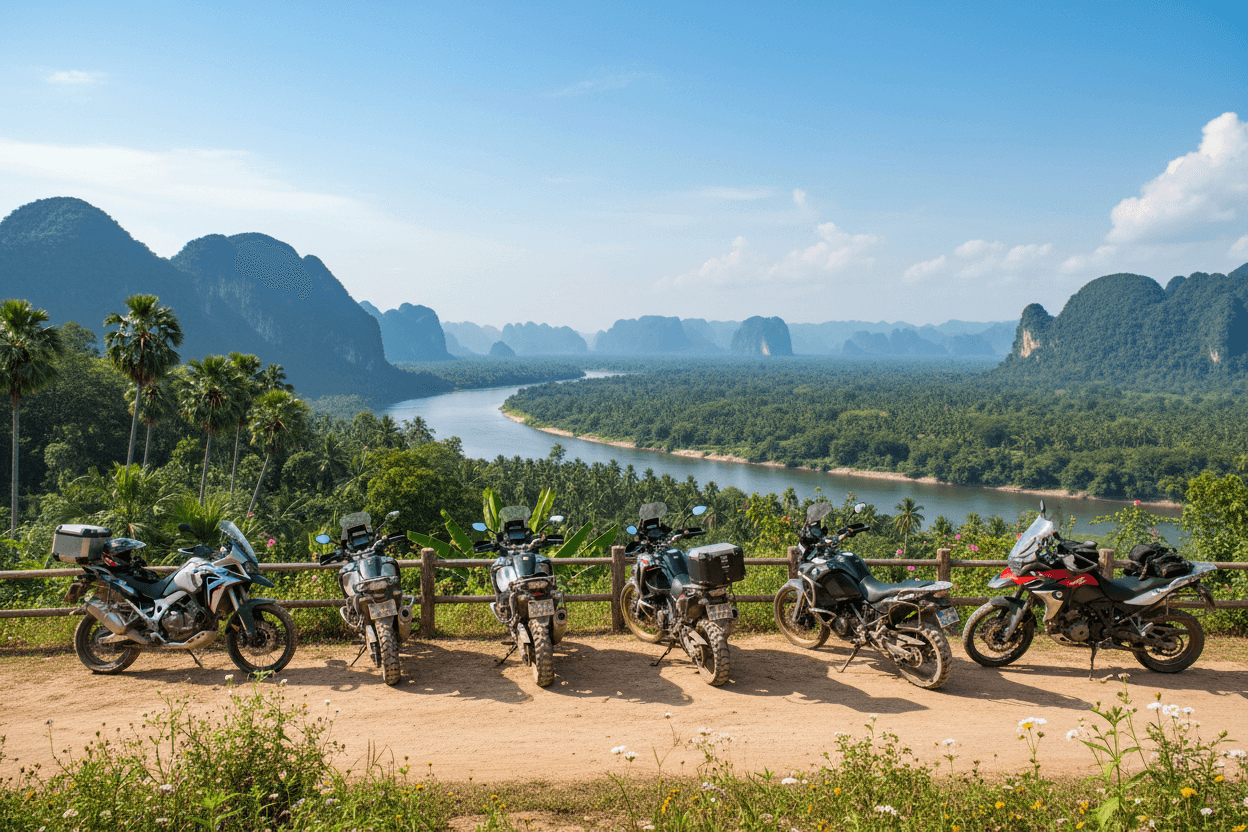
A Chiang Rai motorbike tour in 2026 covers Wat Rong Khun (the White Temple), Wat Rong Suea Ten (the Blue Temple), Doi Mae Salong's Yunnanese tea villages, and the Mekong-side Golden Triangle on a single rental, with daily rates of 125-300 THB for a 125cc Honda Click and 600-1,200 THB for a Honda CRF250L Rally that handles the Doi Tung gravel sections. Most riders base in Chiang Rai town for a 2-3 day loop, or pick the bike up in Chiang Mai (193 km south on Route 118) for the full northern arc.
Key Takeaways
- Daily rates: 125-300 THB for a 125cc Honda Click in Chiang Rai in 2026, 250-450 THB for a Yamaha NMAX or Honda PCX 160, and 600-1,200 THB for a Honda CRF250L Rally (the right bike for Doi Tung's gravel and the steep climbs to Doi Mae Salong).
- Day-trip core: Wat Rong Khun (White Temple, 100 THB entry, designed by Chalermchai Kositpipat), Wat Rong Suea Ten (Blue Temple, free), Wat Huay Pla Kang (Big Buddha, free), and the Black House (Baan Dam Museum, 80 THB) sit within a 25 km radius of Chiang Rai town and ride as one full day on a 125cc.
- Multi-day extension: a 2-3 day loop adds Doi Mae Salong (Route 1130 / 1234 climb), Mae Sai border, Sop Ruak, and Doi Tung Royal Villa (90 THB entry, paved access from Route 1149).
- Rental base: Chiang Rai town has a smaller rental supply than Chiang Mai and the same bike can run 30-50 THB/day cheaper if collected in Chiang Mai's Old City and ridden up Route 118 (193 km, 3 hours).
- License rule: a home-country motorbike license plus an International Driving Permit carrying the "A" (motorcycle) endorsement is required at every Royal Thai Police checkpoint, including the fixed Mae Sai border post and the Doi Tung approach.
- Best months: November to February; avoid the March-April burning season (PM2.5 peaks above 200) and the wettest stretches of August-September.
Why Chiang Rai is the better tour base than Chiang Mai for the far north
Chiang Rai sits 193 km north of Chiang Mai on Route 118 and is the natural base for the far-north arc: the Golden Triangle border tri-junction at Sop Ruak, the Yunnanese-Thai hill villages of Doi Mae Salong, the Doi Tung Royal Villa, and the cluster of unconventional temples the city is known for. Compared to Chiang Mai, Chiang Rai has fewer rental shops, less English-language tourist scaffolding, and a quieter road network, which is exactly the appeal once you have the bike. A Chiang Rai motorbike tour gives you the Mekong riverbank, the Akha and Lahu hill-tribe villages, and the Burmese border in 2-3 riding days, none of which are reachable from Chiang Mai on a single tank.
The town itself is laid out around the clock tower (a Chalermchai Kositpipat work in gold, lit nightly at 7pm, 8pm, and 9pm) and the Mae Fa Luang Art and Culture Park on the western edge. The two-wheel core is short: north on Route 1 toward Mae Sai for the Golden Triangle, west on Route 1130 / 1234 for Doi Mae Salong, and south on Route 1 toward the White Temple. Distances are deceptively short on the map, but the climbs to Mae Salong (1,800 m elevation) and Doi Tung (1,389 m at the Royal Villa) demand a 150cc bike for two-up riding and a 250cc-plus dual-sport for the Doi Tung gravel access roads.
For riders who want the iconic Chiang Mai-area routes alongside the Chiang Rai temples, the 1,864-curve route (600 km on Routes 1095 and 108) and the Pai Loop on Route 1095 (130 km, 762 curves) start from Chiang Mai and pair logically with a Chiang Rai extension. The full northern circuit (Chiang Mai → Pai → Mae Hong Son → back to Chiang Mai → Chiang Rai → Mae Salong → Sop Ruak → home) takes 7-10 days on a 250-300cc manual.
What can you ride from Chiang Rai town in a single day?
A single day from Chiang Rai town comfortably covers the city's three signature temples plus the Black House on a 125cc Honda Click: Wat Rong Khun (the White Temple, 13 km south on Route 1, 100 THB), Wat Rong Suea Ten (the Blue Temple, 4 km north of town, free), Wat Huay Pla Kang (Big Buddha, 7 km northwest, free), and the Black House / Baan Dam Museum (10 km north on Route 1, 80 THB). The four sites total roughly 60 km of mostly flat, paved riding and read as a U-shape around Chiang Rai town. Add Singha Park (12 km west, free entry, paid attractions inside) and Khun Korn Waterfall (33 km southwest on Route 1208, free) for a longer day that still finishes in town for dinner.
The temples are stylistically unrelated and that's why the day works: Wat Rong Khun is Chalermchai Kositpipat's white-and-mirror Buddhist surrealism; Wat Rong Suea Ten ("Tiger Dance Temple") is the cobalt-blue counter; Wat Huay Pla Kang carries a 25-storey-tall white Guan Yin (Big Buddha) visible from anywhere in the valley; and the Black House (Baan Dam) is the late Thawan Duchanee's anti-temple, a collection of 40 dark teak structures filled with bones, hides, and shamanic curiosities. Lonely Planet's Chiang Rai overview is a useful long-form reference for the city's art and temple cluster.
For travelers timing their Chiang Rai stopover with the broader north, the Chiang Mai Travel Guide 5 Day Itinerary covers the upstream half of the loop. For the day-trip companion to Chiang Rai itself, the Best Day Trips from Chiang Mai post ranks Chiang Rai alongside Pai and Doi Inthanon as the highest-payoff scooter-day options out of Chiang Mai.
Multi-day route: Chiang Rai to the Golden Triangle and back
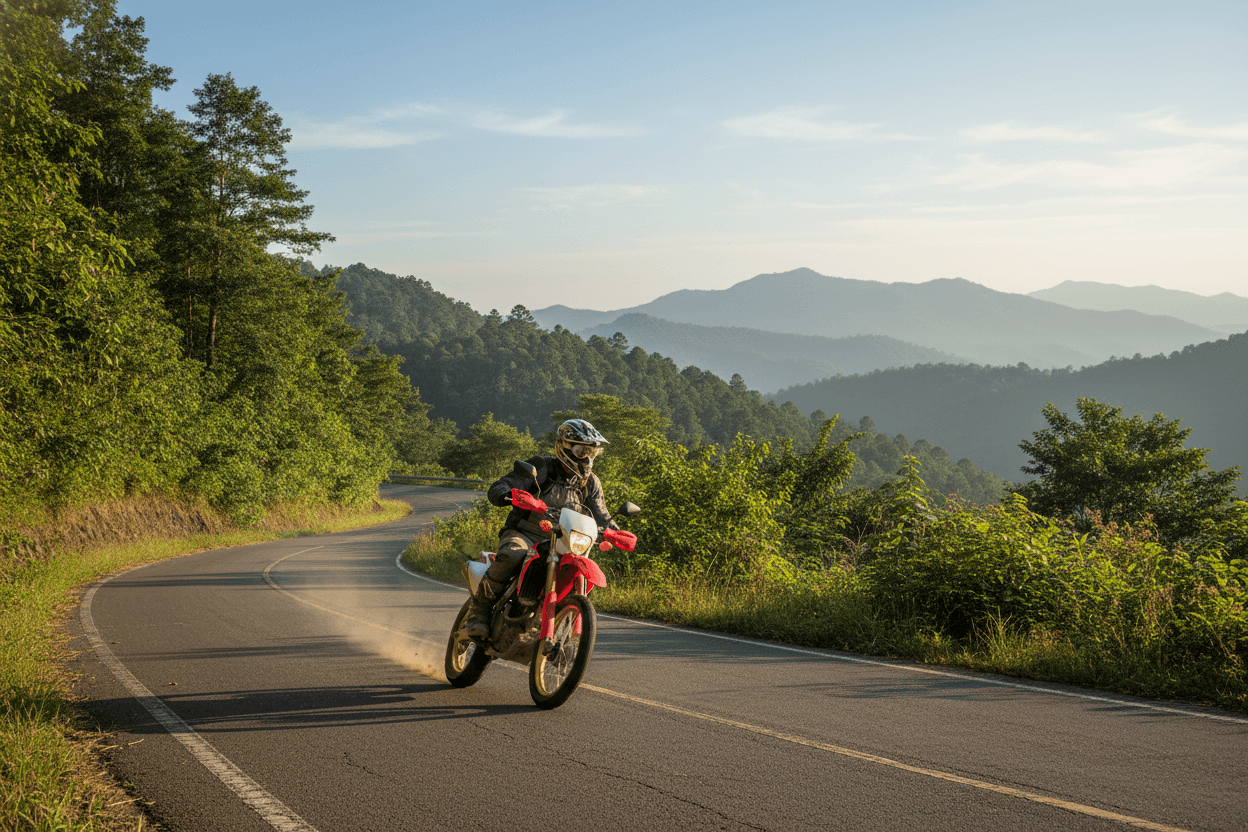
A 2-3 day Chiang Rai loop adds Doi Mae Salong, Mae Sai, Sop Ruak, and Doi Tung to the city day-trip cluster: roughly 250 km of riding split across 2 nights on a Honda PCX 160 (450 THB/day), or 1 longer day for fitter riders on a Honda CRF250L Rally (1,000 THB/day). The classic clockwise loop runs Chiang Rai → north on Route 1 to Mae Chan → west on Route 1130 / 1234 to Doi Mae Salong (overnight) → north on Route 1149 to the Doi Tung Royal Villa → continue to Mae Sai → east on Route 1290 along the Mekong to Sop Ruak and Chiang Saen → south on Route 1016 / 1 back to Chiang Rai. The route is fully paved except for short Doi Tung side roads.
Doi Mae Salong (Santikhiri) is the climax. The village was settled by Kuomintang Chinese veterans of the 93rd Division after the Chinese Civil War, and the cultural overlay is genuine Yunnan: Mandarin signage, oolong tea plantations on terraced slopes, and red-lantern architecture that does not feel Thai. The road up from Mae Chan on Route 1130 is the engineering set-piece: a ribbon of switchbacks climbing from 400 m to 1,800 m over 25 km, with hairpin turns wet from cloud cover even in dry season. The Mae Fa Luang Art and Culture Park (a Princess Mother project, just outside town) and the Doi Tung Royal Villa (90 THB entry, the late Princess Mother's mountain residence) anchor the cultural side; the tea houses anchor the food side.
The Sop Ruak cross-link is the Golden Triangle Motorcycle Adventure post, which covers the 200 km Mae Sai-Sop Ruak-Mae Salong loop in detail. Treat the two posts as paired: this Chiang Rai post is the rental-base and city-cluster guide; the Golden Triangle post is the route-day breakdown for the actual border-and-river run. Chiang Rai also anchors the borderlands chapter of Thailand's six iconic motorcycle regions, so this loop is the gateway between the Northern and Golden Triangle clusters.
Which bike fits a Chiang Rai tour?
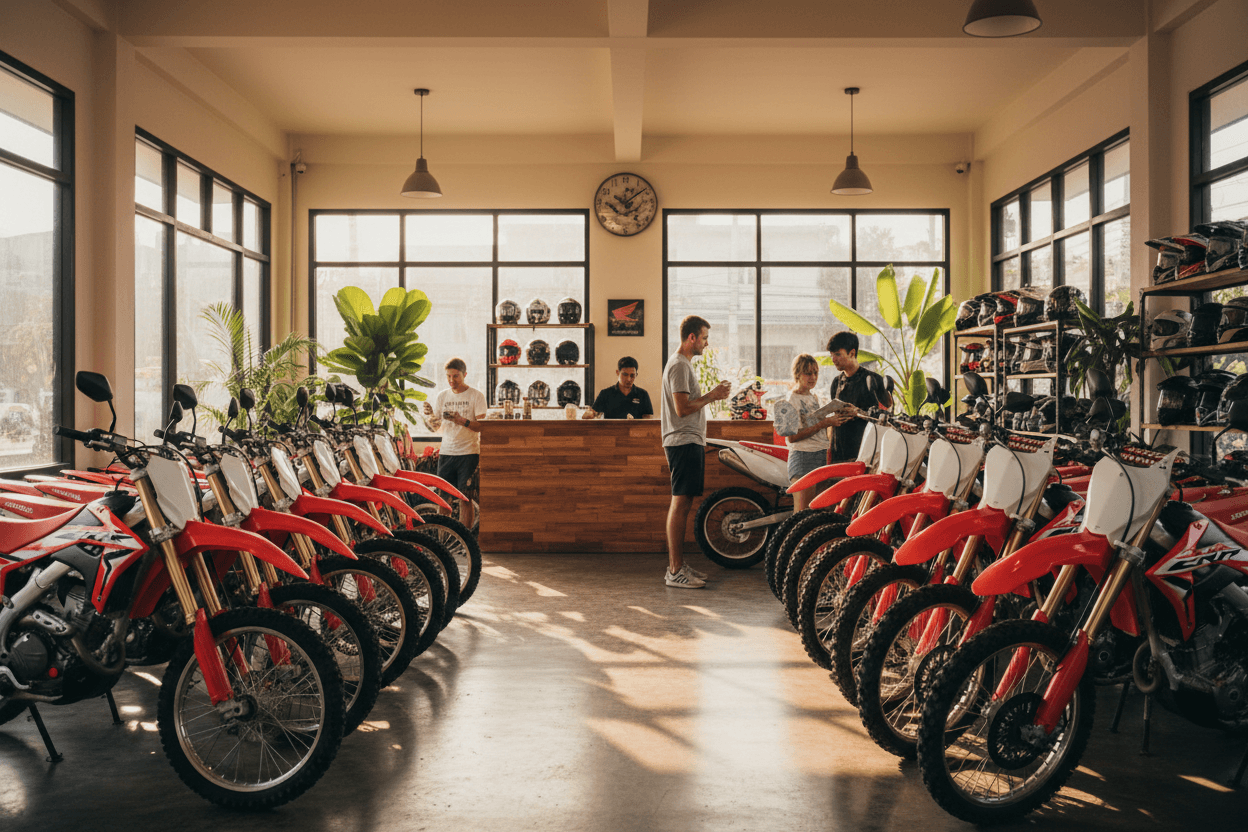
Chiang Rai's terrain has three personalities and the right bike depends on which combination you ride. The town and the four-temple cluster are flat-paved 125cc territory; the Mae Salong climb and the Sop Ruak border run are 150cc-PCX-or-NMAX terrain because of the long sustained ascents and the two-up weight; and the Doi Tung gravel access roads, the Khun Korn Waterfall trailhead approach, and any rainy-season ride above 1,500 m demand a 250cc-plus dual-sport with long-travel suspension. The Honda CRF250L Rally is the standard rental for the third tier; it absorbs cloud-wet pavement and packed gravel with no drama and has the engine braking a 125cc Click cannot deliver on long descents.
If you are riding two-up, planning to overnight in Mae Salong, or taking the bike on any Doi Tung side road, the 100-200 THB/day step up from a 125cc Click to a Honda PCX 160 or a CRF250L pays for itself in safety on the descents. Big bikes are the right tool only for riders who collected the bike in Chiang Mai and are doing the full Mae Hong Son → Chiang Rai → Sop Ruak arc; for a Chiang Rai-only week, a 150cc-class scooter handles 90% of the riding.
When to ride and what to time around
The riding season in Chiang Rai runs November to February: cool dry mornings (12-18°C in town, 5-10°C on Doi Mae Salong), clear visibility, and pavement that has had weeks to dry out from the monsoon. March and April are the burning season, when local farmers clear field stubble and PM2.5 routinely exceeds 200, with peak smoke reducing Mae Salong visibility to under 100 m and triggering eye and throat irritation that no helmet visor filters. May through October is the wet season; the scenery is at its greenest but the Doi Mae Salong switchbacks and the Doi Tung gravel sections become slick, and any waterfall hike (Khun Korn especially) involves wet rock and slippery clay.
Songkran (Thai New Year, April 13-15) overlaps with peak burning season in Chiang Rai. The water-fight tradition is gentler than in Chiang Mai but still meaningful, and CVT seizure on a soaked 125cc is the same risk; the Thailand Motorbike Safety New Year post covers the rental-shop water-damage dispute pattern that spikes every April. The Mae Fa Luang Flower Festival in late December and the Lanna festival nights at the clock tower are the calendar reasons to time a December stay; avoid the first 10 days of April unless your travel dates are fixed.
For a country-wide weather-and-route map, the Best Time to Visit Chiang Mai and When to Visit Chiang Mai Guide posts are the closest sibling references. For deeper safety coverage on Royal Thai Police checkpoint behavior, helmet enforcement, and IDP rules, see the Top 10 Motorbike Safety Tips for Thailand post and the four-tier rental insurance ladder reference.
Stops and timing on a 3-day Chiang Rai itinerary
A standard 3-day Chiang Rai motorbike tour reads as: Day 1 the four-temple city cluster on a 125cc; Day 2 the Mae Salong climb with overnight in Santikhiri; Day 3 the Mae Sai-Sop Ruak-Doi Tung loop and back to Chiang Rai. Total riding distance is roughly 350 km and the route returns the bike to the same Chiang Rai shop. A 4-day version inserts Khun Korn Waterfall (Route 1208, 33 km southwest) on Day 1 afternoon or substitutes a half-day at Singha Park's bike trails. A 5-day version adds the Mae Fa Luang Art and Culture Park half-day and a slow morning at the Hill Tribe Museum on Sukhaphiban 3 Road.
Timing the temples on Day 1: arrive at Wat Rong Khun by 9am, at Wat Rong Suea Ten by 11am (the morning light hits the cobalt-blue facade best between 10 and 12), at Wat Huay Pla Kang by 1pm, and at the Black House by 3pm. The three Buddhist sites close at 5pm; the Black House closes at 5:30pm. The clock-tower light show in central Chiang Rai runs at 7pm, 8pm, and 9pm, so Day 1 ends with a beer and the gilded clock tower, then back to the hotel for an early start on Day 2.
For the multi-day version, Lonely Planet's Doi Mae Salong page is the closest published outside reference for the village's tea-house circuit. The 600 km loop post is the upgrade path if you want to tack a Chiang Mai-side route onto the Chiang Rai trip; the Top 10 Motorbike Routes Chiang Mai post covers the Samoeng Loop, Doi Inthanon, and Mae Sa as the southern half of a longer northern Thailand tour.
Frequently Asked Questions
What is the best motorbike for a Chiang Rai tour?
For the four-temple city cluster and flat valley riding, a 125cc Honda Click at 125-300 THB/day is enough. For the Mae Salong climb or any two-up touring, step up to a Honda PCX 160 or Yamaha NMAX at 250-450 THB/day. For Doi Tung's gravel access roads or wet-season riding above 1,500 m, the right tool is a Honda CRF250L Rally at 600-1,200 THB/day.
Do I need an International Driving Permit to rent in Chiang Rai?
Yes. A home-country motorbike license plus an International Driving Permit carrying the "A" (motorcycle) endorsement is the legal minimum. Royal Thai Police staff a fixed checkpoint on Route 1 near the Mae Sai border crossing and another on the Doi Tung approach. No-IDP fines run 500-1,000 THB on the spot and a car-only IDP counts as no license. The Thai Driving License Requirements post covers the document checklist; the International Driving License Thailand post covers the IDP class trap.
Can I ride from Chiang Mai to Chiang Rai instead of renting locally?
Yes, and many riders do. Route 118 connects Chiang Mai to Chiang Rai over 193 km in about 3 hours of paved highway riding, and a Chiang Mai 125cc rented at 150-300 THB/day handles the climb and the descent. Renting in Chiang Mai gives you a wider fleet, lower prices, and a one-stop bike for the Mae Hong Son Loop plus the Chiang Rai extension. Confirm the geographic scope on the rental contract; some Chiang Mai shops restrict the bike to the metro area.
Is the Golden Triangle worth the extra ride from Chiang Rai?
Yes, but treat it as a route-day rather than a sightseeing-day. Sop Ruak is 60 km north of Chiang Rai on Routes 1 and 1290 and the actual tri-border viewpoint is photogenic for 15 minutes; the value is in the Mekong-side ride from Chiang Saen to Chiang Khong and the Mae Sai border-town energy. The full route-day breakdown is in the Golden Triangle Motorcycle Adventure post.
How much should the Doi Mae Salong overnight cost?
Mae Salong guesthouses run 1,000-2,500 THB per night for a mountain-view room with breakfast, with the higher end on the cliff-edge tea-plantation properties facing west toward Burma. A modest dinner of Yunnanese noodles and pork knuckle is 150-250 THB. Add a 200-400 THB pot of fresh oolong at any Sin Sane Choke or 101 Tea Plantation tea house. Total budget: roughly 2,000-3,500 THB for the overnight including dinner, breakfast, and tea.
Are the hill-tribe villages along the route safe and ethical to visit?
The Akha, Yao, and Lahu villages on the Doi Mae Salong and Doi Tung circuits are open to respectful visitors, but the "long-neck Karen" tourist camps near Mae Hong Son have drawn criticism as exploitative human-zoo setups. On the Chiang Rai loop, the Mae Fa Luang Art and Culture Park and the village stops along Route 1130 are the better-managed experiences. Buy tea, textiles, or food directly from the producers; tip 50-100 THB if you take photographs of named individuals.
What outbound documents and authorities should I be aware of?
For the Mae Sai border, day-trip crossings into Tachileik, Myanmar are open at the discretion of Burmese authorities and can close without notice; bring your passport (not a copy) for the day pass. The Royal Thai Embassy covers the Thai side of border-crossing rules. For licensing, the Thai Motorbike License Guide covers the long-stay path; the rental waiver tiers walkthrough covers what your IDP-backed travel insurance does and does not cover for a hospital stay after a Mae Salong descent goes wrong.
Plan your Chiang Rai loop and a verified rental
A Chiang Rai motorbike tour rewards a small amount of preparation: an IDP from your home country, a 150-250cc bike if you are climbing Mae Salong or riding two-up, a hard-copy of the rental contract with geographic-scope language, and a route plan that finishes the temple cluster on Day 1 so the long days are clean rides rather than rushed sightseeing. For the rental side, see the Motorbike Rental Chiang Mai Guide for a wider fleet and 30-50 THB/day savings if you collect in the Old City, the Golden Triangle Motorcycle Adventure for the Mae Sai-to-Sop Ruak route-day breakdown, and the Route 1095 to Pai and beyond circuit if you are tacking the western mountain arc onto the same trip. Book a Honda Click 125 from Chiang Rai or Chiang Mai at Byklo.rent for the city cluster, or step up to a Honda PCX 160 or Honda CRF250L Rally for the Mae Salong climb and the Doi Tung gravel approach.