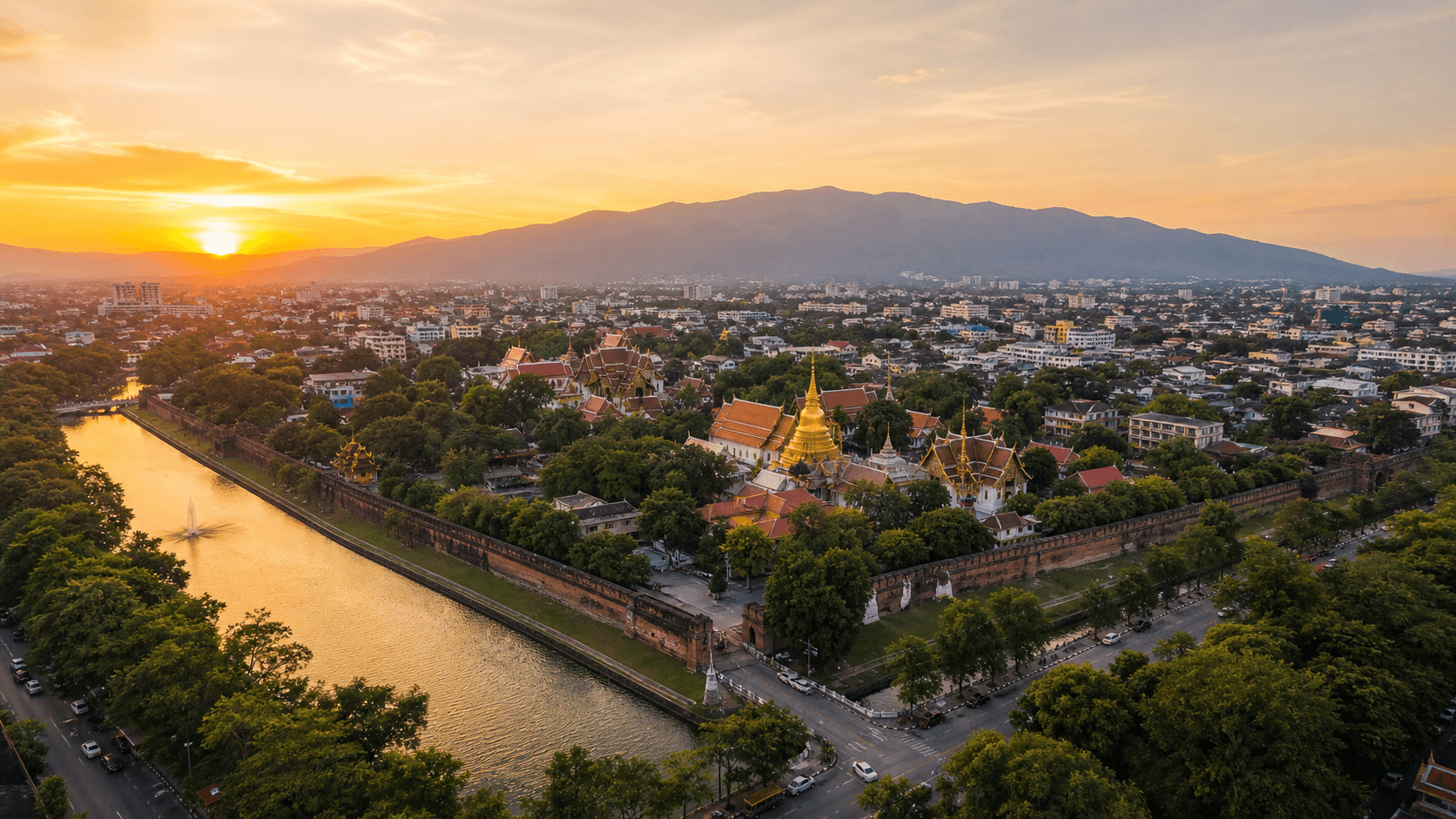
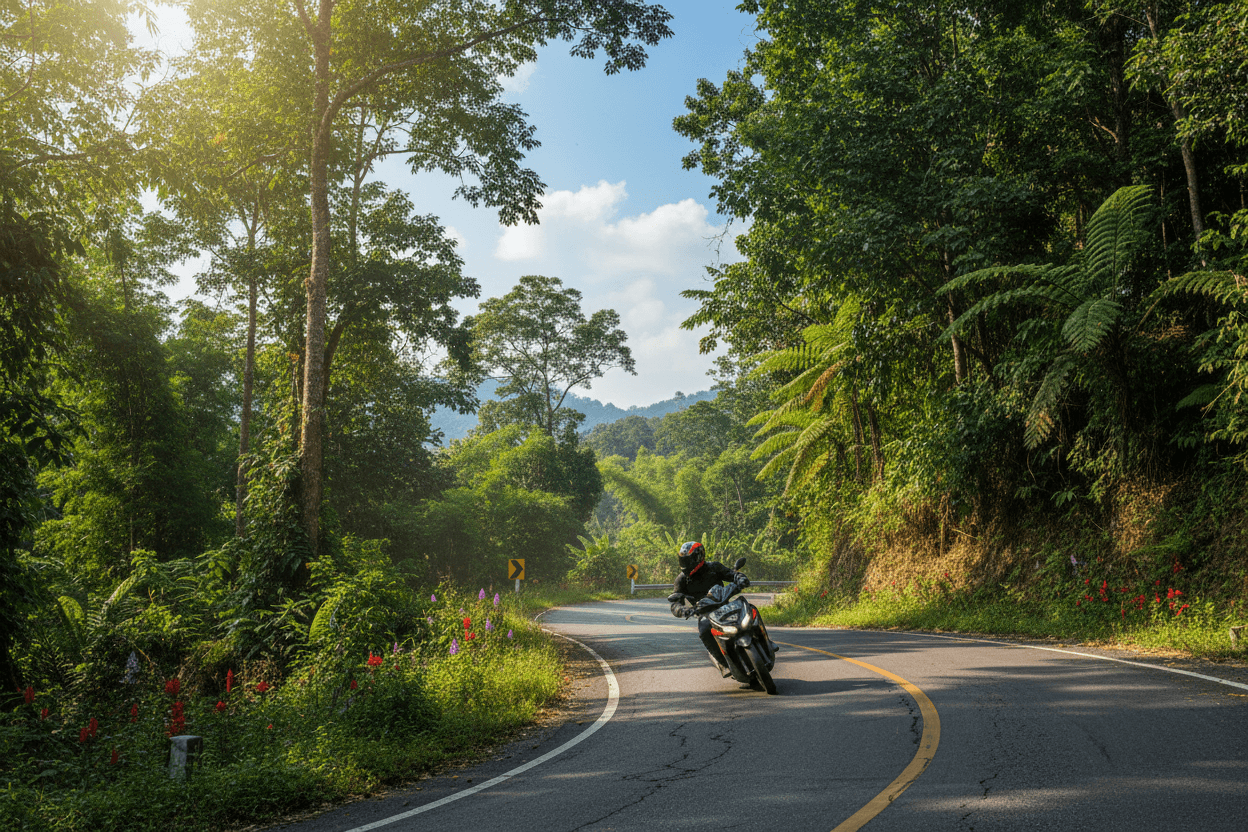
The best time to visit Chiang Mai is November to February, when daytime temperatures sit at 25-30°C, humidity drops, and PM2.5 air quality stays under 50 µg/m³. This is also the prime motorbike-rental window: clear skies on the 16 km Doi Suthep climb (Route 1004), dry tarmac on the 100 km Samoeng Loop, and 8-12°C summit air at Doi Inthanon. Avoid March through mid-April when burning-season PM2.5 routinely exceeds 200 µg/m³ and visibility on Route 1095 to Pai drops below 1 km. A 150-300 THB Honda Click 125 from any Tha Phae Gate or Nimman shop covers every season; the only thing that changes is the riding kit.
Key Takeaways
- Peak window: November to February delivers 25-30°C days, 13-18°C nights, PM2.5 under 50 µg/m³, and clear views from Wat Phra That Doi Suthep (1,073 m) and Doi Inthanon (2,565 m); also the busiest scooter-rental month, so book the Honda Click 125 7-10 days ahead.
- Burning season: late February through April brings PM2.5 readings of 150-300 µg/m³ across the Mae Sa Valley and Route 1095 to Pai; 1 km visibility on the Mae Sa Valley waterfall route and the Doi Suthep switchbacks turns the cool-season showcase rides into N95-mandatory routes.
- Songkran (April 13-15): Thailand's New Year water festival turns the Old City moat into a continuous water fight; Chiang Mai shops report a spike in CVT-seizure repair bills (8,000-20,000 THB debited against the cash deposit) every year.
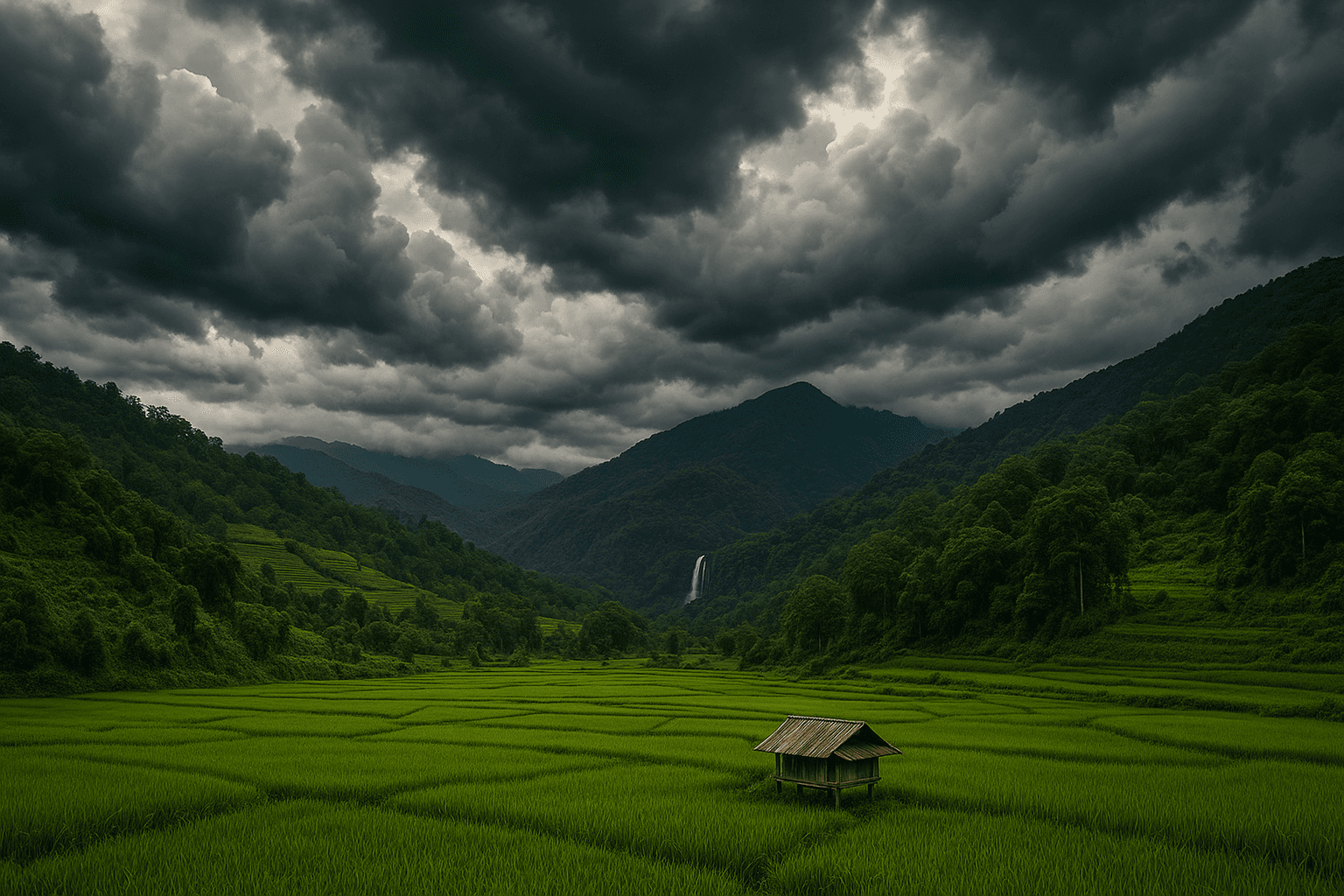
- Rainy season pricing: June-October cuts hostel rates 30-50% and accommodation 20-40%, but adds a 14:00-17:00 thunderstorm window that the 5-day Chiang Mai itinerary plans around with morning starts.
- Yi Peng + Loy Krathong (November full moon): the lantern festival is the headline cultural event; book accommodation 2-3 months ahead and the scooter rental at 250-300 THB/day instead of the off-peak 150 THB floor.
- Rental rate stays flat: a 125cc Honda Click runs 150-300 THB/day in every month; what changes is the demand-driven floor (off-peak 150) versus the peak (250-300) at Tha Phae Gate, Moonmuang Road, and Nimman shops, plus the bike-class step-up to a 250-450 THB Honda PCX 160 or Yamaha NMAX for two-up Doi Suthep climbs.
When is the overall best time to visit Chiang Mai in 2026?
The best time to visit Chiang Mai is November to February: 25-30°C daytime temperatures, 13-18°C nights, PM2.5 air quality reliably under 50 µg/m³, and the lowest single-day rainfall total of the year. This window covers Yi Peng and Loy Krathong (November full moon), the Chiang Mai Flower Festival (first weekend of February), Christmas / New Year, and Chinese New Year. It is also the only window where the Doi Inthanon summit (2,565 m) sits above the haze layer for clear panoramic views and the Wat Phra That Doi Suthep climb on Route 1004 stays dust-free.
The trade-off is demand. November-February peak demand pushes 125cc Honda Click rates from the 150 THB off-peak floor up to 250-300 THB at Tha Phae Gate and Moonmuang Road shops, lifts dorm beds at Stamps Backpackers and Bann Hostel from 200 to 350-450 THB/night, and triples Yi Peng-week accommodation rates inside the Old City moat. Book accommodation 2-3 months ahead for Yi Peng / Loy Krathong; book the Chiang Mai motorbike rental 7-10 days ahead through a verified platform with free hotel delivery, because Honda PCX 160 / Yamaha NMAX maxi-scooter inventory sells out across the Old City and Nimman in the November-February peak.
For travellers who can't move their dates, the second-best windows are late October (rain tapers, prices still off-peak) and mid-May to mid-June (post-burning, pre-monsoon, hot but PM2.5 back under 50). Avoid March 1 through April 20: this is the burning-season floor plus Songkran, and the combination of 200+ PM2.5 and continuous water fights damages bikes, lungs, and patience in roughly that order.
Chiang Mai weather and air quality month by month
Chiang Mai's tropical-savannah climate splits cleanly into three seasons: cool-dry November-February (best), hot-dry March-May (worst air), and rainy-monsoon June-October (cheapest). The single most-decisive variable for a traveller is not temperature; it is PM2.5. Air-quality readings under 50 µg/m³ correspond to "good" on the WHO scale; 150-300+ in late February through April corresponds to "unhealthy" to "hazardous" and is the reason every guidebook tells you to avoid Chiang Mai in those weeks.
The riding-conditions column is the column that matters for a renter. November through February is "ride anywhere, any time of day". May through October is "ride mornings; the bike is fine but the road grip drops in the first 10 minutes of any storm". March through April is "either skip the trip or wear an N95 even on the Old City moat ring road". The rental rate doesn't move enough to compensate for those differences; the riding kit and the daily plan do.
How does each season affect a Chiang Mai motorbike rental?
Each Chiang Mai season changes the riding plan more than the rental rate. November-February delivers the showcase scooter window (clear Doi Suthep views, dry Samoeng Loop tarmac, fleece-tolerable Doi Inthanon summit at 8-12°C), and 125cc Honda Click rates at Tha Phae Gate climb to the 250-300 THB peak end of the canonical 150-300 THB range. March-April adds N95 masks to the kit list and reduces visibility on Route 1095 to Pai below 1 km on bad days; some riders skip Doi Inthanon entirely because the summit panorama disappears into haze. Songkran (April 13-15) layers a CVT-killing water-bucket hazard on top of the heat. May-October cuts rates back to the 150-200 THB off-peak floor and trades a 14:00-17:00 thunderstorm window for empty viewpoints and 30-50% cheaper accommodation.
The bike-class question is season-sensitive too. In November-February cool season, a Honda Click 125 covers the entire 5-day plan, including a two-up Doi Suthep climb in fleece weather; the climb feels easy because cool air is denser and the engine pulls harder. In March-May hot season, the same Click on the same climb at 38°C carries a 6-foot two-up rider less comfortably; pay the 250-450 THB premium for a Honda PCX 160 or Yamaha NMAX. In June-October rainy season, prefer the PCX 160 over the Click for the better front-tyre footprint on wet tarmac and the windshield protection from horizontal rain. The full bike-class breakdown sits in the Chiang Mai motorbike rental guide; the Best Motorbike for Beginners Thailand post ranks Chiang Mai-friendly models on stability and weight.
Fuel costs and route choices also rotate seasonally. The 100 km Samoeng circuit on Routes 107, 1096, and 1269 is a 4-5 hour ride costing 80-100 THB of fuel year-round, but the Mon Cham viewpoint at 1,300 m elevation is haze-obscured March-April. The 212 km Doi Inthanon round-trip (Route 108 + Route 1009) is the showcase November-January ride; in June-September the upper Route 1009 above 1,500 m runs through low cloud and the summit boardwalk is often closed for safety. The 135 km Pai run on Route 1095 (762 curves) is doable year-round but the engine-braking-light corners are most forgiving on dry November-February tarmac.
Cool season (November-February): the showcase scooter window
Cool season in Chiang Mai runs from early November through late February and is the highest-rated motorbike-rental window of the year. Daytime temperatures sit at 25-30°C with 13-18°C nights, humidity drops to 50-60%, PM2.5 stays under 50 µg/m³, and rainfall is statistically negligible. This is the only window where the Wat Phra That Doi Suthep summit (1,073 m on Route 1004), Mon Cham (1,300 m on the Samoeng Loop), and Doi Inthanon's 2,565 m peak deliver the unobstructed mountain panoramas the photos promise.
The headline cultural event is Yi Peng + Loy Krathong on the November full moon: thousands of paper lanterns released into the night sky, plus krathongs (banana-leaf floats) on the Ping River. Accommodation inside the Old City moat sells out 2-3 months ahead; expect 3-5x normal rates in the festival week. The Chiang Mai Flower Festival (first weekend of February) is the second-tier event, smaller crowds but elaborate floral parades on Charoen Muang Road. Christmas, New Year, and Chinese New Year all land inside this window and add three more demand peaks.
For riders, cool-season planning is mostly about booking ahead and packing layers. A 125cc Honda Click rents at the 250-300 THB peak end of the canonical Chiang Mai range; maxi-scooter Honda PCX 160 / Yamaha NMAX inventory at 250-450 THB sells out fastest because of the Mae Hong Son Loop (600 km, 1,864 curves) and Pai-overnight demand. Pack a fleece for Doi Suthep dawn starts (15-18°C at 1,073 m elevation) and a proper jacket for Doi Inthanon summit visits (5-12°C at 2,565 m year-round, 0-5°C on January cold-front mornings). The full route menu sits in Top 10 Scenic Motorbike Routes Around Chiang Mai.
Hot and burning season (March-May): the air-quality crisis window
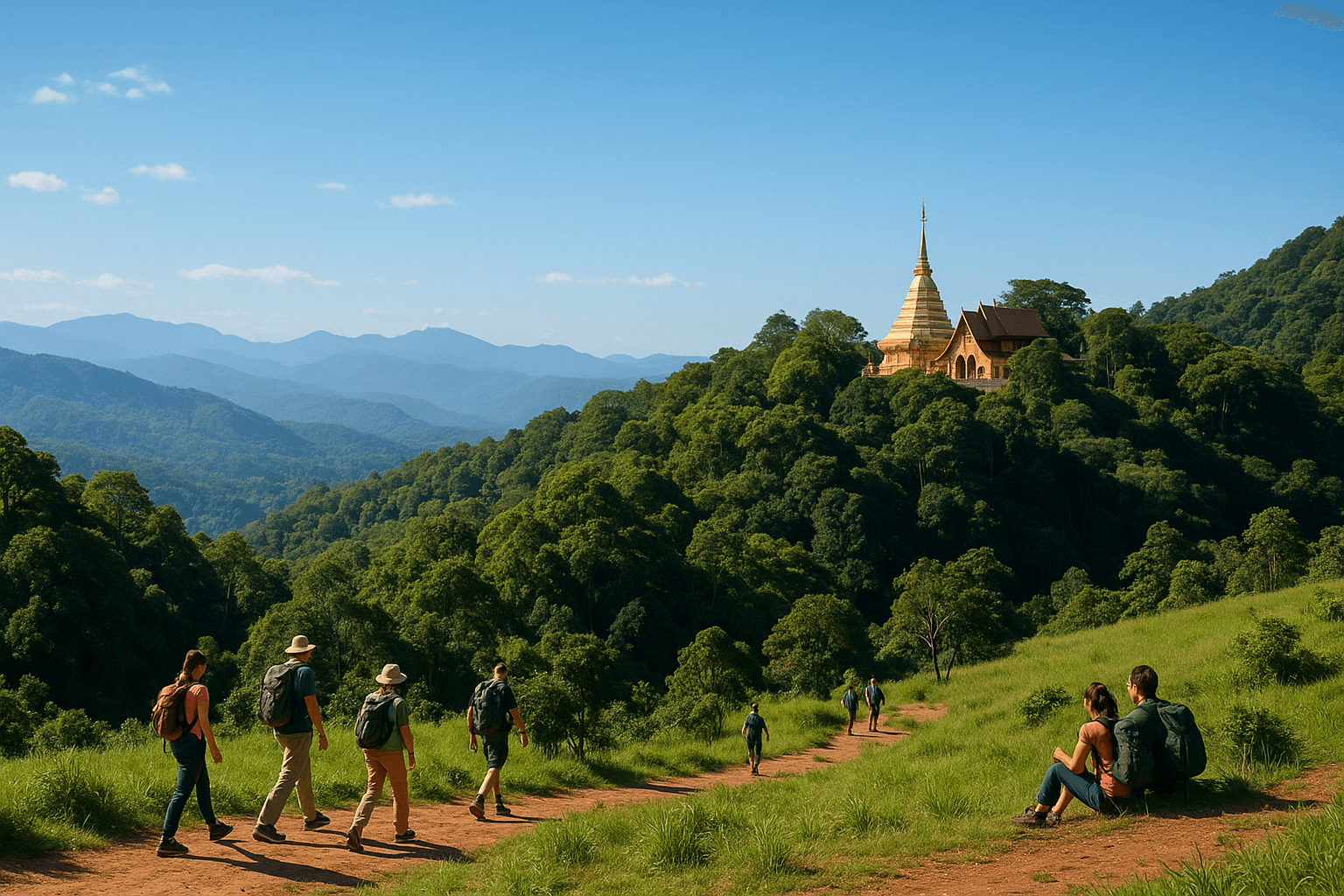
March through early May is Chiang Mai's hot season, and overlapping it from late February through April is the burning season, the regional air-quality crisis caused by agricultural burning of rice stubble and maize debris across Northern Thailand, Myanmar, and Laos. Daytime temperatures climb to 35-40°C in April (the hottest month), nights stay warm at 20-24°C, and PM2.5 routinely sits at 150-300 µg/m³ on bad days, occasionally spiking above 500. March is statistically the worst month for air; April is the hottest with continuing haze.
The riding implication is severe. Visibility on the upper Route 1004 (Doi Suthep climb) drops to 2-3 km on average burning-season days; the panoramic view from the temple-courtyard balcony disappears into white-grey. The Mon Cham viewpoint at 1,300 m on the day-trip warm-up loop from Chiang Mai loses its valley-floor backdrop completely. Doi Inthanon's 2,565 m summit panorama vanishes into haze for weeks at a time; the Doi Inthanon ride guide documents the seasonal closure pattern in detail. The 135 km Route 1095 climb to Pai loses its scenic justification in burning-season; the curves are still there, but the views aren't.
Songkran (April 13-15) is the cultural anchor that pulls travellers into hot season anyway. Thailand's New Year manifests in Chiang Mai as a continuous three-day water fight across the Old City moat: pickup-truck water cannons, hose-pipe street battles, ice-bucket ambushes at every gate. Inside the moat, almost every street is wet from sunrise to sunset. Outside the moat (Nimman, Riverside, Hang Dong), the festival is calmer but you'll still get hit at any major intersection.

Rainy season (June-October): the budget and lush-scenery window
Rainy season in Chiang Mai runs from June through October and is the cheapest, greenest, and most photogenic window of the year. Temperatures sit at 23-32°C (5-7°C cooler than April), humidity climbs to 75-85%, and August is statistically the wettest month. Crucially, the rain pattern is not all-day downpour; it is a 14:00-17:00 thunderstorm window followed by clear evenings. PM2.5 readings drop to 25-45 µg/m³ as the rains wash the haze out of the lower atmosphere, making the air the cleanest of the year.
Pricing rotates accordingly. A 125cc Honda Click drops back to the 150-200 THB off-peak floor at Tha Phae Gate and Moonmuang Road; dorm beds at Stamps Backpackers fall from 350-450 THB to 200-300 THB; mid-range boutique hotels in Nimman cut rates 20-40%. The Chiang Mai Budget Travel Guide breakdown lands a comfortable rainy-season day at 1,200-1,800 THB total versus the 2,500-3,500 THB cool-season equivalent. Tour operators (cooking classes, ethical elephant sanctuaries) discount 10-25% to fill rainy-season slots.
The Mae Sa Valley, Bua Tong Sticky Falls, Mae Ya Falls, and Wachirathan Falls all peak in June-September; the Route 1096 circuit runs through some of the greenest forest of the year. The riding plan that works is morning-bias: leave the Old City by 08:00, complete the headline ride by 13:00, lunch in Mae Rim or Hang Dong, return by 14:00 before the storm window. The 5-day Chiang Mai itinerary plans around exactly this pattern. The first 10 minutes of any storm are the most dangerous because dust and oil mix with water for a near-frictionless surface; if a downpour hits mid-ride, push the bike off the road and wait 10-15 minutes at a 7-Eleven before continuing.
The trade-offs are real. The Doi Inthanon summit at 2,565 m sits inside low cloud most rainy-season days; the boardwalk at the summit is often closed for safety. Route 1009 above 1,500 m can flood at the switchbacks. Route 1095 to Pai is rideable but slick in the famous 762 curves, and engine-braking matters more than horsepower; pay the 250-450 THB premium for a Honda PCX 160 or Yamaha NMAX over the cheaper 125cc Click. The Top 10 Waterfalls Near Chiang Mai post is the single best rainy-season route menu because the cascades are at peak flow.

Plan your trip by traveller profile
Different traveller profiles peak at different months. The fastest way to pick a window is to match the priority to the season: outdoor adventurers and first-time visitors should target November-February; festival hunters target November (Yi Peng) or April (Songkran, weather permitting); budget travellers and crowd-averse photographers target June-October; cooking-class and indoor-culture travellers can ignore the calendar entirely. The match maps cleanly onto the rental plan because a 125cc Honda Click works for every profile; what changes is the daily route mix and the kit.
Outdoor adventurers (trekking, scooter-touring, temple climbing) should book November to mid-February. Cool-season tarmac on the Mae Sa Valley waterfall route, dry switchbacks on the Doi Suthep climb, clear skies for Doi Inthanon panoramas, and 13-18°C dawn temperatures that turn the morning ride into the highlight of the day. The 5-day plan in the Ultimate Chiang Mai Travel Guide is purpose-built for this window. Festival hunters split between November (Yi Peng + Loy Krathong, the lantern release the photos are taken at) and April (Songkran, with the haze and CVT-water-damage caveats above). The Chiang Mai Flower Festival in early February is the third-tier festival pick.
Budget travellers and crowd-averse photographers should target June to October. Hostel beds at 200-300 THB, scooter rentals at the 150 THB off-peak floor, lush green Mae Sa Valley, and 25-40% off cooking-class and ethical-elephant-sanctuary tickets. The Chiang Mai Budget Travel Guide documents the rainy-season cost stack. Cooking-class and indoor-culture travellers (Old City temples, museum runs, Warorot Market, the Chiang Mai Street Food Guide walk) can visit in any month; pair the trip with rainy-season pricing for the best value.
The window to genuinely avoid is March 1 through April 20. Hot, hazy, expensive accommodation around Songkran, plus the highest CVT-seizure risk for rented scooters. The only legitimate reason to book this window is if Songkran itself is the goal and you accept the trade-offs.
Frequently Asked Questions
What is the absolute best month to visit Chiang Mai?
December and January are the best two months to visit Chiang Mai. Daytime temperatures sit at 25-28°C, nights drop to 13-18°C, PM2.5 stays under 50 µg/m³, and rainfall is statistically negligible. Both months deliver clear views from Wat Phra That Doi Suthep (1,073 m) and Doi Inthanon (2,565 m), and dry tarmac on the Samoeng Loop and Route 1095 to Pai.
Should I cancel my Chiang Mai trip during burning season?
If you have asthma, COPD, or any respiratory condition, yes; rebook to May, October, or November. For healthy travellers, March-April is rideable with an N95-grade mask, indoor cooking-class days when AQI exceeds 150, and a route swap from the Doi Inthanon summit (haze-obscured) to lower-elevation rides like the Old City temples. Monitor real-time AQI daily on the AirVisual app; treat any reading above 150 µg/m³ as an indoor day.
Is Chiang Mai worth visiting during the rainy season?
Yes; June-October is the cheapest and greenest window. Hostel beds drop to 200-300 THB/night, the Honda Click 125 rents at the 150-200 THB off-peak floor, and the Mae Sa Valley, Bua Tong Sticky Falls, and Wachirathan Falls all run at peak flow. The rain pattern is a 14:00-17:00 thunderstorm window, not all-day downpour. Plan morning-bias rides (08:00 departure, 13:00 return) and the 5-day itinerary still works.
How hot does Chiang Mai actually get in April?
Chiang Mai's hottest month is April, with daytime temperatures of 35-40°C and occasional spikes above 42°C in the afternoon. Nights stay warm at 22-26°C. The combination of heat and burning-season haze makes April the most physically demanding month of the year for outdoor activity; ride at sunrise (06:00-09:00) or after sunset, and skip the headline mountain rides until the post-Songkran rains arrive in early-to-mid May.
When are the major Chiang Mai festivals in 2026?
Yi Peng + Loy Krathong land on the November 24-25, 2026 full moon (the lantern festival; book accommodation 2-3 months ahead). Songkran is April 13-15, 2026 (Thai New Year water festival; CVT-damage risk to rented scooters). The Chiang Mai Flower Festival runs the first weekend of February (first weekend of February 2026: 6-8 February). Chinese New Year 2026 is February 17. Festival dates shift annually because they follow lunar or astrological calendars; confirm specific dates 2-3 months out.
Does the rental rate change between cool season and rainy season?
The canonical 150-300 THB/day range for a 125cc Honda Click holds in every month, but the demand-driven floor and ceiling shift. November-February peak demand pushes rates to the 250-300 THB ceiling at Tha Phae Gate, Moonmuang Road, and Nimman shops, with some maxi-scooter Honda PCX 160 / Yamaha NMAX inventory selling out 5-7 days ahead. June-October off-peak demand drops the same Click to the 150-200 THB floor. The full pricing breakdown sits in the Chiang Mai motorbike rental guide.
What should I pack for cool-season Chiang Mai if I'm renting a scooter?
Pack layers. Daytime is warm (25-30°C, T-shirt and shorts), but the Doi Suthep climb at dawn (15-18°C at 1,073 m elevation) and the Doi Inthanon summit (5-12°C at 2,565 m, 0-5°C on January cold fronts) demand a fleece or light jacket. Add closed-toe shoes for waterfall scrambles, a folding rain shell for the rare cool-season shower, sunglasses for the open-helmet ride, and a buff or thin scarf to filter dust. Riding gloves cut hand-fatigue on the Samoeng Loop's sustained pace.
Plan your seasonal Chiang Mai ride
The right month for a Chiang Mai trip changes the kit, the bookings lead-time, and the daily route mix; the rental contract itself stays simple. Rent a 150-300 THB Honda Click 125 from any Tha Phae Gate or Nimman shop via Byklo, pair it with a fleece in November-February cool season, an N95 mask in March-April burning season, or a folding rain shell in June-October monsoon, and the same scooter covers the Wat Phra That Doi Suthep climb (16 km on Route 1004), the day-trip warm-up loop from Chiang Mai (100 km), and the full 5-day Chiang Mai itinerary. Book 7-10 days ahead for Yi Peng and Songkran peaks, ride mornings in monsoon, and rebook to November or May if any traveller in your group has respiratory issues.