The complete motorbike rental checklist Thailand riders need in 2026 covers four phases in roughly 12 minutes: documents (passport + home-country motorbike license + IDP with the "A" endorsement), deposit terms (1,000-2,000 THB cash, never the original passport), a 12-point bike inspection (brakes, tires, lights, mirrors, fuel, oil, chain, VIN, helmets, keys, horn, suspension), and a 4K video walkaround logging every existing scratch. Daily rates run 150-350 THB across Bangkok, Chiang Mai, Phuket, and Krabi for a 125cc Honda Click. Skip any phase and you fund the scratch-scam dispute on return.
Key Takeaways
- Inspection time: 12 mechanical points in 5 minutes plus a 2-3 minute 4K video walkaround. Allow 12 minutes total before signing.
- Daily rates: 150-350 THB for a 125cc Honda Click in 2026; 250-450 THB for a Yamaha NMAX or Honda PCX 160.
- Cash deposit: 1,000-2,000 THB cash plus a passport copy. Never deposit the original passport; the Royal Thai Embassy treats it as government property.
- License requirement: home-country motorbike license plus an International Driving Permit with the "A" (motorcycle) endorsement, applied for at home before the flight.
- Helmet law: mandatory for both rider and pillion under Thai Department of Land Transport rules. Police checkpoint fines run 500-1,000 THB on the spot for no-helmet and no-IDP.
- Fuel norm: same-to-same or full-to-full. Always photograph the fuel gauge at handover and again at return.
What documents do you actually need before the keys change hands?
A legal Thai motorbike rental requires three documents on your person and one in the shop's hands. On your person: a valid home-country motorbike license, an International Driving Permit with the "A" (motorcycle) endorsement, and your passport. In the shop's hands: a clear passport copy plus a 1,000-2,000 THB cash deposit. Your original passport stays in your money belt, not in the shop's drawer.
The single most-skipped document among foreign riders is the IDP. Apply through your home country's automobile association before you fly, because the Royal Thai Embassy explicitly cannot issue one in-country. AAA in the United States ($20 + two passport photos), the UK Post Office (£5.50, over-the-counter), CAA in Canada (CAD $25), and AA in Australia (AUD $42) all issue same-day or next-day. The Thai Driving License Requirements post covers the full document checklist; the Thai Motorbike License Guide covers the long-term Thai-license pathway for non-immigrant residents.
The other gotcha: a car-only IDP. UK, EU, and Australian licenses default to a Category B (car) IDP unless you specifically request the motorcycle endorsement at the application desk. Royal Thai Police at checkpoints in Phuket's Bangla Road, Pattaya's Beach Road, Chiang Mai's Old City moat, and Bangkok's Asoke and Thong Lor BTS stations check the IDP class explicitly. A car-only IDP at a checkpoint is the same as no license: 500-1,000 THB on-the-spot fine plus a voided travel-insurance claim if you crash.
How does the deposit work, and why does the passport rule matter?
Thai rental deposits in 2026 run 1,000-10,000 THB cash depending on the bike's value. A standard Honda Click 125 deposits at 1,000-2,000 THB; a Yamaha NMAX 155 or Honda PCX 160 sits at 2,000-3,000 THB; a Kawasaki Versys 650 or Honda CB500X sits at 5,000-10,000 THB. The deposit returns in full at handback if the bike is returned in the condition documented on your video walkaround. Reputable shops accept a passport copy in addition to the cash; they do not require the original passport.
The passport-hostage scam is the single most common dispute pattern reported on Beach Road in Pattaya, Bangla Road in Phuket, Walking Street in Pai, and the backpacker stretch of Khao San Road in Bangkok. The mechanism is simple: shop holds the original passport, "discovers" a scratch on return, demands 3,000-15,000 THB to release it, and the rider pays because they have a flight to catch and no other way to get to the airport without the passport. The Thailand Motorbike Rental Scams Guide walks through the five named scam patterns; the No Passport Deposit Rental Guide covers the legal framing and the script for pushing back at the counter.
The fix is a one-line rule: cash deposit plus passport copy, original passport stays with you. If a shop insists on the original, walk to the next shop. There are 50+ rental shops on Beach Road in Pattaya alone and another 30+ along Bangla Road in Phuket; supply is not the problem. Verified marketplaces like the ones aggregated at Byklo.rent enforce the cash-deposit rule at the partner-shop level so the conversation never happens.
What goes into the 5-minute pre-ride inspection?
The 12-point pre-ride inspection on a Thai rental scooter takes 5 minutes if you know the order and 15 if you don't. Run it before you sign the rental agreement, not after. Once you've signed and ridden away, every defect becomes "your" defect at handback. The order below works left-to-right around the bike, then the controls, then the underside, so you don't double-check or skip a panel.
Start at the front and walk clockwise:
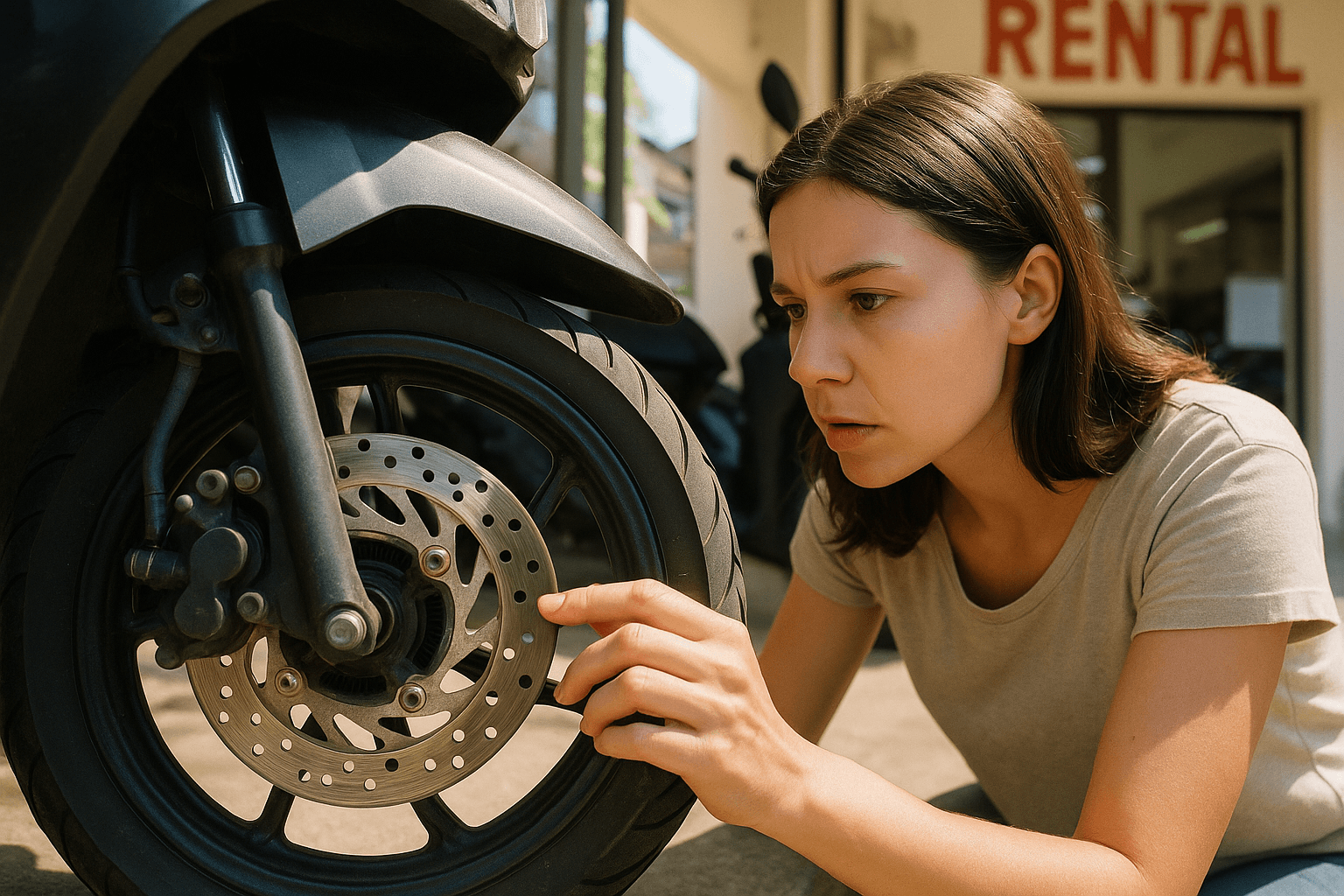
- Front tire: tread depth visible (not flush with the wear bar), no sidewall cracks or bulges, valve cap present. Press the tire with your thumb; firm, not squishy.
- Front brake disc and pads: visible groove pattern, no extreme wear edge, no rust patches. The disc should be silver, not brown.
- Headlight: low-beam and high-beam both fire when you toggle. Lens cover not cracked.
- Right turn signals (front and rear): both flash when you toggle. Lens covers intact.
- Right mirror: present, firm in its mount, adjustable without a wobble.
- Right-hand controls: throttle returns smoothly to idle, front brake lever has firm bite (not spongy, not pulled to the bar).
- Rear tire and brake: tread, sidewalls, brake response, brake-light fires when you press the rear lever (left side on a scooter, right side on a manual bike).
- Left turn signals: both flash on toggle.
- Left mirror: present, firm, adjustable.
- Left-hand controls: rear brake lever firm bite, horn loud.
- Underside: no fresh oil drips on the floor under the bike, no damp patches around the engine cases or fork seals, exhaust mounted firmly.
- VIN match: the chassis VIN stamped on the frame matches the VIN on the registration paper the shop hands you. The Por.Ror.Bor insurance certificate must list the same VIN.
The two most-skipped items are #6 (front-brake bite) and #12 (VIN match). A spongy front brake at handover gets re-charged to you on return as your problem, not the shop's. A VIN that doesn't match means the bike isn't legally insured under the Por.Ror.Bor paper you've been handed; you're personally liable for any third-party injuries. Both checks take 30 seconds. The Motorbike Rental Problems Thailand Guide covers what to do when an inspection-stage red flag escalates into a dispute.
How do you document the bike so the shop can't invent a scratch later?
Your smartphone is the single most valuable piece of inspection equipment. Open the camera, switch to 4K video, and walk slowly around the bike narrating what you see in close-up. Film every panel, every fairing, every plastic, the underside of the engine and exhaust, the wheels close enough to read the tire wear bar, both mirrors, the fuel gauge with the engine on, and the odometer. Each existing scratch gets a verbal call-out: "scratch 3 cm long on the right fairing, here's the close-up; scuff on the left mirror housing, here's the close-up." Total filming time: 2-3 minutes.
The video proves three things at handback time: the date and time of the rental's start, every existing scratch, and the fuel and odometer baseline. Save the video to two places before you ride away: phone gallery and a cloud backup (Google Drive, iCloud, or Dropbox). The shop cannot dispute video evidence with a timestamp. The Thailand Motorbike Rental Scams Guide names the scratch-fee scam as one of the five most common patterns; the video is the counter.
The damage diagram on the rental contract is the second piece of paperwork. Most Thai shops include a printed bike outline (front, rear, both sides) where the handover agent marks every existing defect with an X or circle. Insist on this step before signing. Both you and the agent should initial each marked defect. If the contract doesn't include a damage diagram, sketch one on the back of the contract and have the agent initial it. Take a clear photo of every page of the signed contract before you leave the shop, plus the damage diagram, plus the Por.Ror.Bor insurance paper, plus the bike registration paper.
The contract itself is worth a careful read. Three clauses commonly catch out tourists:
- Mileage limit: many agreements cap daily kilometers at 200, with overage charged at 5-10 THB per km. A Bangkok-to-Pattaya day-trip (147 km each way) blows through this; ask for the limit to be raised or removed before signing.
- Geographic scope: some Bangkok shops restrict the bike to the metro area; some Phuket shops restrict it to the island. Verify the route you plan to ride is permitted.
- Insurance excess: the deductible on a comprehensive cover. Common Thai rental excesses run 8,000-30,000 THB. The Thailand Motorbike Insurance Guide walks through the four insurance tiers and what each one excludes.
What does the test ride and rental contract red-flag check look like?
A 2-3 minute test ride around the block is the next checkpoint. Politely ask the rental agent for a short ride within sight of the shop. Most reputable Bangkok, Chiang Mai, Phuket, and Krabi rental shops allow this; refusal is itself a red flag. During the ride, focus on three behaviors a stationary inspection cannot reveal: does the bike track straight when you briefly loosen your grip on the handlebars; does the throttle respond smoothly or surge; do both brakes pull the bike straight, not to one side. Also confirm the speedometer reads, the fuel gauge tracks, and the bike starts cleanly hot and cold.
The contract red flags worth flagging at this point are paperwork-level: a contract without a damage diagram, a contract written only in Thai with no English copy on offer, a "verbal" insurance promise without a Por.Ror.Bor certificate naming the bike's VIN, or a deposit demand for the original passport (already covered above). Any of these warrants walking away. The Motorbike Rental Problems Thailand Guide covers the legal recourse if you signed before catching one of these and now need to escalate.
The single biggest non-paperwork red flag is a sub-100 THB/day rate. Daily rates below 100 THB in Thailand are a quality red flag, not a deal. Thai law's compulsory Por.Ror.Bor third-party insurance does not cover damage to the rental bike itself, so the shop's incentive to maintain a 100 THB/day bike is roughly zero. The most common failure modes on rock-bottom rentals: bald tires that lose traction in the first rainfall, brake pads worn past the wear indicator, and engines that stall at idle. The Thailand Scooter Rental Cost post covers the canonical 9-city pricing; anything below the city's lower bound deserves extra scrutiny.
For city-specific shop selection, the Best Motorbike Rental Bangkok, Best Scooter Rental Phuket, Best Motorbike Rental Koh Lanta, and How to Rent Motorbike Bangkok guides walk through which verified shops in each city pass the deposit-rule and contract-clarity bar. The Best Motorbike for Beginners Thailand post covers which Honda Click, Yamaha Filano, or PCX 160 model fits a first-time rider.
What rules apply once you ride away from the shop?
Riding obligations under Thai law in 2026 are straightforward and non-negotiable. The Thai Department of Land Transport requires a helmet for both rider and pillion at all times, the IDP and home-country motorbike license carried on the rider, the Por.Ror.Bor insurance paper and registration carried on the bike, and the 0.05% blood-alcohol limit (lower than most home countries; one beer puts most riders over the line). Police checkpoints in Bangkok's Asoke and Thong Lor BTS zones, Phuket's Bangla Road, Pattaya's Beach Road, and Chiang Mai's Old City moat run multiple times daily; fines for no-helmet and no-IDP are 500-1,000 THB each, payable on the spot.
Fuel norms are the second category. Most Thai rental shops use a "same-to-same" fuel policy: return the bike with the fuel level it had at handover. Some use "full-to-full". Always photograph the fuel gauge at handover and confirm the policy in writing. Gasohol 95 (the green pump) is the standard fuel; some older bikes accept 91, but only if specifically approved by the shop. A 125cc Honda Click takes 100-150 THB to fill from empty at 2026 pump prices. In rural Pai, Mae Hong Son, or Chiang Rai, watch for roadside whiskey-bottle gasoline; it costs 10-20% more and works in a pinch when the next station is 20 km away.
The return process is a five-step mirror of the handover:
- Refuel to the agreed-upon level at a Bangchak, PTT, or Esso station; keep the receipt.
- Re-watch the handover video so you remember which scratches were already there.
- Walk through the bike with the rental agent, referencing your handover video if a "new" scratch appears.
- Photograph the fuel gauge again at the same angle as the handover photo.
- Get written confirmation that the bike has been returned in acceptable condition and your full deposit refunded before you leave the premises.
Don't leave the shop until the deposit is back in your hand or confirmed transferred. Once you walk out without that confirmation, recovery is much harder. For deeper safety guidance, the Top 10 Motorbike Safety Tips for Thailand and Thailand Motorbike Safety New Year posts cover the helmet law, monsoon riding, and the Songkran-and-New-Year accident spike in detail.
Frequently Asked Questions
How long does the full Thailand motorbike rental checklist take?
Plan for 12-15 minutes total before you ride away: 5 minutes for the 12-point mechanical inspection, 2-3 minutes for the 4K video walkaround, 2-3 minutes to read and sign the rental agreement (with the damage diagram initialled by both parties), and 2-3 minutes for a short test ride. Skipping any phase shifts the cost of a dispute back to you on return. Most reputable shops allocate this time as standard.
Do I need an International Driving Permit to rent a motorbike in Thailand?
Yes. Thai law requires both a valid motorcycle license from your home country and an International Driving Permit with the "A" (motorcycle) endorsement. While many street shops do not check, riding without proper documentation can invalidate your travel insurance and result in 500-1,000 THB fines at police checkpoints. Apply for the IDP through AAA, CAA, the UK Post Office, or AA before flying; it cannot be issued inside Thailand.
Should I leave my passport as a deposit?
No. Never leave the original passport with a Thai rental shop. Reputable shops accept a 1,000-2,000 THB cash deposit plus a high-resolution passport copy. The passport-hostage scam is the single most common dispute pattern reported on Beach Road in Pattaya, Bangla Road in Phuket, and Khao San Road in Bangkok. The Royal Thai Embassy treats your passport as government property; once a shop holds it, they have leverage to invent any scratch fee on return.
How much cash deposit should I expect to pay?
Cash deposits typically run 1,000-2,000 THB for a 125cc Honda Click, 2,000-3,000 THB for a Yamaha NMAX or Honda PCX 160, and 5,000-10,000 THB for a 500cc+ big bike. The deposit returns in full at handback if the bike is in the same condition documented on your handover video. Newer-model bikes naturally require higher deposits. Confirm the deposit amount and refund mechanism in writing before paying.
What's the most important thing to do before taking possession of a rental motorbike?
Record a 4K video walkaround of the entire bike before signing or paying. Walk slowly around the bike, narrating every existing scratch, dent, or mark in close-up; film the odometer, fuel gauge, both mirrors, all four lights, and the underside of the engine. Save the video to two places (phone gallery plus cloud backup) before you ride away. Video evidence with a timestamp wins every scratch-fee dispute.
Is comprehensive insurance worth the extra 50-100 THB per day?
Yes for most riders. Compulsory Por.Ror.Bor insurance covers third-party injuries only; damage to the rental bike, theft, and your own injuries are separate. Without comprehensive cover, a serious crash can cost 100,000-300,000 THB in hospital fees plus the bike's replacement (typically 80,000-150,000 THB for a "totalled" Honda Click). The Thailand Motorbike Insurance Guide walks through the four insurance tiers and what each one excludes.
What should I do if I'm stopped at a Thai police checkpoint while riding a rental?
Stay calm and present three documents: your home-country motorbike license, the International Driving Permit with the "A" endorsement, and your passport. The bike's Por.Ror.Bor insurance paper and registration (carried in the bike's under-seat compartment) are checked separately. Helmet on, both feet on the ground, polite English is fine. Fines for no-IDP, no-helmet, or no-license run 500-1,000 THB each, payable on the spot.
Plan your rental and ride from a verified shop
A complete Thailand motorbike rental checklist is not optional theatre; it is the difference between a 250 THB/day ride and a 5,000 THB scratch-fee dispute on return. Twelve minutes of inspection plus a 4K video plus a cash-deposit-only rule eliminates almost every common rental scam. For city-specific shop picks, the Best Motorbike Rental Bangkok, Best Scooter Rental Phuket, and Motorbike Rental Thailand Guide cover verified shops by city. Lock in a 125cc Honda Click at 150-300 THB/day from a shop that accepts a cash deposit and a passport copy at Byklo.rent, with free hotel delivery in 15 cities including Bangkok, Chiang Mai, Phuket, Krabi, and Pattaya.