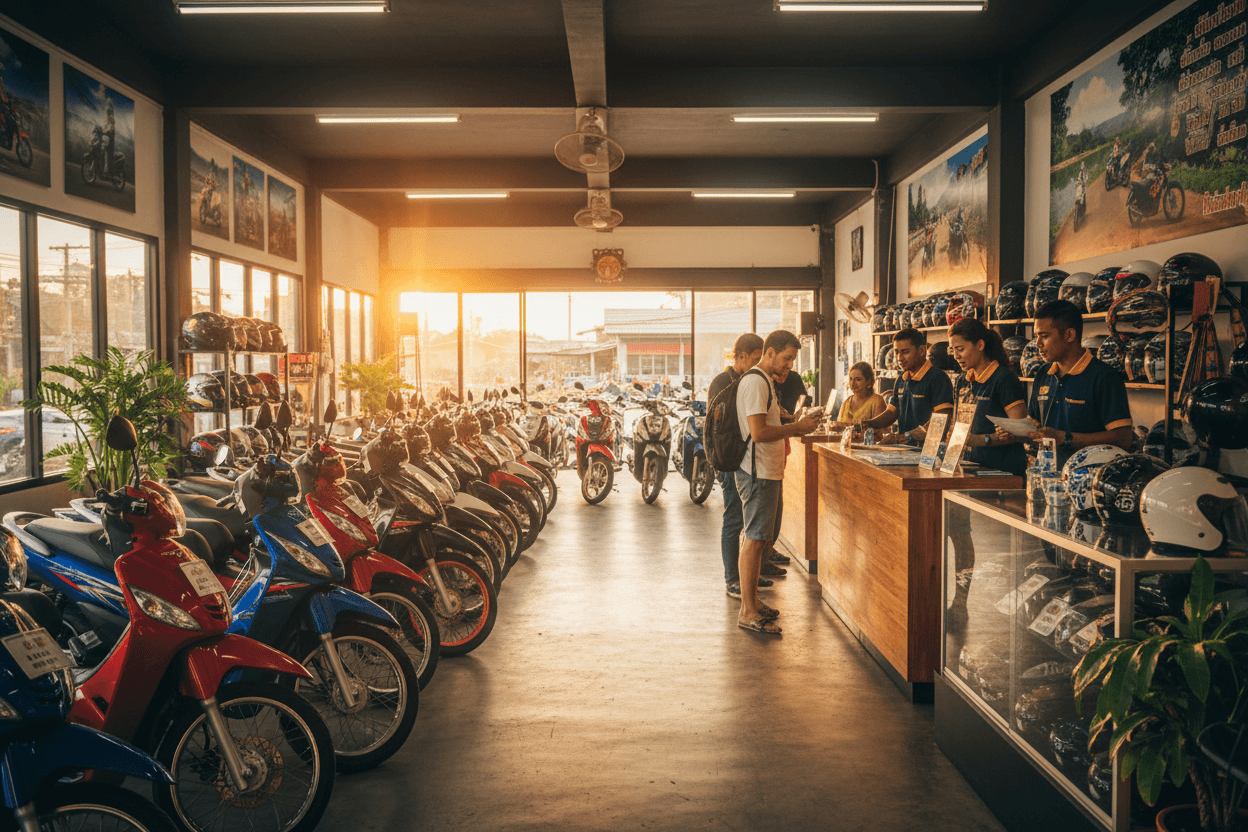
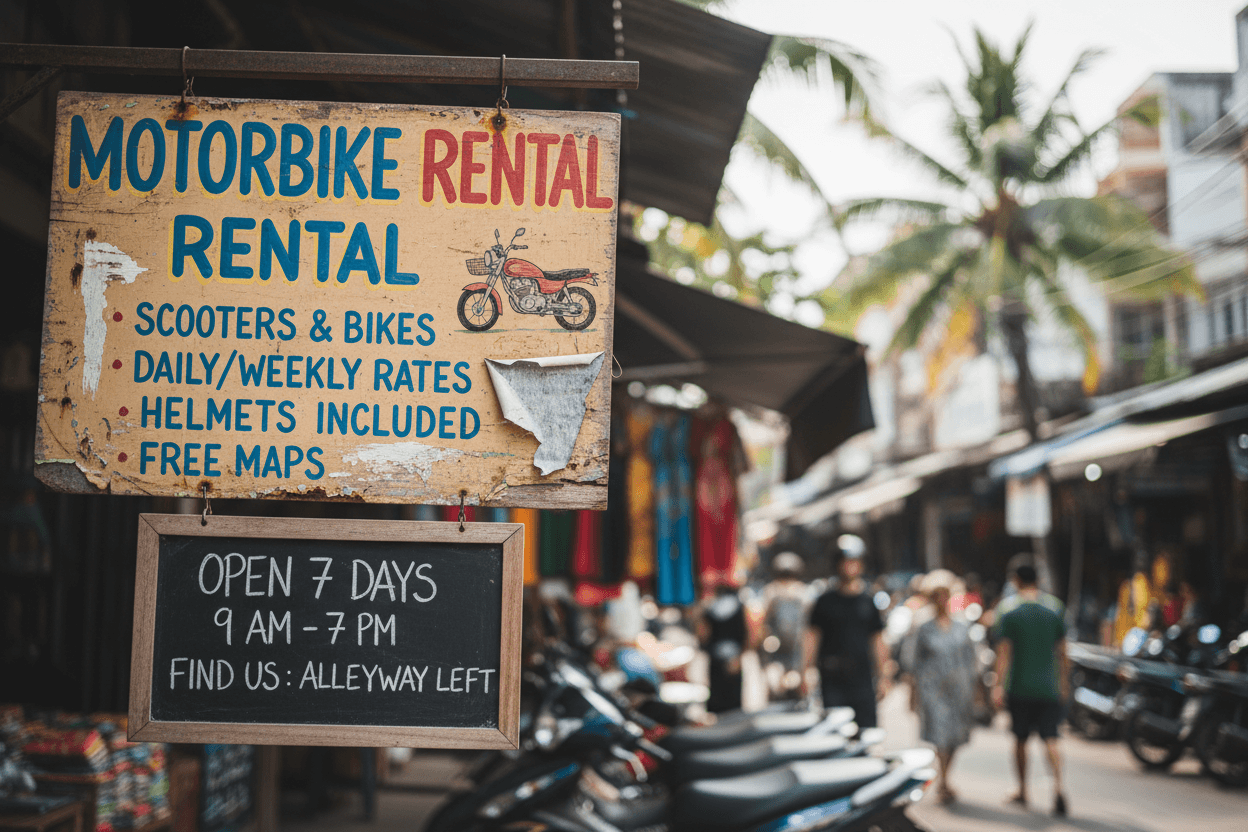
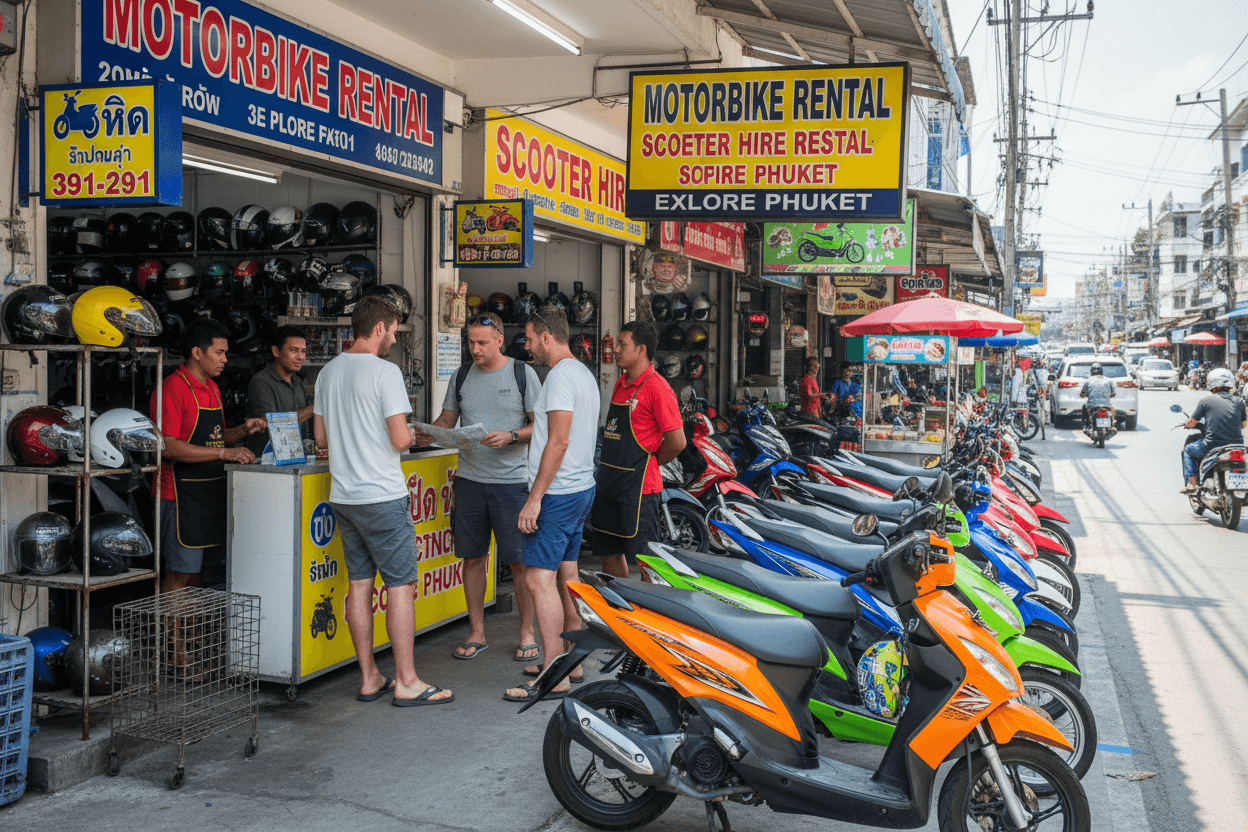
Motorbike safety Thailand tips for 2026 distill to four enforced rules and three practiced habits, because the country's road-fatality rate ranks among the world's highest: the Thai Health Promotion Foundation and World Health Organization put motorbike riders at roughly 74% of all road deaths, with more than 14,000 motorcyclist fatalities logged in 2024. The non-negotiable safety tips are: helmet on for both rider and pillion (Land Traffic Act, 500-1,000 THB on-the-spot fine), blood-alcohol under 50 mg/100 ml (0.05% BAC), a valid home-country motorcycle licence plus a Geneva-Convention IDP carrying the "A" motorcycle endorsement, and Tourist Police 1155 / medical 1669 saved on speed-dial before you turn the key.
Key Takeaways
- Helmet law: mandatory for both rider and pillion under the Land Traffic Act. On-the-spot fines run 500-1,000 THB per head and apply at every Royal Thai Police checkpoint, including the Bangla Road, Beach Road, and Tha Phae Gate stops.
- Blood-alcohol limit: 50 mg/100 ml (0.05% BAC), tested by breathalyzer. One Singha is enough to fail on a 70 kg adult; over the limit means 5,000-20,000 THB plus a mandatory court appearance and travel-insurance void.
- Emergency numbers: Tourist Police 1155 (English-speaking), medical 1669, general police 191, fire 199. Save all four before you ride and pin Bangkok Hospital, Bangkok Hospital Phuket, or Chiang Mai Ram on Google Maps for the trauma route.
- Two windows of peak danger: the December "Seven Dangerous Days" (Dec 29 to Jan 4) and Songkran's water-festival days (April 13-15), when motorbike share of crashes climbs to roughly 82% and police checkpoints run 24 hours.
- Highway 4 and Route 1095: two of the highest-fatality riding corridors. Highway 4 connects Phuket and Krabi to the southern peninsula with heavy truck traffic; Route 1095 carries 762 of the Mae Hong Son Loop's 1,864 curves and accounts for a disproportionate share of foreigner crashes.
- Monsoon riding: roads can flip from dry to flash-flooded inside 10 minutes from May to October. Halve your speed, double your following distance, and avoid the first 10 minutes after the rain starts (oil rises off the surface).
How dangerous is riding a motorbike in Thailand, really?
Riding a motorbike in Thailand carries roughly 10x the per-kilometre fatality risk of riding in the United Kingdom or Australia, and motorcyclists make up about 74% of all road deaths in Thailand according to Thai Department of Disease Control data referenced by the World Health Organization country report. The 2024 toll was over 14,000 dead riders, on top of tens of thousands of severe injuries; Thai Health Promotion Foundation tracks the daily counts during peak campaigns at thaihealth.or.th.
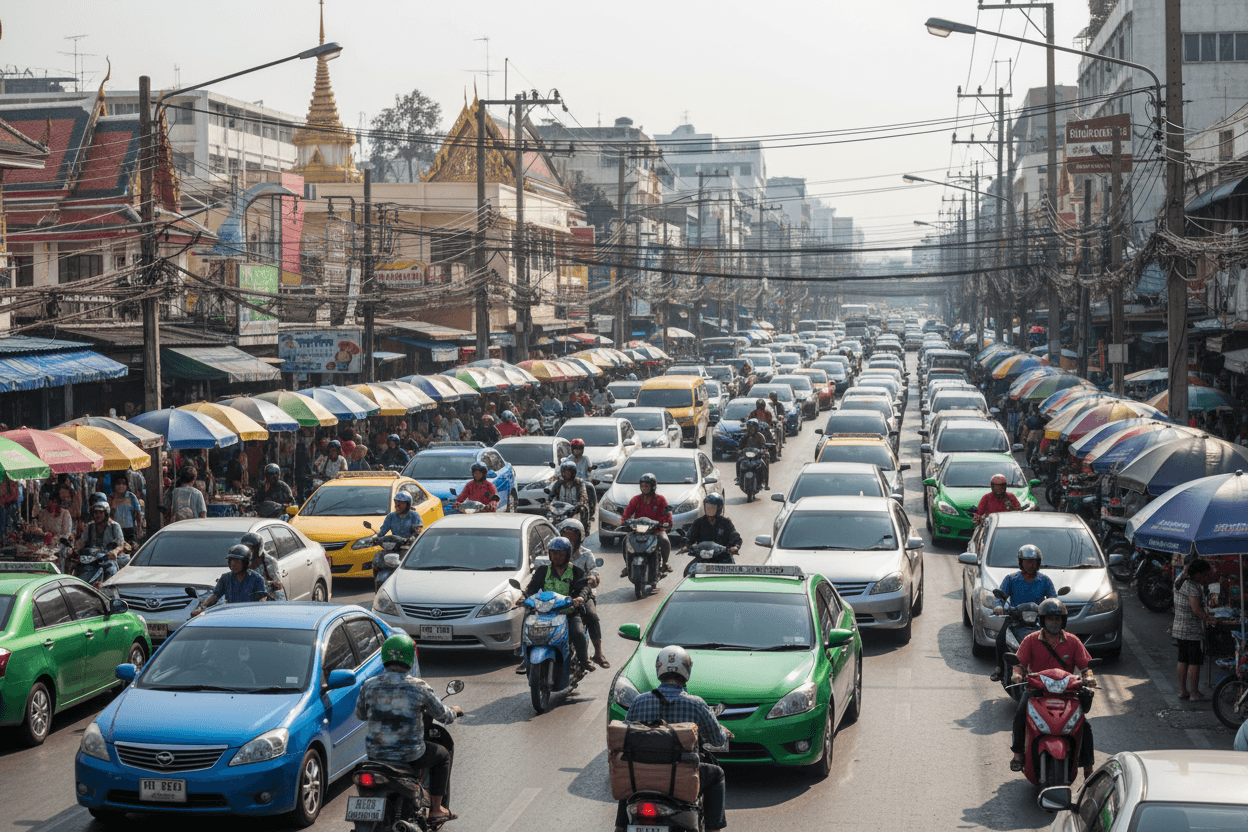
The risk is not evenly distributed. Three demographics carry it disproportionately: tourists in their first week riding on left-hand traffic, Thai workers commuting on rural roads at dawn or dusk, and any rider during the two annual road-safety campaigns. The fatal-crash mix is dominated by intoxicated riding (alcohol involvement in roughly 35-40% of motorbike fatalities per Thai Health Promotion Foundation), helmetless impacts, and rear-ended scooters during stop-go traffic in Bangkok, Pattaya, and Phuket. Country-side curves on Route 1095 and Highway 4 add a fourth pattern: solo single-vehicle losses where the rider underestimated the corner.
What that means for a foreign rider in 2026 is concrete. The bike itself is fine; Honda Clicks, Yamaha NMAXs, and PCX 160s in vetted fleets are well-maintained 110-160cc machines that European licence-holders ride at home without trouble. The risk is in the surrounding traffic, the road surface, the season, and the gear. Each section below addresses one of those four dimensions with the rule, the enforcement reality, and the specific habit that drops your exposure.
What does Thailand's helmet law actually require?
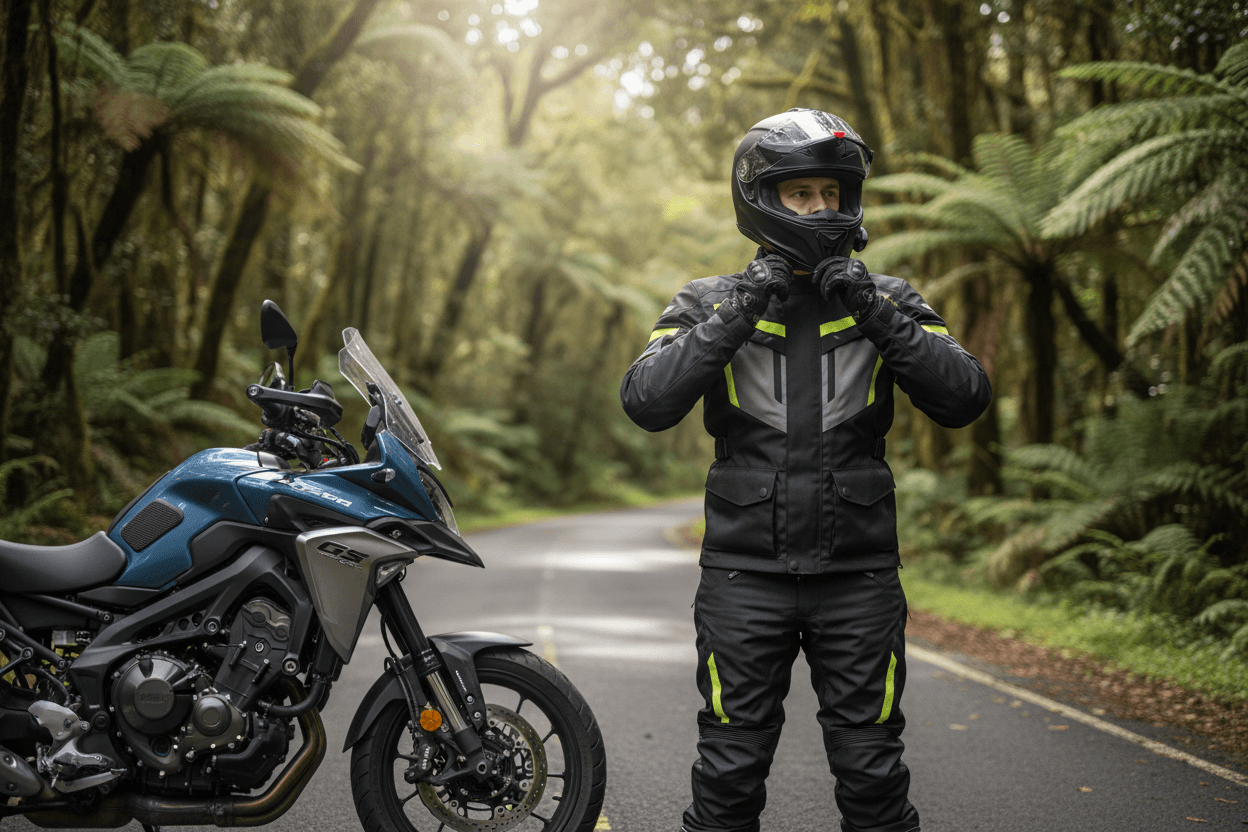
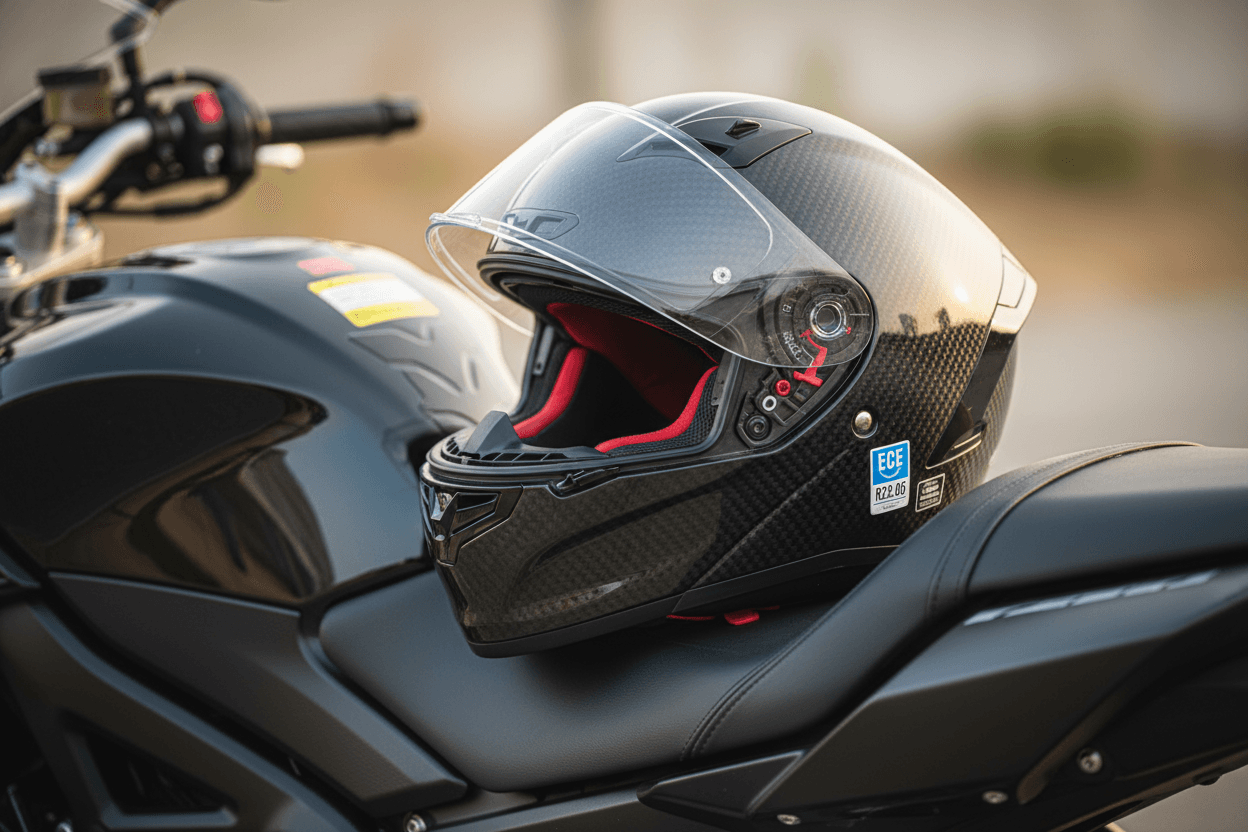
Thailand's Land Traffic Act (Section 122) makes a certified helmet mandatory for both the rider and any pillion passenger on every motorbike on every public road, with no carve-out by engine size, by trip length, by hire status, or by the rider's nationality. The helmet must have a chin strap fastened (not perched unfastened on the head) and must carry a recognised certification: DOT (US Department of Transportation), ECE 22.05/22.06 (Economic Commission for Europe), Snell, or the Thai Industrial Standards Institute (TISI) mark. Royal Thai Police enforce on the spot at marked checkpoints with fines of 500-1,000 THB per head; both the rider's fine and the pillion's fine compound on a single stop.
Enforcement intensity varies by location. Bangla Road in Phuket, Beach Road in Pattaya, the Tha Phae Gate moat in Chiang Mai's Old City, and the Sukhumvit/Asoke and Silom corridors in Bangkok run helmet sweeps daily; fines are paid via a printed slip at the police station within 7 days, or on the spot in cash with a receipt during peak campaigns. Rural provincial roads see far less enforcement, but the legal exposure does not change. The travel-insurance impact is what makes a no-helmet crash catastrophic: every major UK, EU, US, and Australian travel-insurance policy voids cover for a motorbike claim if the helmet wasn't on, regardless of whether the helmet would have prevented the injury. The Royal Thai Embassy publishes travel-document and rider safety guidance for foreign visitors.
The certification distinction matters in 2026 because rental shops still hand out unbranded "show helmets" with no liner, no DOT/ECE mark, and zero impact protection. They satisfy the police-check (any helmet on a strap is enough at a checkpoint) but fail the medical test on a real impact. The minimum acceptable rental helmet has an ECE 22.05/06 or DOT sticker on the back, an EPS foam liner thicker than 25 mm, and no shell cracks. If the rental shop can't provide that, buy a 1,500-3,000 THB ECE-certified helmet at any Bangkok 7-Eleven-adjacent moto shop or a Tesco Lotus and use it for the trip; carry-on luggage takes a half-shell helmet without trouble on the way home.
Which riding habits prevent the most accidents in Thailand?
Five practiced habits drop a foreign rider's crash risk in Thailand by roughly 70-80% according to crash-data work cited by the Thai Health Promotion Foundation: ride sober (zero alcohol if you intend to ride that day), ride with the headlight on day and night, hold a 3-second following distance from the vehicle ahead, scan 12-15 seconds ahead for hazards, and ride within one mental "click" below your skill ceiling. None of these are exotic. All five are missing from the average tourist's first ride out of Patong, Pai, or Ao Nang.
The defensive frame that makes them stick is to ride as if you're invisible to other drivers, because in Thai mixed-traffic conditions you effectively are. Sukhumvit Road traffic in Bangkok, the Patong-Karon coastal stretch in Phuket, and the Soi Buakhao crossings in Pattaya all feature drivers changing lanes without indicators, taxis stopping mid-traffic for fares, and pedestrians crossing between gaps in moving cars. A scooter slotted into any of those flows must be the rider doing the seeing, not the one being seen. The thai motorbike license guide covers what the DLT theory test asks about right-of-way; the thailand motorbike rental scams guide covers the rental-shop dimension; and the on-road habits below cover the rest.
The single biggest behavior-level win is alcohol abstinence on riding days. Thailand's 50 mg/100 ml limit (0.05% BAC) is identical to the UK and Germany and stricter than the US; one large Singha bottle (about 24 g of ethanol) lifts a 70 kg adult past it inside an hour, two definitely. Royal Thai Police breath-test at every checkpoint during the December and Songkran campaigns and at random checkpoints all year. A failed test means immediate detention, a 5,000-20,000 THB fine, mandatory court appearance, and travel-insurance void on any subsequent crash. The numbers also compound at the personal level: alcohol involvement is implicated in roughly 35-40% of fatal motorbike crashes per Thai Health Promotion Foundation tracking. The simplest possible rule, and the one every Byklo partner shop endorses, is to not ride and drink in the same calendar day.
How does Thailand's monsoon season change the risk profile?
Thailand's southwest monsoon (May to October) produces sudden cloudbursts that flip dry asphalt to standing water inside 10 minutes, with peak intensity in September and October when single-day totals routinely exceed 100 mm in Krabi, Phuket, and Koh Lanta. The first 10 minutes of any rain are the most dangerous: weeks of accumulated oil, diesel residue, and rubber dust rise off the asphalt and turn the surface into something close to ice. Crashes during this 10-minute window cluster at intersections, where the painted lane lines are also slick.
Three regional patterns matter. Phuket's Highway 4 and the Phuket-Krabi A road run alongside coastal slopes that wash sand and gravel onto the carriageway during heavy rain; coastal corners are where solo single-vehicle losses spike. Chiang Mai's mountain approaches (Doi Suthep, Doi Inthanon, Mae Hong Son Loop's Route 1095) develop landslide debris and sudden mud flows after heavy storms; the curve count is unforgiving on a wet road, with roughly 762 curves on the Pai-Mae Hong Son leg alone. Bangkok and Pattaya don't see landslides but see the deepest urban flooding, with feeder roads to Sukhumvit and Beach Road regularly under 30-50 cm of standing water in late September.
The riding adjustments that work in monsoon are mechanical and behavioural. Halve your normal cruising speed, double the following distance from 3 seconds to 6, and ride in the dry tracks left by car tires (the centre and edge of a lane are wettest). Cover the front brake; in 1-2 cm of standing water, hard front-braking on most rental tires loses traction instantly. Drop down a gear before any curve. Swap the cheap rain poncho for a real waterproof jacket if you'll be riding for more than 20 minutes; soaked-through riders tense up, and tense riders crash. The Royal Thai Embassy travel advisory and Wikipedia's Songkran entry cover the festival-season dimension separately.
What should you do at the scene of a motorbike accident?
The first 60 seconds at a Thai motorbike crash scene determine whether a survivable injury becomes a fatality, and the sequence is the same in Bangkok, Krabi, or rural Pai: get yourself and any pillion off the carriageway and onto the verge, dial 1669 for the medical ambulance, dial 1155 for Tourist Police if a foreign rider is involved, do not move anyone with suspected spinal or head injury unless a fire or further-impact risk forces it, and keep the helmet on the injured rider until paramedics arrive. The 1669 dispatcher speaks basic English in tourist provinces; the 1155 Tourist Police line speaks fluent English and dispatches an English-speaking officer to the scene. Save both before you ride.
The next 10-15 minutes are paperwork. Photograph the scene from four angles, the bikes from both sides, the helmets (worn and not), and any visible injury before bandaging. Get the contact details of two independent witnesses if possible; Thai accident-investigation procedure relies heavily on witness statements when CCTV is absent. Notify your rental shop within an hour; vetted Byklo.rent partner shops have a dispatch protocol for picking up the bike and connecting you with the partner-network insurance line. Notify your travel-insurance provider within their stated window (usually 24-48 hours) regardless of how minor the crash looks; underreported crashes get denied later if a hospital visit happens.
Hospital choice matters enormously in Thailand. Public hospitals are free or subsidised for Thai citizens but bill foreigners at uneven rates; private internationally-accredited hospitals (Bangkok Hospital, Bumrungrad in Bangkok, Bangkok Hospital Phuket, Chiang Mai Ram, Sikarin in Bang Na, Vejthani in Bangkok) handle motorbike trauma routinely, file directly with major UK, EU, US, and Australian travel-insurance carriers, and have English-speaking trauma teams. Save the nearest one to your accommodation as a Google Maps pin before you ride. The four-tier rental insurance ladder breakdown walks through each tier and how it handles a hospital admission.
Who do you call, and how do Thai police handle a foreign rider?
Thailand runs three parallel emergency numbers a foreign rider needs to know cold: 1669 for medical ambulance and rescue, 1155 for the English-speaking Tourist Police, and 191 for the general Royal Thai Police line. The 1669 dispatcher in tourist provinces will route an ambulance and bridge to a hospital with English-speaking ER staff if asked. The Tourist Police 1155 line is the single most useful contact for any rental dispute, scam encounter, or accident involving a foreigner; officers are bilingual and trained on tourist-bureaucracy. The general 191 line is fine for theft and fights but limited on English; default to 1155 first.
A real Royal Thai Police checkpoint and a fake-officer shakedown look different from the saddle, and the difference matters because a rider who pays the fake one can be hit by the real one a kilometre later. Real checkpoints sit at fixed pull-over zones with cones, multiple officers in full Royal Thai Police uniform with rank insignia, marked patrol vehicles, and a printed ticket book; legitimate fines are 500-1,000 THB per offence, written on a numbered slip, payable at the police station within 7 days. Fake stops are solo, mobile, half-uniformed (most often a tan shirt with no rank insignia), and demand cash on the spot for an invented offence with no paperwork. A polite request for the officer's rank, station, and printed ticket usually resolves it; offer to follow them to the station to pay there, and a real officer agrees while a fake one waves you on.
For accident response specifically, the protocol Royal Thai Police follow with a foreign rider is slower than home-country practice. Expect to wait 30-60 minutes for the crash report, longer outside major cities. The Tourist Police representative (called via 1155) often arrives separately and acts as your translator and advocate during questioning. Do not sign any statement that you cannot read in English; insist that 1155 send a translator before signing. The pattaya motorbike rental safety and scams guide covers the fake-checkpoint pattern in more detail, and the thailand motorbike safety new year post covers the December campaign window where checkpoints multiply.
Frequently Asked Questions
What are the emergency numbers in Thailand for a motorbike accident?
Three numbers cover almost every situation. 1669 is the medical ambulance and rescue line; 1155 is the English-speaking Tourist Police, the most useful single number for any foreign rider; and 191 is the general Royal Thai Police. Save all three, plus the nearest international hospital (Bangkok Hospital, Bangkok Hospital Phuket, or Chiang Mai Ram) before your first ride.
Is a Thai motorbike helmet from a 7-Eleven good enough?
Yes, for short trips, if the helmet has an ECE 22.05/22.06 or DOT sticker on the back. A 1,500-3,000 THB Tesco Lotus or roadside moto-shop helmet with a real certification beats a free unbranded "show helmet" from a Bangla Road street-rental shop on every measurable safety metric. The chin-strap and EPS-foam liner are what matter; the cosmetic shell does not.
What is the legal blood-alcohol limit for motorbike riders in Thailand?
Thailand's legal threshold is 50 mg of alcohol per 100 ml of blood (0.05% BAC), tested by breathalyzer at every police checkpoint. The threshold drops to 20 mg/100 ml (0.02% BAC) for drivers in their 2-year probationary first-licence window. A failed test means immediate detention, a 5,000-20,000 THB fine, mandatory court appearance, and automatic travel-insurance void on any subsequent crash claim.
Are Thai roads safe to ride in monsoon season?
Riding in monsoon (May to October) is acceptable with adjusted habits but adds measurable risk. Halve your normal speed, double the 3-second following distance, avoid the first 10 minutes of any rain (oil rises off the asphalt and traction collapses), and ride only in daylight on coastal routes like Highway 4 or mountain routes like Route 1095. September and October bring the heaviest single-day totals.
What documents must I carry on every ride in Thailand?
Three documents minimum: your original passport (or, in many provinces, a high-quality colour copy plus the original in your hotel safe), your home-country motorcycle licence, and a home-country IDP with the "A" motorcycle endorsement explicitly stamped. A car-only IDP is functionally the same as no licence at a Thai checkpoint.
Is it safe for a beginner rider to start in Bangkok or Phuket?
For a true beginner, neither Bangkok nor Phuket is the right first ride. Sukhumvit Road traffic, Bangla Road weekend density, and Patong's hill-and-curve sections are unforgiving for first-time left-hand traffic. Cleaner first-ride options in 2026: Pai's flat town centre, Krabi Town's grid streets, Hua Hin's Naresdamri side roads, or Chiang Mai's Old City moat outside rush hour. The best motorbike for beginners thailand guide covers bike choice.
Will my travel insurance pay if I crash in Thailand?
Only if all three legal conditions held at the moment of the crash: helmet on (rider and pillion), blood-alcohol under 50 mg/100 ml, and a valid licence (home-country motorcycle licence plus IDP with the "A" endorsement, or a Thai motorbike licence). A failure on any one of the three triggers reflexive denial. The rental waiver tiers reference covers the four cover levels and what each excludes.
Plan a safer ride before you turn the key
Thailand's motorbike risk profile is real and measurable, but every dimension of it has a known counter-action: helmet on under the Land Traffic Act, blood-alcohol at zero on riding days, IDP plus home licence in the wallet, the four emergency numbers (1669, 1155, 191, 199) saved in advance, and a vetted bike from a partner shop that won't hand you a leftover during the December and Songkran windows. The 200-300 THB/day premium between a Bangla Road street rental and a vetted Byklo.rent partner buys a maintained bike, an ECE/DOT helmet, a written contract before keys change hands, and a dispatch line that picks up after a crash. Compare verified shops in Bangkok, Chiang Mai, Phuket, Krabi, Pattaya, Hua Hin, Pai, and the southern islands; pair the booking with the thailand motorbike rental scams guide and the thailand motorbike safety new year post for the seasonal context; and keep the original passport in your hotel safe where it belongs.