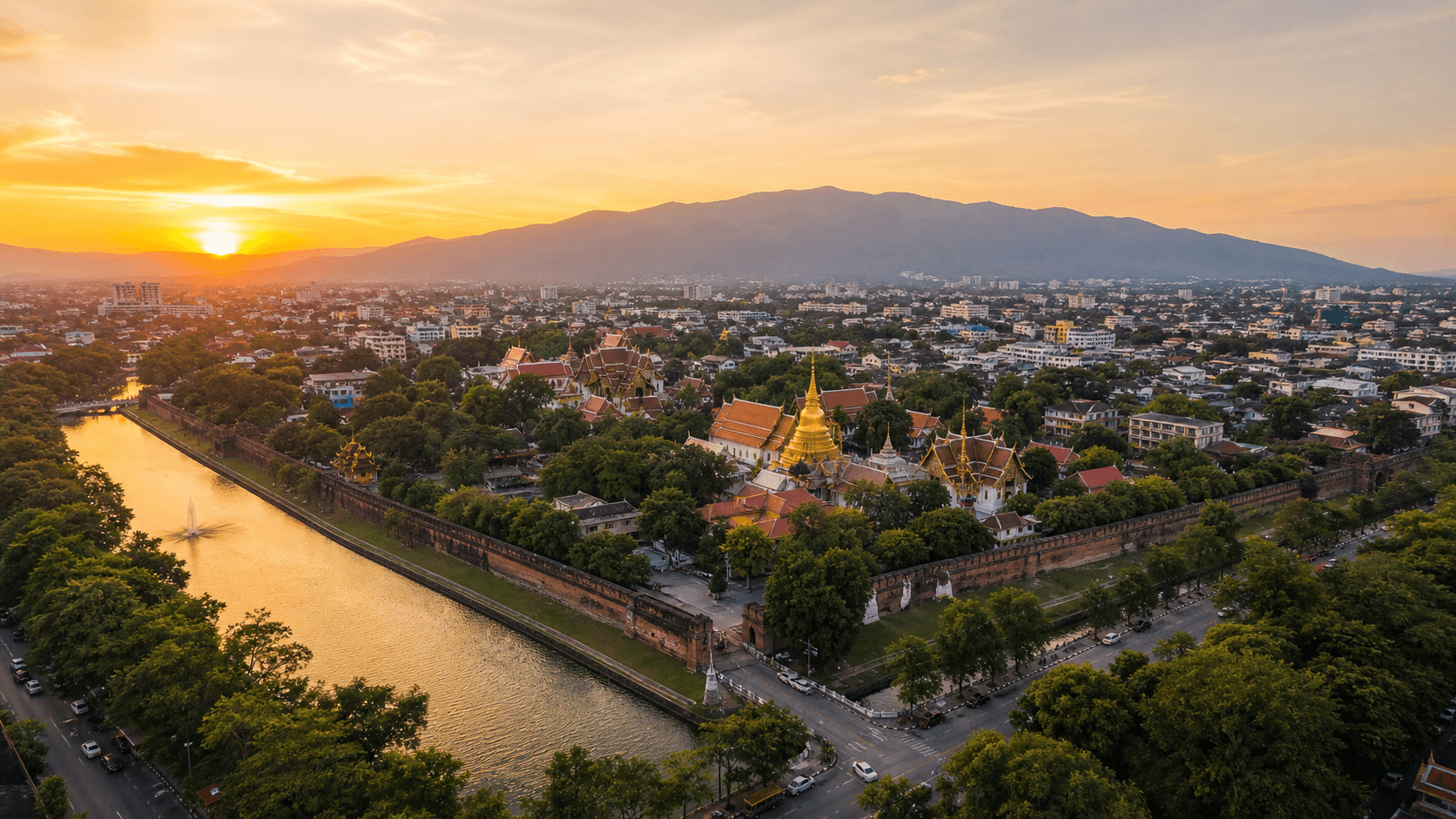
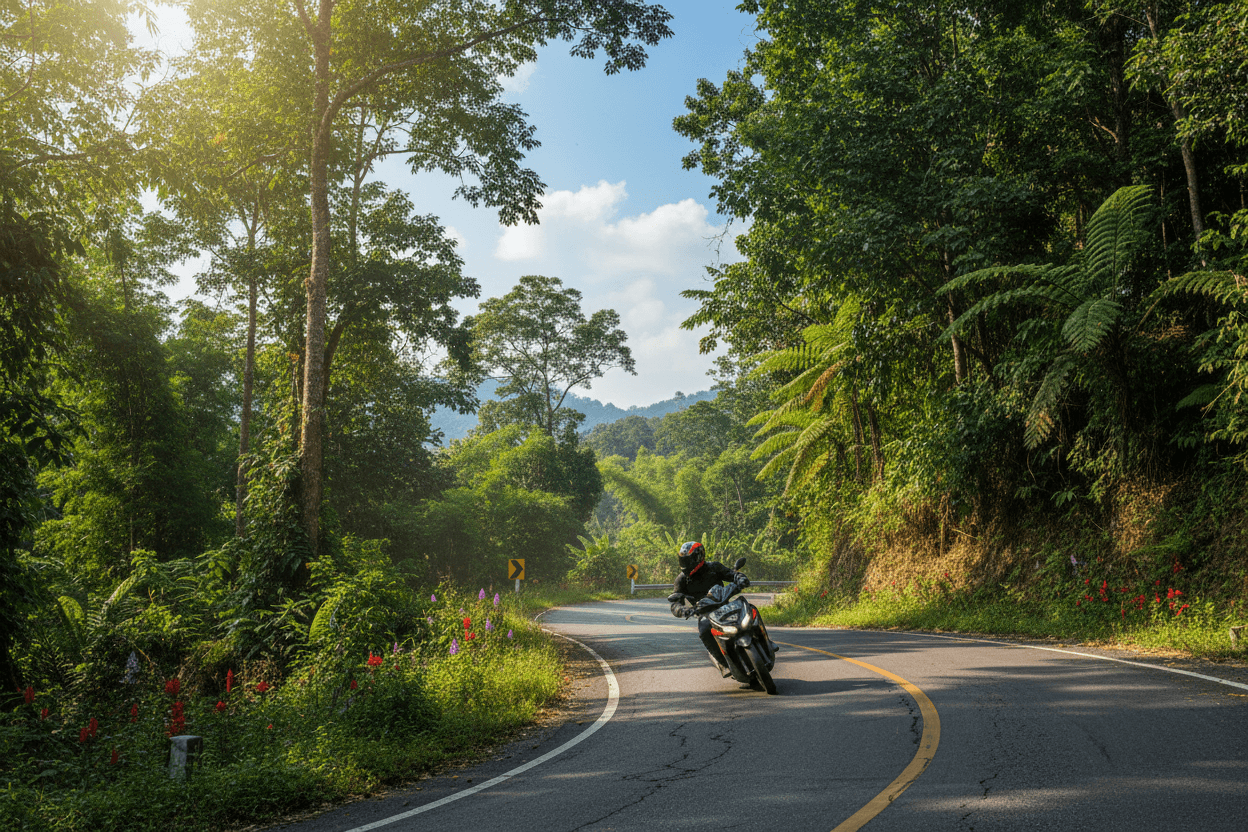
The best temples in Chiang Mai in 2026, ranked by visit-priority, are Wat Phra That Doi Suthep (mountain icon, 16 km west of the Old City), Wat Chedi Luang (15th-century earthquake-ruined chedi inside the moat), Wat Phra Singh (the Lanna masterpiece on Ratchadamnoen Road), Wat Phan Tao (all-teakwood viharn), Wat Suan Dok (royal cremation grounds, Monk Chat), and Wat Umong (1297 forest meditation tunnels). All six fit a 35 km, 6-7 hour day on a 150-300 THB Honda Click 125 from any Tha Phae Gate shop, with foreigner entry totals under 200 THB.
Key Takeaways
- Top six ranked: Wat Phra That Doi Suthep, Wat Chedi Luang, Wat Phra Singh, Wat Phan Tao, Wat Suan Dok, and Wat Umong make the must-visit shortlist; Wat Sri Suphan, Wat Lok Molee, and Wat Phra That Doi Kham earn honorable mentions.
- Entry fees in 2026: Free at most Old City wats; 50 THB at Wat Chedi Luang; 30 THB foreigner entry at Wat Phra That Doi Suthep; 20 THB at Wat Phra That Hariphunchai (Lamphun). Cash only.
- Distance from Tha Phae Gate: 0.8 km to Wat Phra Singh, 1.4 km to Wat Chedi Luang, 4 km to Wat Suan Dok, 7 km to Wat Umong, 11 km to Wat Phra That Doi Kham, 16 km to Wat Phra That Doi Suthep, 26 km to Lamphun.
- Scooter rate: 150-300 THB/day for a Honda Click 125 from any Tha Phae Gate or Nimman shop; 250-450 THB for a Honda PCX 160 or Yamaha NMAX if you ride two-up on the Doi Suthep climb.
- Dress code: Shoulders and knees covered at every wat; sarong rental 50 THB at the Wat Phra Singh and Wat Chedi Luang gates; shoes off at every prayer hall.
- Parking norms: Free or 20 THB inside the temple courtyard at every Old City wat; 50 THB at the Doi Suthep cable-car base; never on the moat verge (Royal Thai Police ticket at 500 THB).
Why these six wats top a Chiang Mai temple ranking
Chiang Mai houses more than 300 wats inside and around the moat, and the six headline temples above earn the top of any 2026 ranking on three criteria: Lanna heritage age (each pre-dates the 17th century), the density of original architecture surviving present-day restoration, and a still-active monastic community that animates the compound rather than reducing it to a museum exhibit. Wat Phra That Doi Suthep founded 1383, Wat Chedi Luang construction begun 1391, Wat Phra Singh founded 1345, Wat Phan Tao 14th-century origin, Wat Suan Dok founded 1370 as the Lanna royal-cremation grounds, and Wat Umong founded 1297 as Chiang Mai's oldest forest meditation site, all clear those bars.
The ranking also reflects how a foreign visitor on a 125cc rental experiences each compound on a single day. Wat Phra That Doi Suthep tops the list because of its 1,073 m elevation, its city-panorama terrace, and the 309-step naga staircase that frames a separate sense of arrival from any flat-city wat. Wat Chedi Luang follows because the partially-collapsed 15th-century chedi (felled by the 1545 earthquake) is the largest surviving Lanna structure inside the moat. Wat Phra Singh's Viharn Lai Kham, finished in 1345 and home to the Phra Singh Buddha image, is the Lanna painting and woodwork pinnacle. Wat Phan Tao is the rare all-teakwood viharn that shares a wall with Wat Chedi Luang. Wat Suan Dok's white royal chedis and Monk Chat program (Mon, Wed, Fri 5-7 PM) reward an evening detour. Wat Umong's brick meditation tunnels are unique to Chiang Mai's temple stock.
For the route-first companion to this ranked list, the Chiang Mai temples by motorbike day loop sequences these same six wats counter-clockwise from Tha Phae Gate; for the city-rental context (Old City versus Nimman shops, deposit norms, IDP rule), the Motorbike Rental Chiang Mai Guide covers the four-step booking flow and the bike-class step-up for the Doi Suthep climb.
Wat Phra That Doi Suthep: the mountain icon (rank 1)
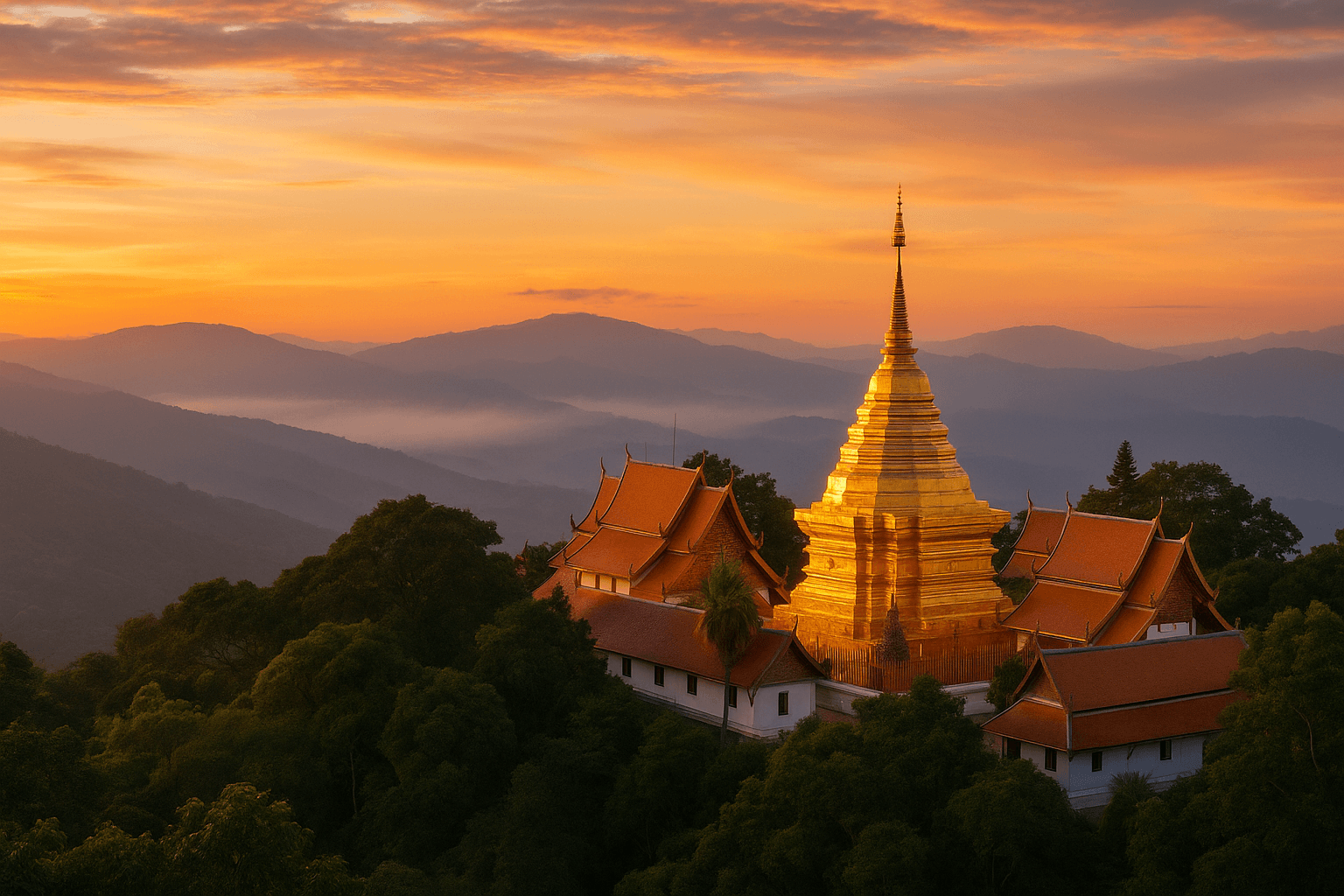
Wat Phra That Doi Suthep sits 16 km west of the Old City via Huay Kaew Road and Route 1004 at 1,073 m elevation, founded in 1383 under King Keu Naone, and earns the top rank because no other Chiang Mai temple delivers the same combination of altitude, Lanna craftsmanship, and city panorama. Foreigner entry is 30 THB; the 309-step naga staircase or a 30 THB cable car carries you from the lower car park to the chedi terrace; supervised motorbike parking at the cable-car base is 50 THB. The 24 m gold-clad chedi enshrines a Buddha shoulder-bone relic and is the most-photographed structure in Northern Thailand.
The temple's white-elephant founding myth structures the compound's layout. King Keu Naone strapped the relic to a white elephant set free to wander; the elephant climbed Doi Suthep, trumpeted three times, and died on the present-day terrace. The chedi marks the death point. The terrace at 1,073 m looks east across the city to Doi Saket and the Mae Ping Valley; on the clearest November-February dry-season days, you can see the Pai Loop's Route 1095 turn-off in the haze. The official Wat Phra That Doi Suthep Wikipedia entry covers the 1383 founding and the lineage of the relic in detail.
A 60-90 minute stop is the comfortable pacing. Combine the temple visit with a 10-15 minute terrace photo walk and a cool-mountain coffee at the on-site cafe; arrive late afternoon (after 3 PM) to skip the 9-11 AM cable-car queue and align the descent with the 5-6 PM city-panorama sunset. Reach by motorbike: 16 km on Huay Kaew Road and Route 1004, 30-40 minutes from Tha Phae Gate, around 30-40 THB of fuel; 125cc Click is doable solo in dry weather, Honda PCX 160 or Yamaha NMAX is the comfortable two-up choice.
Wat Chedi Luang and Wat Phan Tao: the Old City core (ranks 2 and 4)
Wat Chedi Luang on Phra Pok Klao Road, 1.4 km south-west of Tha Phae Gate, is the Old City's anchor temple and the second-priority stop after Doi Suthep, with a 50 THB foreigner entry and a 20 THB courtyard parking fee. Construction of the chedi began in 1391 under King Saen Muang Ma, and at its 84 m peak it was the tallest structure in the Lanna Kingdom; the 1545 earthquake collapsed the upper levels, leaving the present 60 m brick stump that still towers over the Old City rooflines. The Inthakhin City Pillar shrine on the same compound is the spiritual axis Chiang Mai citizens still venerate during the May Inthakhin Festival.
Wat Phan Tao shares a wall with Wat Chedi Luang and ranks fourth on the priority list because its all-teakwood Lanna viharn, free entry, no parking fee, is the only structure of its kind in central Chiang Mai and is routinely missed by riders who turn straight back to the moat after Wat Chedi Luang. The teak panels, peacock door reliefs, and king's-throne pediment date from the 19th-century reconstruction of an older 14th-century structure. The two compounds share a 100 m walking corridor and chain naturally on the same morning visit.
The Wat Chedi Luang and Wat Phan Tao pairing is the densest 30-minute stop in the Old City. Park inside the Wat Chedi Luang courtyard for 20 THB, walk the chedi base counter-clockwise (the standard Theravada veneration direction), step into the active prayer hall on the west side of the compound, then walk 100 m east to Wat Phan Tao through the unmarked side gate. Add a 30-minute detour to the Inthakhin City Pillar shrine if you visit in the second week of May; the rest of the year, the shrine is a 5-minute photo stop on the way back to the bike.
Wat Phra Singh and the inner ring (rank 3)
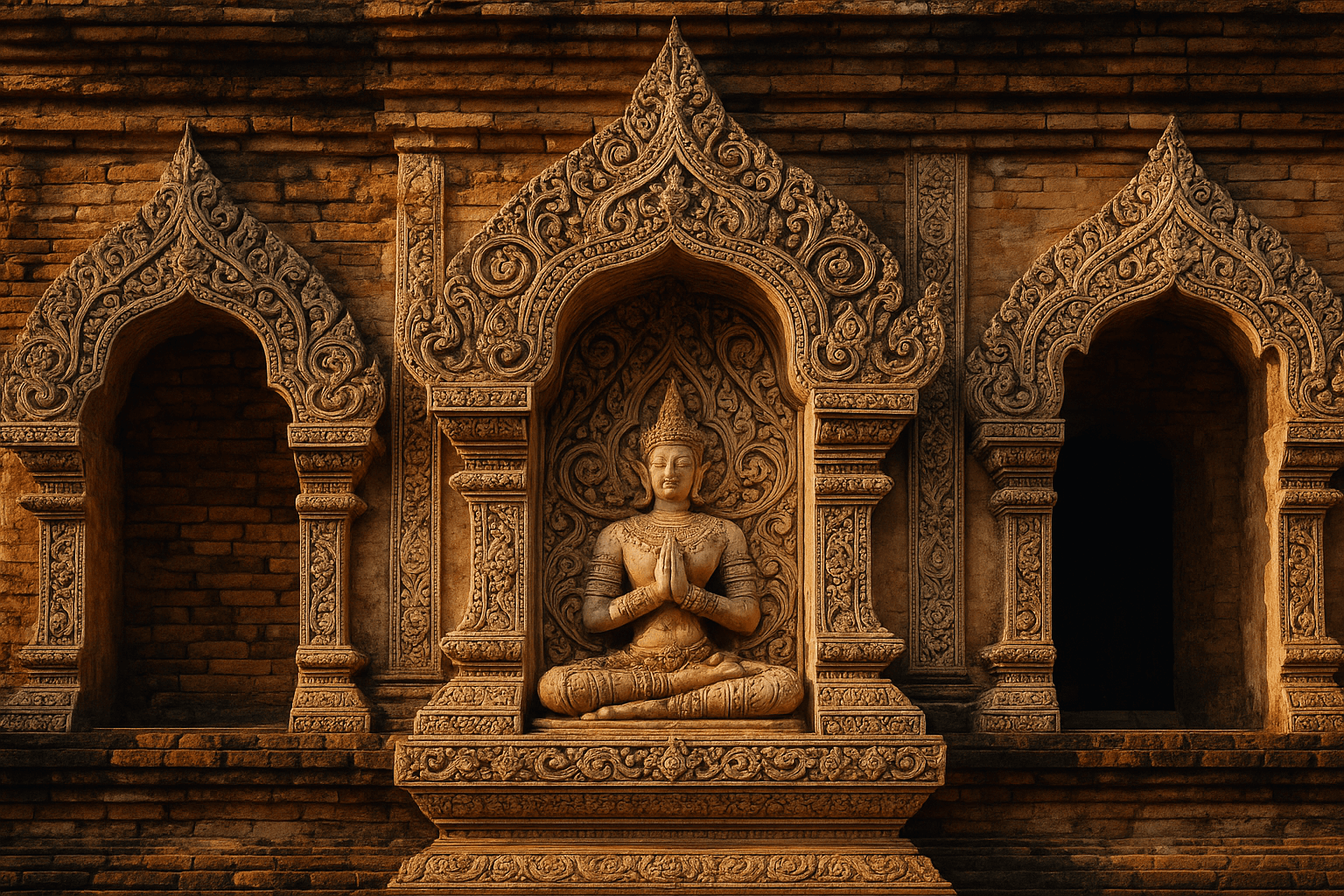
Wat Phra Singh on Ratchadamnoen Road, 800 m west of Tha Phae Gate, ranks third on a Chiang Mai temple priority list because its Viharn Lai Kham, finished in 1345 and home to the namesake Phra Singh Buddha image, is the single best surviving example of Lanna painting and woodwork. Free entry; free courtyard parking; sarong rental 50 THB at the gate. The 14th-century murals inside the Viharn Lai Kham depict scenes from the Sang Thong jataka alongside vignettes of medieval Chiang Mai daily life, rendered in the gold-on-red palette that defines Northern Thai temple art.
The compound also hosts the city's most active religious calendar. Wat Phra Singh is the epicenter of Chiang Mai's Songkran (Thai New Year, April 13-15) Phra Singh Buddha procession, when the image is paraded around the Old City moat for the public water-blessing; it is the Royal Coronation Day venue (May 4); and it hosts the Visakha Bucha (May full moon) candle procession. Visiting outside these dates rewards a 45-60 minute stop: walk the chedi compound clockwise, enter the Viharn Lai Kham (shoes off, photography permitted), and finish with the Phra Singh Buddha image in the main viharn.
A practical Old City sequence chains Wat Phra Singh, Wat Chedi Luang, and Wat Phan Tao in a 90-minute walk-and-ride loop: park near Tha Phae Gate, ride 800 m west to Wat Phra Singh, ride 700 m south-east to Wat Chedi Luang and Wat Phan Tao on the same compound, then exit Suan Dok Gate west toward the Suthep Road wats. Total seat time inside the moat is 8-10 minutes; total stop time is 90 minutes. For the inner-ring context including the Saturday and Sunday Walking Streets that anchor the same Ratchadamnoen Road, the Chiang Mai Old City Guide covers the moat's four-gate layout and the surrounding food-and-market scene.
Wat Suan Dok and Wat Umong: the Suthep Road pair (ranks 5 and 6)
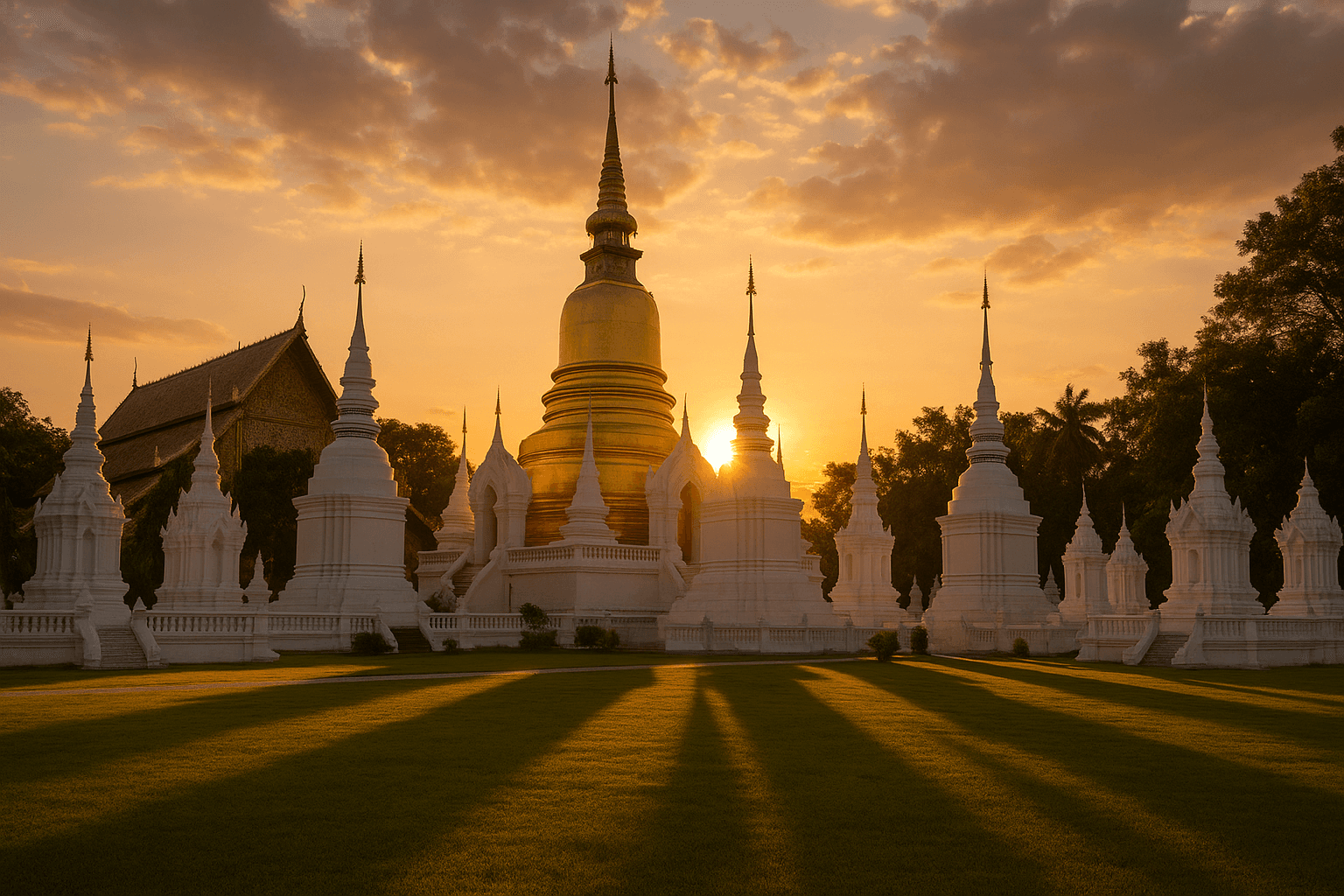
Wat Suan Dok at km 2.5 on Suthep Road, 4 km west of Tha Phae Gate, ranks fifth as the Lanna royal-cremation grounds: a cluster of brilliant-white chedis containing the ashes of the Chiang Mai royal line, free entry, free courtyard parking, and the city's longest-running Monk Chat program (Mon, Wed, Fri 5-7 PM) that lets visitors converse with English-speaking novices about Buddhist philosophy and monastic life. The temple's massive open-sided viharn is among Northern Thailand's largest, and the connection to Mahachulalongkornrajavidyalaya University adds a serious scholarly weight to the compound that pure tourist temples lack.
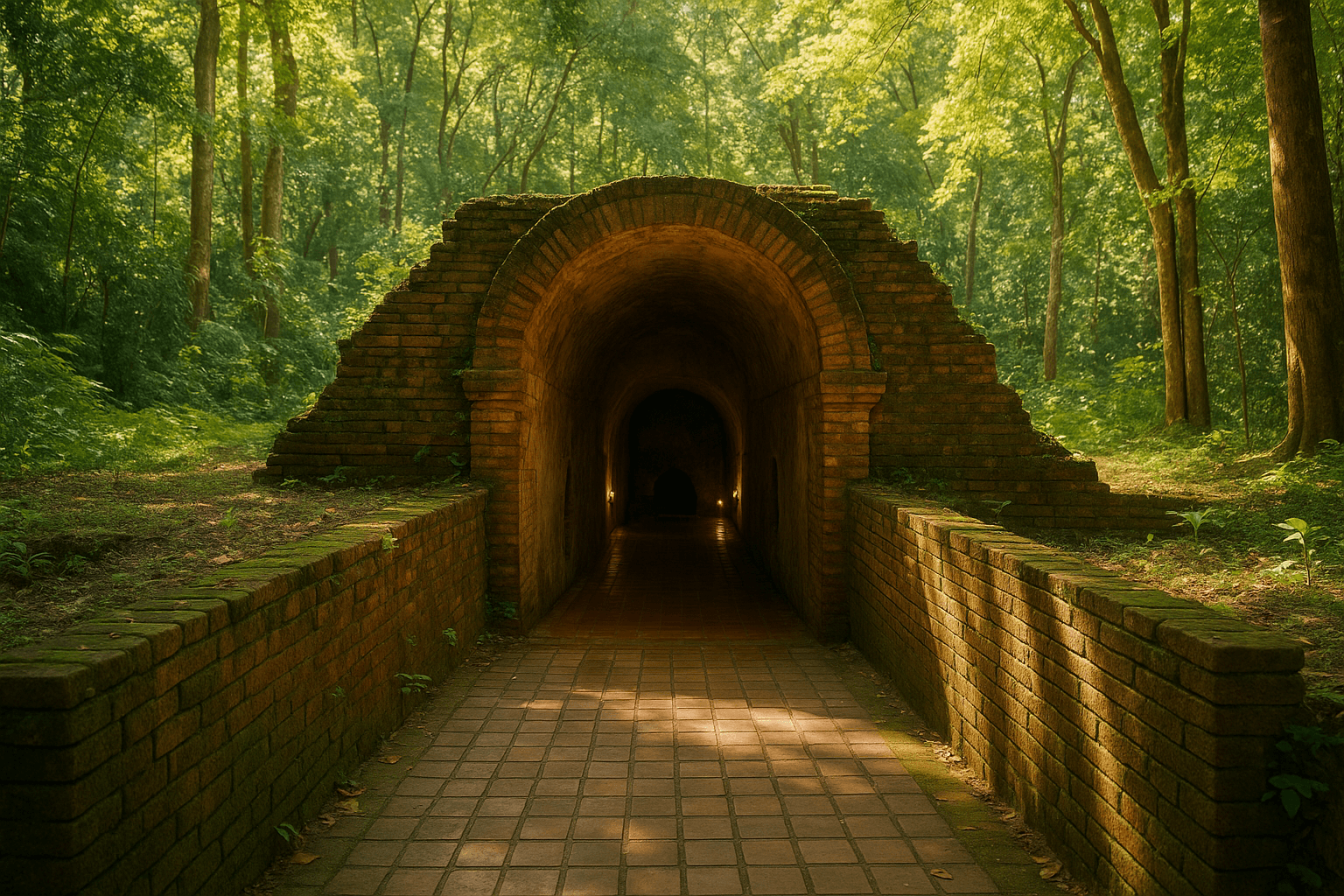
Wat Umong at km 5.5 on Suthep Road, 7 km west of Tha Phae Gate, ranks sixth as the city's oldest forest meditation temple, founded in 1297, with brick tunnel galleries below the main viharn and a quiet pond loop favoured by Bangkok day-trippers. Free entry, 20 THB suggested donation, free courtyard parking. The brick tunnels run 4-6 m below grade and frame meditation alcoves with original 14th-century murals; the surrounding forest hosts the famous "talking trees" hung with multilingual philosophical aphorisms; the pond is the city's longest-standing turtle-and-fish release site.
A practical 90-minute Suthep Road sequence chains both temples in one stop. Park at Wat Suan Dok, walk the white chedi rows (best at golden-hour for photography), join Monk Chat if your day permits, then ride 3 km west on Suthep Road to Wat Umong, walk the tunnel galleries and pond loop, and ride 1.5 km north on Canal Road to the Route 1004 Doi Suthep turn-off. The Suthep Road segment is the natural transition from the Old City inner ring to the Doi Suthep climb.
Honorable mentions and one-day temple loop
Three honorable-mention temples reward a longer day or a separate trip: Wat Sri Suphan in the Wua Lai Silver Village (1.4 km south of Chiang Mai Gate) is the silver-clad ubosot finished in 2008, free entry by daylight and 50 THB after dark for the Saturday-night light show; Wat Lok Molee at 14 km north of the Old City on Manee Nopparat Road has the 14th-century laterite chedi and the only formally-Lanna-style scripture hall in central Chiang Mai; and Wat Phra That Doi Kham 11 km south-west on Canal Road has the 17 m sitting Buddha and dramatically thinner crowds than Doi Suthep on weekday mornings. Add Wat Phra That Hariphunchai in Lamphun (26 km south on Highway 11, 11th-century Mon-period chedi pre-dating Chiang Mai) only on a separate southern-leg day.
The one-day six-wat loop covers Wat Phra Singh, Wat Chedi Luang, Wat Phan Tao, Wat Suan Dok, Wat Umong, and Wat Phra That Doi Suthep counter-clockwise from Tha Phae Gate. Total distance 35 km, total time 6-7 hours including stops, total fuel 60-80 THB on a Honda Click 125. The route exits Tha Phae Gate west to Wat Phra Singh, south-east to Wat Chedi Luang and Wat Phan Tao, exits Suan Dok Gate west to Wat Suan Dok and Wat Umong, then north on Canal Road to Route 1004 for the Doi Suthep climb, and descends Huay Kaew Road back to the moat. For the day-by-day route narrative including parking sequences and one-way moat warnings, the exploring Chiang Mai temples by motorbike sibling post covers the route in full.
Reach by motorbike from the Old City
A 125cc scooter from any Tha Phae Gate, Kotchasarn Road, or Nimman shop is the cheapest and most flexible way to chain Chiang Mai's headline wats in a single day, because the geographic spread (1.6 km Old City moat, 4-7 km Suthep Road, 16 km Doi Suthep climb, optional 11 km south to Doi Kham) defeats every other transport option on cost and pacing. A 150-300 THB Honda Click 125 covers the full six-wat loop with the bike still in your hands at sunset; a songthaew loop for the same day costs 600-1,000 THB and stops only where the driver wants; a Grab to Doi Suthep alone is 250-400 THB one-way; an organized temple tour is 800-1,500 THB and is paced for the slowest passenger.
Bike-class match: a Honda Click 125 covers 90% of the loop comfortably for solo riders. The Doi Suthep climb on Route 1004 is the only segment where a Honda PCX 160 or Yamaha NMAX (250-450 THB/day) earns its premium, especially for two-up couples and especially in the May-October monsoon descent. A 200-400cc manual (Honda CB300R, Kawasaki Versys-X 300, Honda CRF300 Rally, 500-1,200 THB/day) is overkill for a temple-only day but useful if you stretch the trip into the Mae Hong Son Loop or Doi Inthanon afterwards.
For the country-wide rental price baseline including 125cc weekly and monthly rates, the Thailand Scooter Rental Cost overview covers the full pricing matrix; for the booking-flow walkthrough including the deposit handover and the IDP-and-licence document folder, the How to Rent a Scooter in Chiang Mai post is the step-by-step companion. To avoid the passport-hostage trap that a few Tha Phae Gate walk-ins still run, the five-pattern scams playbook names the five main rental scams and their counter-actions. Holding a valid home-country IDP with the "A" (motorcycle) endorsement is a hard rule at the Huay Kaew Road checkpoint, not a suggestion.
Frequently Asked Questions
What is the most important temple to visit in Chiang Mai?
Wat Phra That Doi Suthep is the single most-visited temple and the safest "if you only visit one" choice. Founded in 1383 at 1,073 m elevation, it pairs a 24 m gold-clad Lanna chedi with a city-panorama terrace; foreigner entry is 30 THB. If a 35-minute Route 1004 climb is impractical, Wat Phra Singh on Ratchadamnoen Road (free, 800 m from Tha Phae Gate) is the Old City equivalent for Lanna painting and woodwork.
How many Chiang Mai temples can I see in one day?
Five to six in a comfortable day on a 125cc rental, eight if you push. The standard counter-clockwise loop covers Wat Phra Singh, Wat Chedi Luang, Wat Phan Tao, Wat Suan Dok, Wat Umong, and Wat Phra That Doi Suthep in 6-7 hours from a Tha Phae Gate start; total 35 km, total fuel 60-80 THB. Add Wat Sri Suphan or Wat Phra That Doi Kham for a 7-8 wat day. Beyond eight, you stop appreciating any of them.
What does it cost to enter Chiang Mai's temples in 2026?
Most are free. Wat Phra Singh, Wat Phan Tao, Wat Suan Dok, Wat Umong, and Wat Phra That Doi Kham charge no foreigner fee; Wat Chedi Luang charges 50 THB; Wat Phra That Doi Suthep charges 30 THB foreigner entry plus an optional 30 THB cable car; Wat Phra That Hariphunchai in Lamphun charges 20 THB. Cash only. Add the Doi Suthep parking at 50 THB and the courtyard parking at 0-20 THB elsewhere, and the full six-wat loop entry total is under 200 THB.
What should I wear to visit Chiang Mai's temples?
Shoulders and knees covered at every wat, shoes off before any prayer hall (a labelled rack sits at every viharn entrance), and a long-sleeve cover layer for the ride between sites. Mesh riding jackets are fine for the city but will not pass at any prayer-hall entrance. Pack a thin scarf or buy one for 50-100 THB at the Wat Phra Singh or Wat Chedi Luang gate. Helmet legally required for both rider and pillion under Thai law.
Where do I park my motorbike at Chiang Mai temples?
In the supervised courtyard of every wat. Free at Wat Phra Singh, Wat Phan Tao, Wat Suan Dok, and Wat Umong; 20 THB at Wat Chedi Luang; 50 THB at the Doi Suthep cable-car base. Every site has a green-and-white motorbike sign at the entrance and a supervisor who watches your helmet. Never park on the moat verge or on Phra Pok Klao Road's pedestrian footpath: Royal Thai Police ticket foreign-plated rentals at 500 THB.
Is Wat Phra That Doi Suthep worth the Route 1004 climb?
Yes. Doi Suthep is qualitatively different from any Old City wat: 1,073 m elevation, gold-clad 24 m Lanna chedi from 1383, an east-facing terrace looking across Chiang Mai to Doi Saket, and a separate cool-mountain microclimate that sits 5-7 degrees C below the city. Skip the climb only if you ride a 125cc Click in heavy monsoon and the Route 1004 surface is wet, in which case take the cable car back down (30 THB) and wait the rain out at the temple cafe.
When is the best time of day to visit Chiang Mai's temples?
Two windows beat the midday heat. Early morning 7-9 AM is best for the Old City cluster (Wat Phra Singh, Wat Chedi Luang, Wat Phan Tao) before the cable-car queue at Doi Suthep and the songthaew tour buses arrive. Late afternoon 3-6 PM is best for Doi Suthep and Wat Suan Dok, when the road heat drops 5-7 degrees C below midday and the city-panorama sunset from the chedi terrace lands at 5-6 PM in the November-February dry season.
Plan your six-wat day with a verified Chiang Mai rental
The Chiang Mai temple ranking rewards a counter-clockwise route, a 125-160cc bike that handles the Doi Suthep climb, and a verified Old City or Nimman shop instead of a hotel-concierge markup. Book a Honda Click 125 from any Tha Phae Gate counter at 150-300 THB per day via Byklo, pair it with an 8 AM departure to clear Wat Phra Singh and Wat Chedi Luang before the cable-car queue at Doi Suthep builds, and combine the same rental day with the day-by-day temples-by-motorbike route (35 km, 6-7 hours) or stretch into a multi-day trip with the Samoeng Loop and Doi Inthanon. Free hotel delivery across the Old City, Nimman, and Santitham; cash deposits paid in cash; the original passport stays in your pocket.