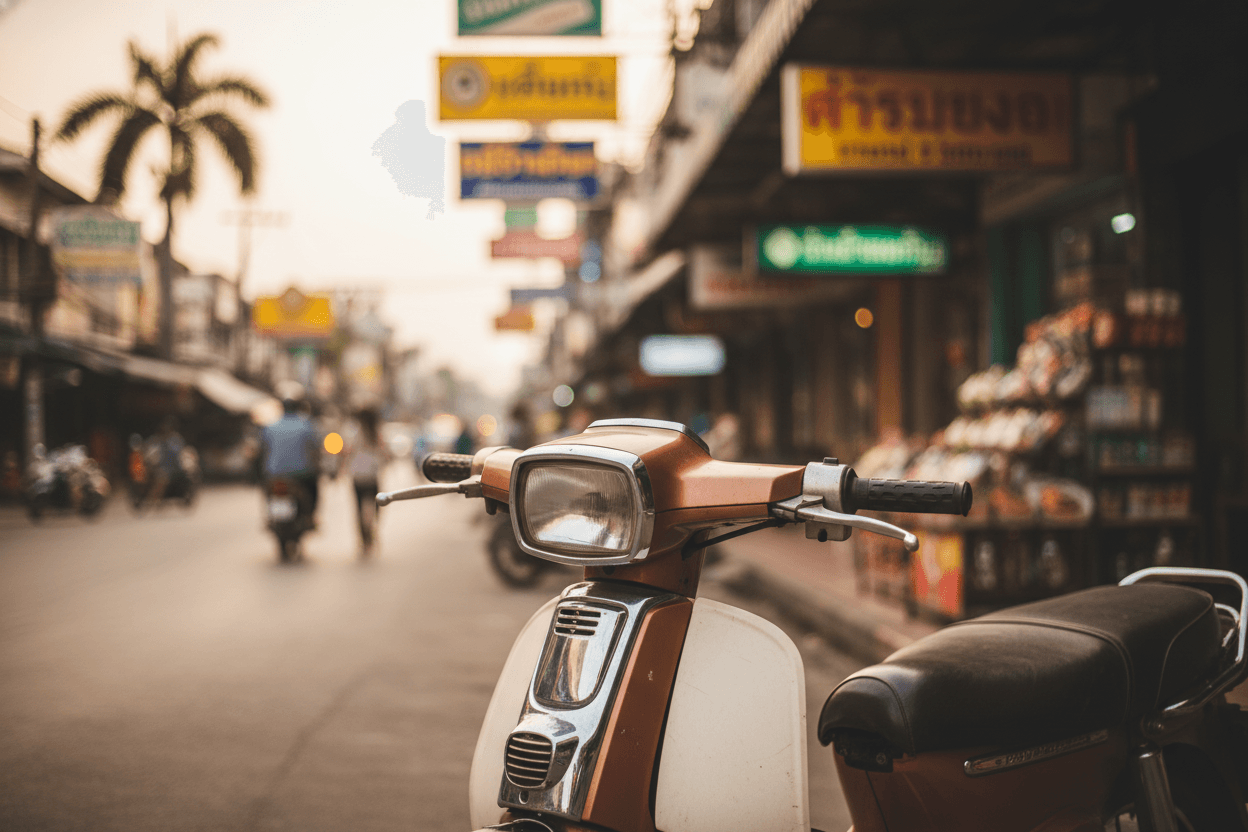
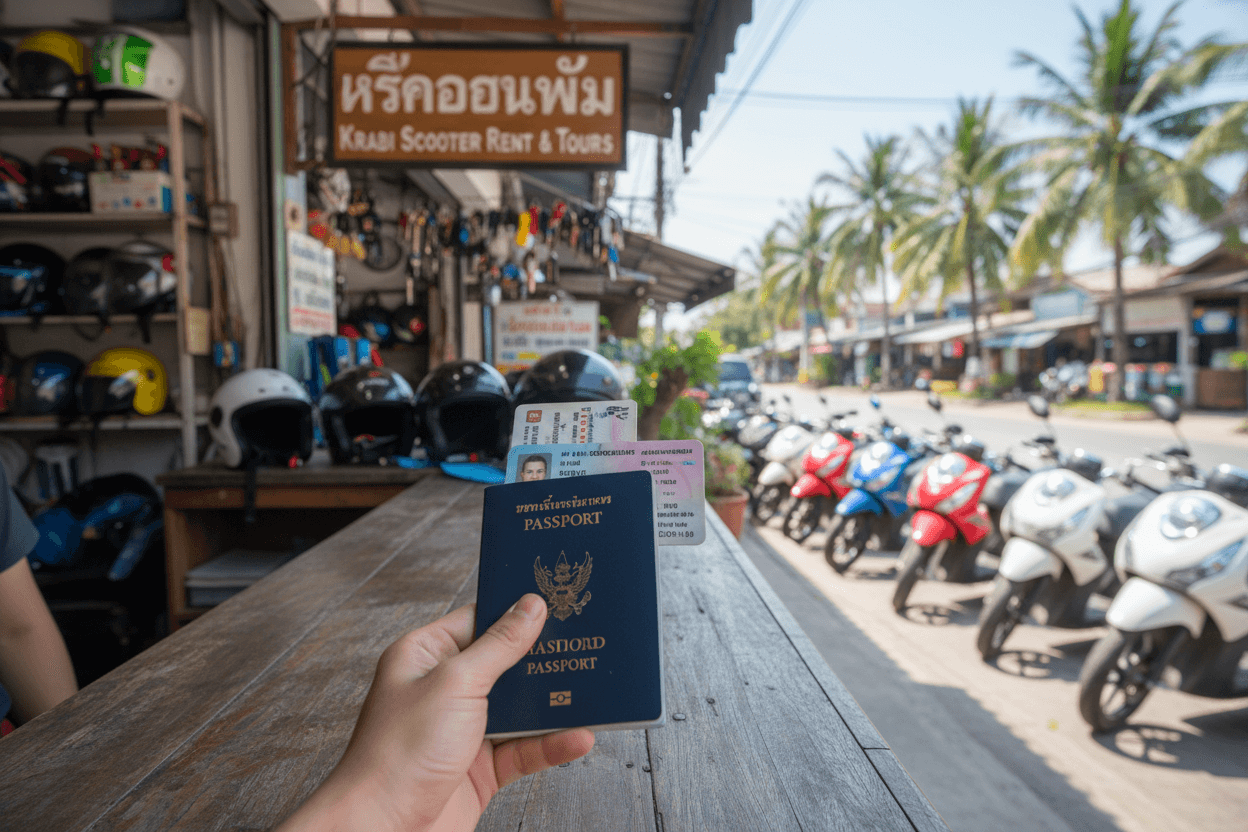
The best time to visit Krabi is November to March, when the Andaman seas are calm, daytime sits at 28-32°C, sunshine averages 8-9 hours a day, and the Highway 4034 climb from Ao Nang to Tup Kaek viewpoint stays grippy in dry tarmac. This is also the prime motorbike-rental window: a 200-300 THB Honda Click 125 from any Soi Ao Nang shop reaches Tup Kaek (14 km, 25 minutes) and Wat Tham Suea (Tiger Cave Temple, 9 km from Krabi Town) without rain interrupting the day. Monsoon season (May-October) drops accommodation 30-50% but regularly cancels Phi Phi and Hong Islands longtail trips.
Key Takeaways
- Peak window: November to March delivers 28-32°C days, sunshine 8-9 hours daily, calm Andaman seas (under 1.5 m swell), and dry tarmac on Highway 4203/4034 between Ao Nang and Tup Kaek viewpoint; book accommodation 4-6 weeks ahead and the Krabi motorbike rental 5-7 days ahead.
- False peak (August-September): a 2-3 week mid-monsoon dry window typically arrives in late August or early September with PM2.5 under 40 and 30-50% lower hotel rates than December; longtail operators still run Hong Islands and Four Islands tours when swell drops below 1.5 m.
- Avoid Songkran on Phi Phi (April 13-15): Phi Phi Don's narrow lanes turn into continuous water fights with rental scooter CVT-seizure repair bills hitting 8,000-15,000 THB; Krabi mainland sees the festival but with less density than Phi Phi or Chiang Mai.
- Low-season ferry suspensions (May-October): the Krabi-Phi Phi passenger ferry from Klong Jilad Pier suspends one day in three on rough-sea days; speedboats from Ao Nang Pier cancel less but still 1 day in 5; budget a flexible Phi Phi window or skip the trip in September-October.
- Peak demand month is February: 23 mm average rainfall, 8-9 hours sunshine, 31°C daytime, and excellent underwater visibility for the Phi Phi snorkel stops; expect 250-300 THB Honda Click 125 rates at Soi Ao Nang shops and 80% Ao Nang occupancy rates.
- Rental rate stays flat year-round: a 125cc Honda Click runs 150-300 THB/day in every month at the canonical Krabi range; demand drives floor-to-ceiling movement (off-peak 150 in Krabi Town, peak 300 on Soi Ao Nang) but the riding kit and route plan change far more than the contract does.
When is the overall best time to visit Krabi in 2026?
The best time to visit Krabi is November through March: 28-32°C daytime temperatures, 23-25°C nights, rainfall under 50 mm/month for January-February, sunshine 8-9 hours per day, and Andaman swell consistently under 1.5 m for longtail operations. This window aligns with Krabi Province's tropical-monsoon dry phase, when the southwest monsoon retreats and the calm northeast pattern dominates the Andaman coast. The window covers Loy Krathong (early November), Christmas / New Year, Chinese New Year (February 17, 2026), and the early-March transition into hot season. It is also the only window where Highway 4034's two short steep cliff sections from Klong Muang to Tup Kaek viewpoint stay fully grippy and Phi Phi day-trip speedboats run their full daily schedule from Ao Nang Pier.
The trade-off is demand and price. November-March peak demand pushes 125cc Honda Click rates from the 150 THB Krabi Town floor up to the 250-300 THB Ao Nang ceiling, lifts Ao Nang four-star resort rates 50-80% versus rainy-season rates, and books out the Phi Phi day-trip operators 1-2 weeks ahead in February peak. Book Ao Nang accommodation 4-6 weeks ahead for December-February peak; book the Krabi motorbike rental 5-7 days ahead through a verified platform with free hotel delivery, because Honda PCX 160 / Yamaha NMAX maxi-scooter inventory tightens at Soi Ao Nang strip shops in the December-February peak.
For travellers who can't move their dates, the second-best windows are November (peak weather, shoulder pricing as the calendar transitions into high season) and the late-August / early-September false peak (2-3 weeks of dry mid-monsoon weather with rainy-season prices). Avoid mid-September through mid-October: this is the wettest stretch (300-355 mm/month rainfall), the rough-sea ferry-suspension peak, and the highest concentration of cancelled longtail trips.
Krabi weather and riding conditions month by month
Krabi's tropical monsoon climate splits into three windows: dry-season November-March (best), hot-shoulder April-May (Songkran + early rains), and full monsoon June-October (cheapest, wettest, ferry-disrupted). The most-decisive variable for a traveller is not temperature; it is sea state and rainfall pattern, because both gate the Phi Phi/Hong/Four Islands schedule and the Highway 4034 cliff-section traction. The riding-conditions column is the column that matters for a motorbike renter: it tells you whether to ride, what bike class to pick, and how to plan the day.
The riding-conditions column drives the rental plan more than the rate does. November through March is "ride anywhere, any time of day, any bike class works." June through early August is "ride mornings only; postpone the Highway 4034 climb if a Khao Phanom Bencha thunderhead is visible." September through mid-October is "skip the Highway 4034 cliff section entirely; the Wat Tham Suea inland day on Highway 4035 is the safer option." April adds a Songkran water-bucket caveat on Phi Phi specifically. The bike-class question follows the same axis: November-March a 110-125cc Honda Click handles every route; June-October the Honda PCX 160 wins for its better front-tyre footprint on wet tarmac and longer wheelbase on the Highway 4034 climb.
How does each Krabi season affect a motorbike rental?
Each Krabi season changes the riding plan more than the rental rate. November-March delivers the showcase scooter window, with dry tarmac on the Highway 4203/4034 coastal arc, 28-32°C daytime conditions, and Honda Click 125 rates at the 250-300 THB peak end of the canonical 150-300 THB range. April-May trades hot-season heat (34-35°C midday) for thinning crowds and 20-30% off accommodation; the Songkran window (April 13-15) layers a CVT-water-damage hazard on Phi Phi specifically, less so on the Krabi mainland. June-September cuts rates back to the 150-200 THB Krabi Town off-peak floor and trades a 14:00-17:00 thunderstorm window for empty Tup Kaek viewpoint and 30-50% cheaper Ao Nang accommodation.
The bike-class recommendation rotates with the season. In November-March dry season, a Honda Click 125 covers the entire 5-day plan, including a two-up Tup Kaek run on Highway 4034. In April-May hot season, the same Click on the same climb at 34°C carries a heavier two-up rider less comfortably; pay the 250-450 THB premium for a Honda PCX 160 or Yamaha NMAX from a Soi Ao Nang shop for the bigger seat and the windshield. In June-October monsoon, prefer the PCX 160 over the Click for the better front-tyre footprint on wet tarmac and the additional weight that helps on the Highway 4034 climbing-section descent. The full bike-class breakdown for Krabi Province sits in the motorbike rental Krabi guide; the Best Motorbike for Beginners Thailand post ranks Krabi-friendly models on stability and weight.
Fuel costs and route choices also rotate seasonally. The 28 km Ao Nang to Klong Muang to Tup Kaek round trip is a 1.5-2 hour ride costing 80-100 THB of fuel year-round, but the Highway 4034 climbing section above Klong Muang turns slick in the first 10 minutes of any wet-season squall. The 100 km Krabi Town to Khlong Thom hot springs and Emerald Pool round trip on Highway 4 + 4038 is fully sealed and gentle gradient; rideable on a 125cc year-round, just morning-bias the timing in monsoon months. The 9 km Krabi Town to Wat Tham Suea inland run on Highway 4035 is the most weather-resistant route in the province because it runs through forested rubber plantations and the canopy shades the road.
Dry season (November-March): the showcase scooter and longtail window
Dry season in Krabi runs early November through late March and is the highest-rated combined motorbike + longtail window of the year. Daytime temperatures sit at 28-32°C with 23-25°C nights, humidity drops to 65-75%, sunshine averages 8-9 hours per day, and Andaman swell stays under 1.5 m. This is the only window where the Phi Phi day-trip speedboat runs its full daily schedule from Ao Nang Pier, the Hong Islands longtail tours sail every morning from Nopparat Thara, and the Highway 4034 climb from Klong Muang to Tup Kaek viewpoint stays dry every day.
The headline cultural event is Loy Krathong on the November full moon (around November 4-5, 2026): banana-leaf floats released onto the Krabi River and at Ao Nang beach, far smaller in scale than the Chiang Mai Yi Peng spectacle but a calm, photogenic local festival. Christmas and New Year both land inside this window and add a 7-10 day demand peak that pushes Ao Nang resort rates 50-80% above rainy-season floors. Chinese New Year (February 17, 2026) brings a third demand peak driven by the China and Hong Kong outbound market; expect a notable share of mainland Chinese tour groups at Tup Kaek viewpoint and the Phi Phi day-trip boats during that week.
For riders, dry-season planning is mostly about booking ahead and timing the headline ride for sunset. A 125cc Honda Click rents at the 250-300 THB peak end of the canonical Krabi range; maxi-scooter Honda PCX 160 / Yamaha NMAX inventory at 250-450 THB sells out fastest because of two-up demand for the Highway 4034 climb. Pack short-sleeve riding shirts, a folding rain shell for the rare dry-season shower, and closed-toe shoes for the 1,260-step Wat Tham Suea climb. The full route catalogue with viewpoint coordinates and bike-class advice sits in Top 10 Krabi Motorbike Rides.
Hot-shoulder season (April-May): the Songkran trade-off window
April through early May is Krabi's hot-shoulder season, when daytime temperatures climb to 33-35°C, the first monsoon rains start to arrive (120-190 mm in April, jumping to 192 mm in May), and the calendar's biggest cultural event lands inside the heat. Krabi mainland sees Songkran (April 13-15) but with less density than Chiang Mai's Old City moat or the Phi Phi Don narrow lanes; expect water battles at the Krabi Town riverside, Ao Nang's Soi Ao Nang strip, and any major intersection on Highway 4203, but the rest of Krabi Province continues normal life by April 16.
The riding implication is mixed. April-May tarmac on Highway 4203 between Ao Nang and Klong Muang stays mostly dry through April but starts to slick up after the first May squalls; the Highway 4034 climb to Tup Kaek viewpoint goes from "ride any time" in April to "morning rides only" by mid-May. Tup Kaek viewpoint sunset stays achievable through April but requires a radar check from mid-May onward. The 9 km Krabi Town to Wat Tham Suea run is the most weather-resistant option in the shoulder window because the rubber-plantation canopy on Highway 4035 shades the road and the temple complex is open every day.
Phi Phi-specific Songkran is the one trade-off worth flagging. Phi Phi Don's narrow lanes between Tonsai and Loh Dalum Bay turn into continuous three-day water fights with pickup-truck water cannons and ice-bucket ambushes; rental scooter CVT seizure repair bills run 8,000-15,000 THB and get debited against the cash deposit. If you're day-tripping to Phi Phi from Krabi mainland during Songkran, you'll get wet on the Tonsai pier walk; if you're overnighting on Phi Phi Don, garage any rented scooter for the festival peak (April 13-15) and walk between Tonsai and Loh Dalum.
Monsoon season (May-October): the budget, lush, and ferry-suspended window
Monsoon season in Krabi runs May through October and is the cheapest, greenest, and most weather-disrupted window of the year. Temperatures stay relatively cool at 30-32°C (4-5°C cooler than April peaks), humidity climbs to 80-90%, and September is statistically the wettest month at 355 mm. Crucially, the rain pattern is not all-day downpour for most of the season; it is a 14:00-17:00 thunderstorm window followed by clear evenings. The Krabi Top 5 Waterfalls post documents the cascade-flow peaks across the same months because Huai To Falls, Hot Stream Waterfall, and the Khlong Thom system all run at 2-3x dry-season volume.
Pricing rotates accordingly. A 125cc Honda Click drops back to the 150-200 THB Krabi Town off-peak floor; Ao Nang four-star resorts cut rates 30-50% versus December peaks; mid-range guesthouses on Soi Ao Nang fall 25-40%. The Budget Travel Krabi Guide breakdown lands a comfortable rainy-season day at 900-1,400 THB total versus the 2,500-4,000 THB high-season equivalent. Tour operators (cooking classes, Khao Phanom Bencha hikes, even some Hong Islands operators) discount 15-25% to fill rainy-season slots.
The trade-offs are real and concentrated in two areas: ferry suspensions and Highway 4034 traction. The Krabi-Phi Phi passenger ferry from Klong Jilad Pier suspends roughly one day in three on rough-sea days in September-October; speedboats from Ao Nang Pier cancel less often (1 day in 5) but still represent a real risk to a tightly-scheduled itinerary. Hong Islands and Four Islands tours sail when swell is below 1.5 m; expect 30-40% of September days to be cancelled. The Krabi Island Hopping Tour Guide documents the operator-level cancellation patterns. Highway 4034's two short steep cliff sections from Klong Muang to Tup Kaek viewpoint go slick in the first 10 minutes of any wet-season squall; the riding plan that works is a 07:00-13:00 morning bias with a return to Ao Nang before the storm window builds.
The August-September false peak is the one rainy-season window worth booking against. A 2-3 week dry break typically arrives in late August or early September, with PM2.5 under 40, sea swell dropping to 1-1.5 m, and longtail operators running their full schedule. Hotel rates stay at the rainy-season 30-50% discount, scooter rentals stay at the 150-200 THB Krabi Town floor, and the crowds stay thin because most travellers wrote off the month entirely. Track the Thai Meteorological Department forecast 5-7 days out and book flexible-cancellation accommodation; if the dry break holds, it is the highest value-per-baht window of the year.

Plan your Krabi window by traveller profile
Different traveller profiles peak at different months. The fastest way to pick a window is to match the priority to the season: beach-and-island-first travellers should target December-February peak; budget travellers and crowd-averse photographers should target the August-September false peak or the October-November transition; nature-and-waterfall travellers should target May-July; and overlanding scooter tourers should target November-March for the dry tarmac on Highway 4 and Highway 4203/4034. The match maps cleanly onto the rental plan because a 125cc Honda Click works for every profile; what changes is the daily route mix and the kit. For the same season laid out as a decision tree by traveler profile (climber, beach, island hopper, rider), see the sister When to Visit Krabi post.
Beach-and-island-first travellers (the most common Krabi profile) should book December through early March. Calm Andaman seas under 1 m swell, full Phi Phi and Hong Islands schedules, dry Highway 4034 cliff sections for sunset at Tup Kaek viewpoint, and 28-32°C beach days with negligible rain. The Best Beaches in Krabi and Best Sunset Spots in Krabi posts both peak in this window. Book Ao Nang accommodation 4-6 weeks ahead; book the Krabi 5-day itinerary Phi Phi day-trip 1-2 weeks ahead in February peak.
Budget travellers and crowd-averse photographers should target the August-September false peak or the late-October to early-November transition. Hostel beds at 200-300 THB, scooter rentals at the 150-200 THB Krabi Town off-peak floor, and 30-50% off Ao Nang accommodation versus December rates. The Budget Travel Krabi Guide documents the rainy-season cost stack. Nature-and-waterfall travellers (Khao Phanom Bencha hikes, Khlong Thom hot springs, Huai To Falls swimming) should target May-July when the cascades peak in flow and the inland trails are at their lushest; combine with morning-bias riding to beat the afternoon thunderstorms.
The window to genuinely avoid is mid-September through mid-October. Wettest stretch of the year (300-355 mm/month rainfall), highest concentration of cancelled longtail and ferry trips, slickest Highway 4034 cliff sections, and only marginal price savings versus the much-better August false peak or the late-October transition. The only legitimate reason to book this window is a pre-locked work schedule or a budget that requires the absolute floor of every cost line.
Frequently Asked Questions
What is the absolute best month to visit Krabi?
February is the best single month to visit Krabi. Daytime temperatures sit at 31°C, rainfall averages 23 mm (the lowest of the year), Andaman seas stay calm under 1 m swell, sunshine averages 8-9 hours per day, and underwater visibility on the Phi Phi snorkel stops is at peak. Book Ao Nang accommodation 4-6 weeks ahead for February and the Krabi motorbike rental 5-7 days ahead, because Honda PCX 160 inventory tightens at Soi Ao Nang shops in February peak.
Is Krabi worth visiting during the rainy season?
Yes, with caveats. June-October is the cheapest and greenest window, with hostel beds at 200-300 THB/night, the Honda Click 125 at the 150-200 THB Krabi Town off-peak floor, and 30-50% off Ao Nang accommodation. The rain pattern is a 14:00-17:00 thunderstorm window, not all-day downpour. The trade-offs are Phi Phi ferry suspensions (1 day in 3 in September-October) and slick Highway 4034 cliff sections; plan morning-bias rides (07:00 departure, 13:00 return) and budget a flexible Phi Phi window or skip the trip for September.
When is the August-September false peak worth booking?
The August-September false peak is a 2-3 week dry break that typically arrives in late August or early September, with PM2.5 under 40, Andaman swell dropping to 1-1.5 m, and longtail operators running full schedules. Hotel rates stay at the rainy-season 30-50% discount, scooter rentals stay at the 150-200 THB floor, and crowds stay thin. Track the Thai Meteorological Department forecast 5-7 days out and book flexible-cancellation accommodation; if the dry break holds, it is the highest value-per-baht window of the Krabi calendar.
How many days should I spend in Krabi?
Plan 3-4 days for the headline highlights (a Phi Phi or Four Islands tour, a Railay longtail half-day, one inland scooter day to Wat Tham Suea or the Emerald Pool). Five to seven days adds a Highway 4203/4034 coastal scooter loop to Tup Kaek viewpoint, a Hong Islands trip, and time for Khao Phanom Bencha or a Koh Lanta day. The full day-by-day plan with restaurant picks, lodging tiers, and longtail timings sits in the Krabi 5-day itinerary guide.
Are Phi Phi day trips reliable in monsoon season?
Partially. Speedboat tours from Ao Nang Pier cancel roughly 1 day in 5 in June-August and 1 day in 3 in September-October on rough-sea days. The Krabi-Phi Phi passenger ferry from Klong Jilad Pier suspends slightly more often, and Hong Islands longtail tours stop running when Andaman swell exceeds 1.5 m. Build a flexible Phi Phi window into a monsoon-season Krabi itinerary, or front-load the islands at the start of the trip so you have re-book days at the back. The Krabi Island Hopping Tour Guide documents per-operator cancellation patterns.
Does the rental rate change between dry season and monsoon?
The canonical 150-300 THB/day range for a 125cc Honda Click holds in every month, but the demand-driven floor and ceiling shift. November-March peak demand pushes rates to the 250-300 THB Ao Nang ceiling, with some Honda PCX 160 / Yamaha NMAX inventory selling out 5-7 days ahead at Soi Ao Nang shops. June-October off-peak demand drops the same Click to the 150-200 THB Krabi Town floor. The full Krabi pricing breakdown sits in the Krabi motorbike rental guide, with the Krabi Town vs Ao Nang sub-ranges matching the canonical price ranges.
What should I pack for monsoon-season Krabi if I'm renting a scooter?
Pack rain-ready riding kit. A folding rain shell or compact poncho is non-negotiable for the 14:00-17:00 thunderstorm window; closed-toe waterproof shoes (not flip-flops) handle wet pavement on the Highway 4034 climb; a quick-dry T-shirt and shorts are the daytime base layer; sunglasses for the morning ride and the dry evenings; a waterproof phone pouch for radar checks. Skip the fleece (Krabi nights stay at 23-25°C in monsoon); add insect repellent for the Khao Phanom Bencha and Khlong Thom inland days when humidity peaks.
Plan your seasonal Krabi ride and longtail mix
The right month for a Krabi trip changes the kit, the booking lead-time, and the daily route mix; the rental contract itself stays simple. Rent a 150-300 THB Honda Click 125 from any Krabi Town or Ao Nang shop via Byklo, pair it with a folding rain shell in June-October monsoon, dry-tarmac riding kit in November-March peak, or a hot-weather mesh shirt in April-May, and the same scooter covers the Highway 4203/4034 coastal arc to Tup Kaek viewpoint (28 km, 1.5-2 hours), the 9 km Wat Tham Suea inland run, and the 100 km Khlong Thom hot springs day. Book 5-7 days ahead for December-February peak, ride mornings in monsoon, target the August-September false peak for the highest value-per-baht window, and skip mid-September through mid-October entirely if Phi Phi or Highway 4034 sunset is the priority.
For wider Krabi trip planning, the Tourism Authority of Thailand Krabi page covers transit, festivals, and the dry-season-versus-monsoon calendar at the provincial level.