Railay rock climbing in 2026 covers three crag clusters on a road-free peninsula reached only by longtail boat from Ao Nang Pier (10-15 minutes, 100-150 THB per person). Railay West holds the photogenic beach-access slabs, Railay East packs the densest top-rope and sport routes around Diamond Cave and Thaiwand Wall, and Tonsai (the bohemian sister beach 5 minutes by longtail or a low-tide walk) hides the steepest test pieces and Tonsai Roof. 700-plus bolted lines run 5a beginner to 8c+ expert. Half-day group lessons cost 1,200-1,800 THB and full-day private guides 2,800-3,500 THB; gear-only kit rental (shoes, harness, chalk bag, helmet) runs 250-400 THB.
The mainland scooter base is Ao Nang on Highway 4203, where a Honda Click 125 rents at 200-300 THB/day with free hotel delivery for the rest-day rides to Tup Kaek viewpoint, Klong Muang, and Wat Tham Suea.
Key Takeaways
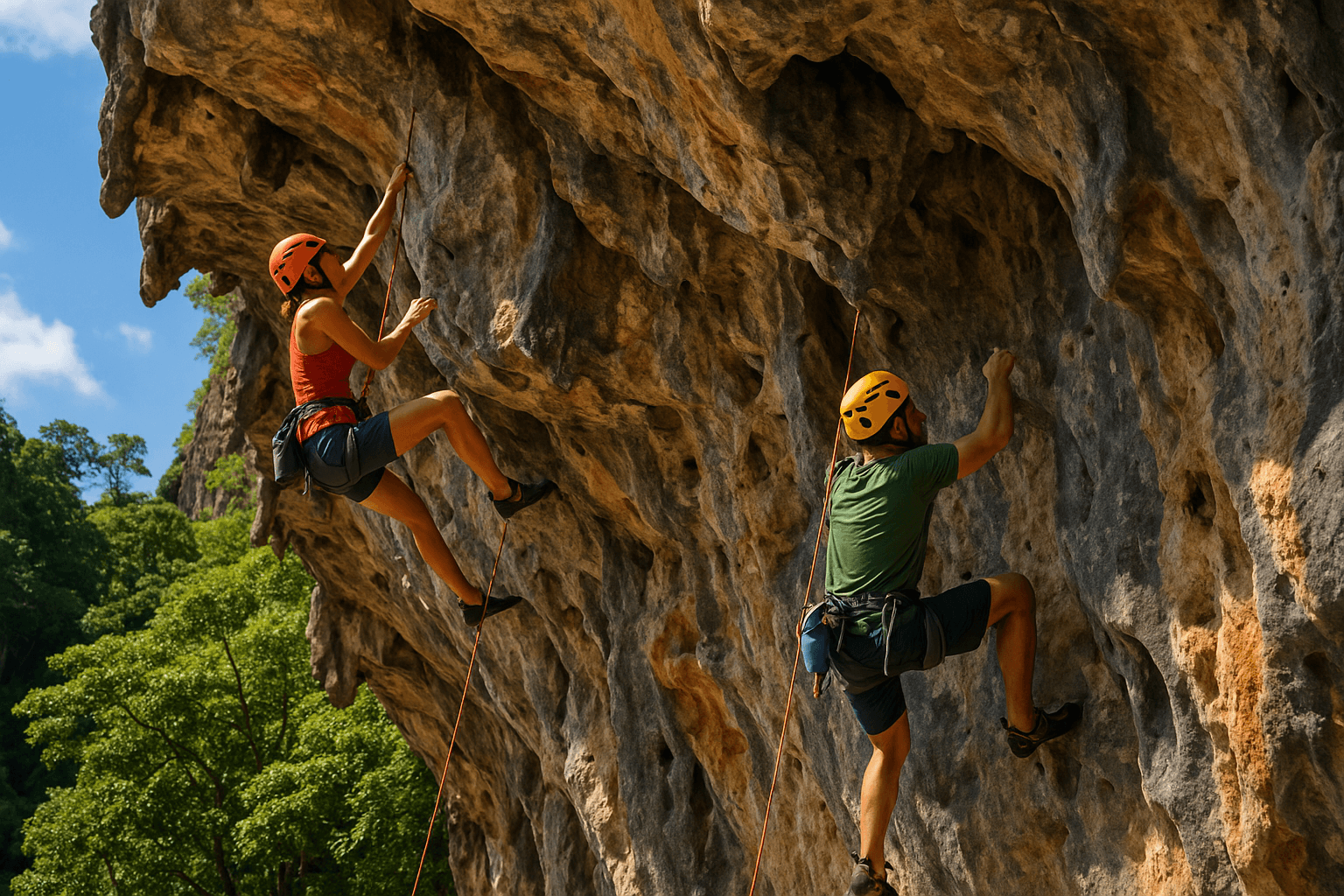
- Three crag clusters: Railay West (slabs and sunset multi-pitches), Railay East (sport-route density at Diamond Cave, Thaiwand Wall, Muay Thai Wall), and Tonsai (overhangs, Tonsai Roof, deep-water solo on Phra Nang headland) cover 700-plus routes from 5a to 8c+.
- No roads to Railay: The peninsula is cut off from the mainland by limestone cliffs; reach it only by 10-15 minute longtail from Ao Nang Pier (100-150 THB per person), Krabi Town's Klong Jilad Pier, or Ao Nam Mao (slightly cheaper longtail from the East side).
- Mainland base on a scooter: Ao Nang sits 2 km from the longtail pier; rent a Honda Click 125 from any Soi Ao Nang shop at 200-300 THB/day with free hotel delivery, per the Motorbike Rental Krabi Guide.
- Lessons and gear: Half-day group lessons run 1,200-1,800 THB, full-day private 2,800-3,500 THB; gear rentals (shoes, harness, chalk bag) 250-400 THB/day from Wee's, King Climbers, Hot Rock, or Real Rocks schools on the East side.
- Best season: November to April for dry rock and a safe Highway 4034 ride to rest-day viewpoints; May-October monsoon afternoons soak the limestone and cancel longtails on roughly one day in three.
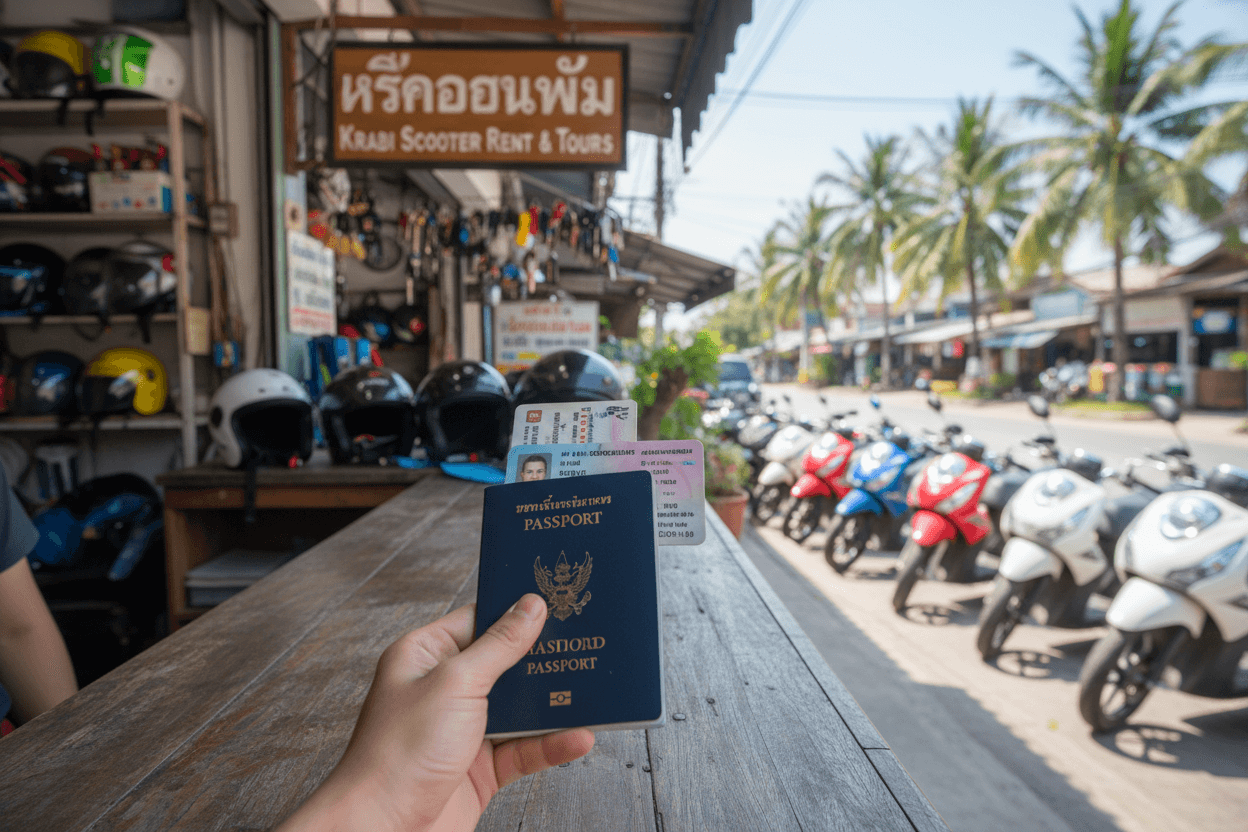
- Documents: Thai law requires a home-country motorcycle license plus a home-country IDP carrying the "A" motorcycle endorsement for the Ao Nang scooter; checkpoint fines on Highway 4203 run 500-1,000 THB.
How do you reach Railay from Ao Nang on a scooter and longtail?
Railay sits on a peninsula cut off from the road network by limestone cliffs, so every climbing day starts with a 5-minute scooter ride from Ao Nang to Ao Nang Pier and a 10-15 minute longtail crossing to Railay West (100-150 THB per person, departures every 15-30 minutes when the boat fills with 8 passengers). The full chain runs: rent a Honda Click 125 in Ao Nang at 200-300 THB/day, ride 2 km along Soi Ao Nang to the pier on the eastern end of the beach, park scooter-side for 50-100 THB on tour days, longtail to Railay West, walk 5 minutes across the peninsula to Railay East or 10 minutes south to Phra Nang Cave Beach, and another 12-minute longtail or low-tide walk reaches Tonsai. Krabi Town's Klong Jilad and Ao Nam Mao Piers are alternative launch points (cheaper longtails to Railay East from Ao Nam Mao, but further from the western beach access).
The scooter is your Krabi day-out vehicle on rest days, not a transport tool for the climbing itself. There are no cars and no roads on the Railay peninsula; everything inside Railay moves on foot or by 5-minute inter-beach longtail. The day chain is the model: scooter from your Ao Nang hotel to Ao Nang Pier (5 minutes), longtail to Railay (10-15 minutes), climb, longtail back at 17:00-17:30 latest in monsoon and 18:00 in dry season, scooter back to your hotel for sunset on Ao Nang Beach. The sunset timing matters because pier-side parking attendants knock off around 19:30. For a typical Krabi week, three climbing days bracket two scooter rest days for Tup Kaek viewpoint (14 km, 25 minutes), Klong Muang Beach (18 km, 30 minutes), and Wat Tham Suea or Tiger Cave Temple (40 km from Ao Nang via Highway 4 to Krabi Town then Highway 4035, 1 hour).
Best Railay walls ranked by grade, sun timing, and approach
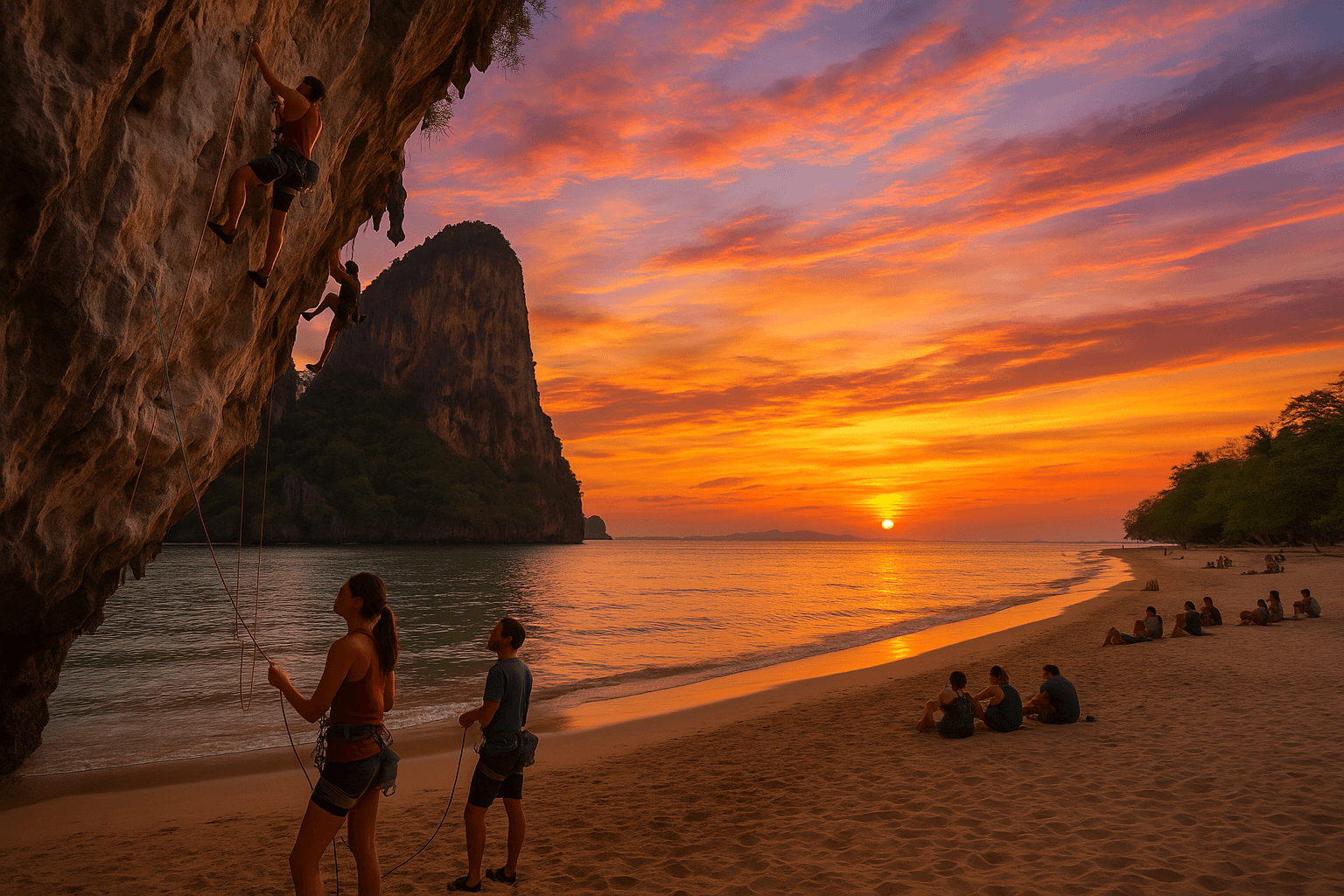
The three crag clusters split by skill and sun aspect, and choosing the right wall for the time of day is the single biggest comfort lever in Railay rock climbing. Railay East gets morning shade from the cliff line behind it (good for 7-11 AM climbs), Tonsai is partly shaded all day under the jungle canopy (best for the strongest hours of midday), and Railay West catches the afternoon sun and the iconic 17:30-18:30 sunset glow. Beginner walls (5a-5c) cluster on the Muay Thai Wall and the Diamond Cave area on Railay East; intermediate routes (6a-6c+) spread across Tamarind Wall, Hidden World, and Eagle Wall; advanced overhangs (7a+) live on Thaiwand Wall (Railay West multi-pitch), Tonsai Roof (Tonsai), Spider Wall (East), and the iconic Humanality on Tonsai. The full route catalogue across all 10 named Krabi crags including the mainland Crazy Horse Buttress and Tham Yao is in Top 10 Climbing Spots in Krabi.
Climbing schools, lesson rates, and gear rental on Railay
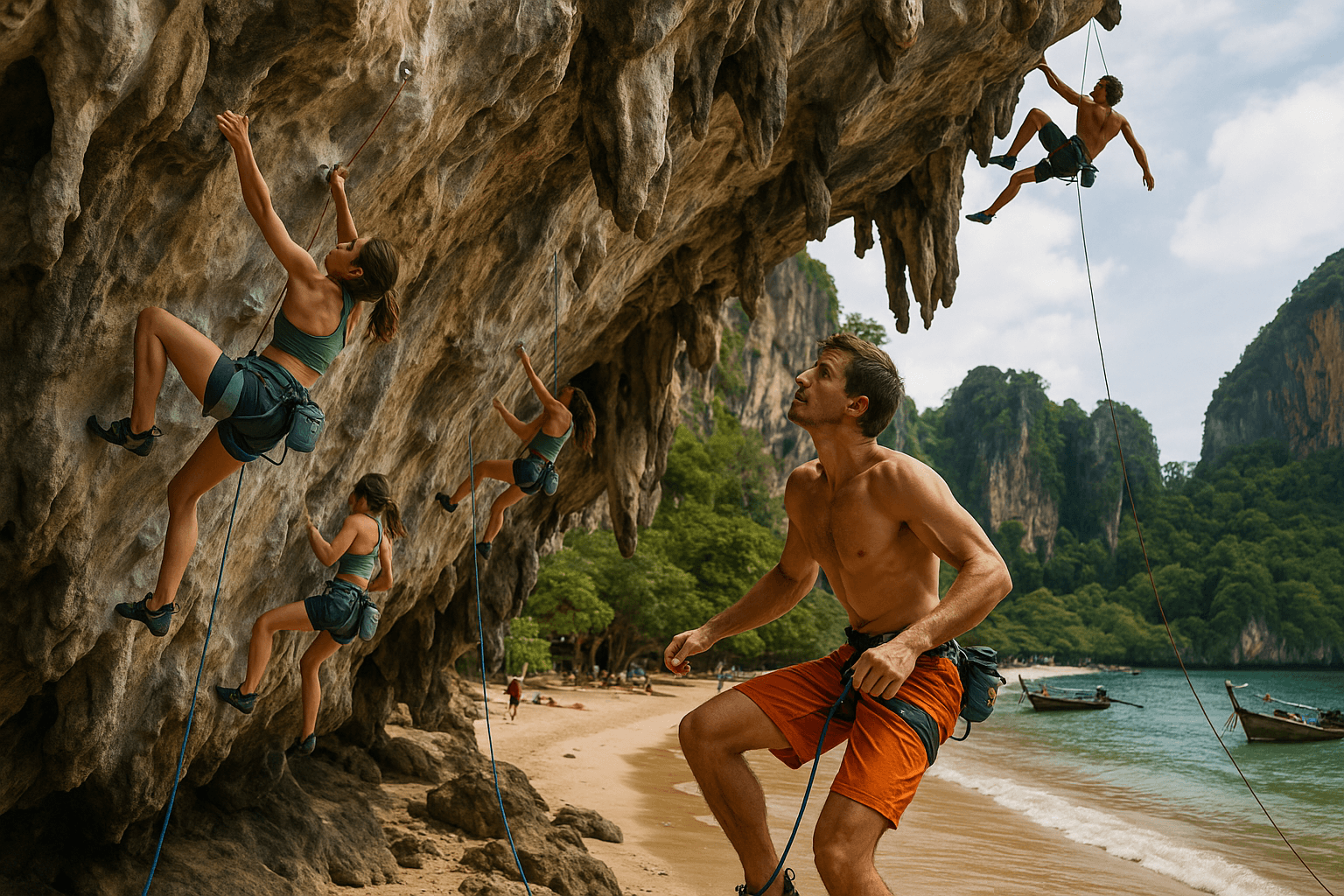
Four established schools cover the Railay teaching market and have done so for two decades plus: Wee's Climbing School (the founder-school, Railay East), King Climbers School (longest-running, broad lead-climbing curriculum), Hot Rock School (deep-water solo specialty plus Tonsai overhangs), and Real Rocks School (smaller groups, 1-on-2 ratios). All four operate from a strip of bamboo-and-canvas booths on Railay East a 5-minute walk from the longtail drop-off, and all four publish day rates rather than running surge pricing. Half-day group lessons (4-hour, 4-6 students) run 1,200-1,800 THB per person and cover a safety briefing, harness/shoe/helmet fitting, knots and belaying, and 3-4 routes on the Muay Thai Wall or Diamond Cave area; full-day group lessons (7-hour) run 2,000-2,500 THB; full-day private guides cost 2,800-3,500 THB and unlock Eagle Wall, Spider Wall, or a Thaiwand multi-pitch depending on level.
Gear rental for self-led climbers runs at the same Railay East strip. A standard kit (climbing shoes, harness, chalk bag, helmet, belay device, locking carabiner) costs 250-400 THB per day; ropes and quickdraws run 200-300 THB per day on top if your partner doesn't bring a rack. Most independent climbers carry their own shoes (sized for limestone is not the same as gym-rental sizing) and rent the rest. The schools double as the booking points for guided climbs at Crazy Horse Buttress on the mainland (90 minutes by transfer plus longtail back, 3,500-4,500 THB full day) and for deep-water solo clinics at the Phra Nang headland (1,500-2,500 THB half-day, May to October only when the swell is generous).
Where to stay: Railay overnight versus Ao Nang base
The Railay versus Ao Nang base call hinges on trip length and rest-day appetite, not climbing-day convenience (the longtail crossing is a 10-15 minute side-cost either way). Railay accommodation is the on-peninsula option: Sand Sea Resort and Railay Bay Resort on Railay West (mid-tier, 3,500-7,500 THB/night dry season), Anyavee Railay and Diamond Cave Resort on Railay East (budget, 1,500-3,500 THB/night), and the singular Rayavadee on Phra Nang Cave Beach (luxury, 25,000-60,000 THB/night). The pure climber's choice is Tonsai's bamboo bungalows and longhouse hostels (500-1,500 THB/night, May-October monsoon discount); the Tonsai community is what climbers come back for, with the Highline (slackline) culture, the Princess Cave shrine within walking distance, and the shared-fire dinners that make a 6-week Tonsai stay feel like a home.
Ao Nang as a base offers more flexibility, more dining diversity, mainland scooter access on rest days, and a stronger ATM and pharmacy network. The 2 km ride to Ao Nang Pier and 10-15 minute longtail across costs roughly 30 minutes door-to-cliff each way, and the hotel options range from 800 THB/night guesthouses on Soi Ao Nang to 6,000-12,000 THB/night beach resorts on Ao Nang Beach. For 3-4 day climbing trips the Ao Nang base wins (the rest-day flexibility offsets the boat commute); for 7-day-plus dedicated climbing weeks the Railay or Tonsai stay wins (you eliminate the daily longtail and you steep in the climbing community). The full Krabi base comparison including delivery and density is in Krabi Town vs Ao Nang Rental. Railay's geology and the wider Railay peninsula on Wikipedia document the cliff-locked headland that defines the climbing area's character.

Best season and rest-day combinations on the mainland
Railay's prime climbing window runs November to April: cool dry mornings (24-30°C), low humidity that keeps friction in the limestone, and the dry-season Highway 4034 climb to Tup Kaek staying grippy for rest-day rides. Peak Christmas and Lunar New Year periods (mid-December to mid-February) book out; March and April hold the same dry rock with thinner queues at the Muay Thai Wall and Tamarind Wall. May to October is the monsoon's variable: rock dries surprisingly fast after rain (limestone shears water), but tropical-storm afternoons saturate any unshaded route for 2-4 hours, and the boats from Ao Nang Pier cancel on roughly one day in three. The compensating upside is 30-40% lower accommodation rates and far more elbow room at the schools and the popular routes.
The rest-day pattern that travelers regret skipping: bracket two climbing days with a scooter day from Ao Nang. The standard combo is the Highway 4203/4034 coastal arc to Tup Kaek viewpoint (14 km, 25 minutes one way) plus a Klong Muang lunch stop (18 km, 30 minutes), which gives the forearms a full recovery while delivering the iconic Krabi headland sunset. The longer rest-day option swaps coast for inland: Highway 4 east 13 km to Krabi Town then Highway 4035 north 9 km to Wat Tham Suea (Tiger Cave Temple) for the 1,260-step summit climb. The Khlong Thom hot springs and Emerald Pool day (45 km south on Highway 4 + 4038, full day, 100 km return on a 125cc) is the third option for week-plus stays. The full mainland sequencing is mapped in the Krabi Travel Guide and the Top 10 Krabi Motorbike Rides post pairs each route to a recommended bike class.
The deeper mainland-versus-Railay decision is whether to leave the peninsula for the Crazy Horse Buttress, Tham Yao, and the Spirit Mountain crag (covered in Top 10 Climbing Spots in Krabi). These three sit south of Krabi Town reachable only by scooter or transfer (60-90 km, 1.5-2 hours each way), and they're the right call only if you've already covered the Railay top-rope and sport-route catalogue or you want a quieter session. For most travelers, three days on Railay plus one mainland-crag day plus one rest-day ride covers the full Krabi climbing arc.
Frequently Asked Questions
Can complete beginners climb at Railay?
Yes. Railay's school strip on Railay East is built around half-day group lessons (1,200-1,800 THB) for first-time climbers, covering safety briefing, harness/shoe/helmet fitting, knots and belaying, and 3-4 beginner routes graded 5a-5c on the Muay Thai Wall or Diamond Cave area. Wee's, King Climbers, Hot Rock, and Real Rocks all run beginner-friendly half-days in shoulder seasons; book 24-48 hours ahead in low season, 3-7 days in peak December-February.
Are there any roads or scooters on Railay Beach?
No. Railay is a peninsula cut off from the mainland by sheer limestone cliffs, so there are no cars, no scooters, and no roads on the peninsula. Reach it only by 10-15 minute longtail from Ao Nang Pier (100-150 THB per person), Krabi Town's Klong Jilad Pier, or Ao Nam Mao. Inside Railay everything is on foot or by 5-minute inter-beach longtail (100 THB) between Railay West, Railay East, Phra Nang, and Tonsai.
What's the difference between climbing on Railay and Tonsai?
Railay's three crag areas (Railay West slabs and multi-pitches, Railay East sport routes, the Phra Nang DWS wall) suit beginners through advanced climbers and have school strips with full gear rental. Tonsai is the bohemian sister beach 5 minutes by longtail or a low-tide walk, with the densest concentration of overhanging 7c-8a+ test pieces (Tonsai Roof, Humanality), canopy-shaded crags, the slackline and Highline culture, and the long-stay accommodation scene that produces 6-week climbing residencies.
When is the best time of year for Railay rock climbing?
November through April is the dry-season climbing window: 24-30°C mornings, low humidity that keeps friction in the limestone, and reliable longtails from Ao Nang Pier. May-October is monsoon: rock dries surprisingly fast (limestone shears water), but tropical storms typically 14:00-17:00 saturate the rock for 2-4 hours afterward and cancel longtail crossings on roughly one day in three. Peak season is December to mid-February; March-April is the cleanest balance of dry weather and lighter crowds.
Do I need my own gear, or can I rent everything on Railay?
Most climbers carry their own shoes (the fit matters too much for rentals); everything else can be rented at the Railay East school strip. A standard kit (shoes, harness, chalk bag, helmet, belay device, locking carabiner) costs 250-400 THB per day; ropes and quickdraws run 200-300 THB extra if your partner doesn't bring a rack. Booking a guided lesson rolls the gear into the rate.
Should I stay on Railay or in Ao Nang for a climbing trip?
For 3-4 day climbing trips, Ao Nang's Soi Ao Nang base wins: more food choices, ATM access, easier rest-day scooter rides to Tup Kaek viewpoint and Wat Tham Suea, and a 30-minute door-to-cliff commute (5 min scooter to pier + 10-15 min longtail). For 7-day-plus dedicated climbing weeks, on-peninsula Railay or Tonsai accommodation pays back: you eliminate the daily longtail, your meals walk to your bungalow, and you steep in the climbing community.
How do I park my scooter at Ao Nang Pier for a Railay day?
Ao Nang Pier has a paid scooter lot at the eastern end of Soi Ao Nang. Pay the 50-100 THB flat fee to the pier attendant on tour days, which covers the day until pier closure around 19:30. Bring your key only (lock the steering, leave nothing valuable in the under-seat compartment), and confirm the last longtail back to the pier (18:00 dry season, 17:00-17:30 monsoon) so you don't end up paying a 1,500-2,500 THB private return charter.
Plan your Railay climbing week from an Ao Nang scooter base
Railay rock climbing rewards a week-long base in Ao Nang with three climbing days bracketed by two scooter rest days, because the 30-minute door-to-cliff longtail commute is short enough to absorb daily but long enough that on-peninsula rest days lose the mainland's variety. Rent a Honda Click 125 from any Soi Ao Nang shop at 200-300 THB/day with free hotel delivery per the Motorbike Rental Krabi Guide, and use it for the 5-minute pier run on climbing days plus the rest-day rides to Tup Kaek viewpoint (14 km, 25 minutes), Klong Muang Beach (18 km), and Wat Tham Suea or Tiger Cave Temple (40 km via Krabi Town). For the broader mainland crag scene including Crazy Horse Buttress and Tham Yao, see Top 10 Climbing Spots in Krabi; for the full week's day-by-day Krabi structure, the Krabi Travel Guide. Free hotel delivery, cash deposits, your passport stays in your hand, and the same scooter covers the rest-day coast and the airport return run to Krabi International Airport (KBV).
The national-park fees, closed-season window, and access rules for the Railay-peninsula crags inside Mu Ko Phi Phi National Park are published by the Thai Department of National Parks; confirm before any climbing day.